
Dividend Sustainability in International Equities: Evaluating the Dimensional International Value ETF's Recent Payout
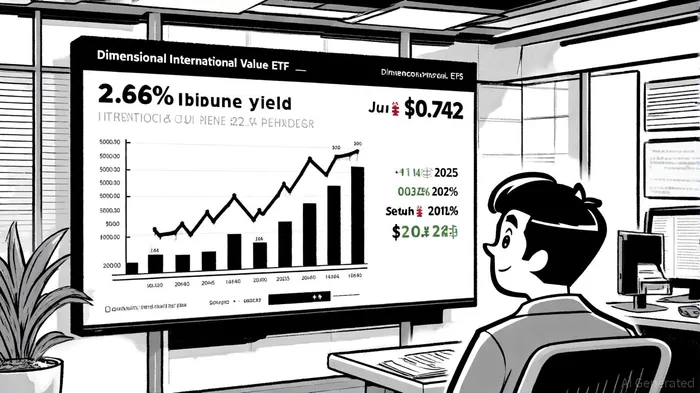
The Dimensional International Value ETF (DFIV) has emerged as a focal point for investors seeking exposure to international equities with a dividend-centric strategy. Recent data reveals a significant jump in its dividend yield, raising questions about the sustainability of such returns and the underlying strength of its portfolio. While the user's reference to a $0.2009 dividend appears to be a miscalculation—DFIV's most recent quarterly payout was $0.742 per share on June 26, 2025[2]—this discrepancy underscores the importance of scrutinizing both the fund's historical performance and its macroeconomic context.
DFIV's Dividend Trajectory: A Barometer of Portfolio Resilience
DFIV's trailing twelve-month (TTM) dividend yield of 2.66% as of June 2025 reflects a 112.87% increase in dividend per share over the past year[4]. This surge is driven by the fund's exposure to high-quality, dividend-paying equities in developed markets. Top holdings such as ShellSHEL-- (2.99% weight), Toyota MotorTM-- (2.02%), and TotalEnergiesTTE-- (1.75%) have demonstrated robust dividend sustainability. For instance, Shell has committed to a 4% annual dividend growth target through 2025[3], while TotalEnergies has consistently raised its payouts, including a 7.6% increase in its 2025 interim dividend[1]. These companies' ability to maintain or grow dividends amid inflationary pressures and energy transition challenges signals a resilient underpinning for DFIV's returns.
However, the fund's quarterly payout variability—such as the $0.1417 per share distribution in March 2025[3]—highlights the influence of macroeconomic factors. Global trade tensions, interest rate shifts, and sector-specific dynamics (e.g., energy prices for oil majors) can amplify or dampen dividend flows. For example, Toyota's 19.55% payout ratio in fiscal 2024[5] suggests ample capacity to sustain dividends, but its exposure to automotive sector headwinds, such as EV transitions, could test this flexibility in the future.
Macroeconomic Headwinds and Tailwinds
The sustainability of international dividends remains intertwined with broader economic conditions. Rising interest rates, while beneficial for yield-seeking investors, can strain corporate cash flows by increasing borrowing costs. Conversely, companies with strong free cash flow generation—such as Shell's 40–50% shareholder distributions target[3]—are better positioned to navigate these pressures.
Inflation also plays a dual role. While it erodes purchasing power, firms in sectors like energy and industrials (prominent in DFIV's portfolio) have leveraged pricing power to offset cost increases. TotalEnergies' 63.63% annual dividend growth over the past year[2] exemplifies this resilience. Yet, prolonged inflation could force companies to prioritize reinvestment over dividends, particularly in capital-intensive industries.
Long-Term Investor Implications
For DFIVDFIV--, the key lies in balancing its exposure to high-dividend-yield equities with diversification across sectors and geographies. The fund's 537 holdings[1] mitigate concentration risk, but its heavy reliance on energy and financials (e.g., HSBC at 1.30% weight) introduces sector-specific vulnerabilities. Investors must weigh these dynamics against the fund's historical dividend growth—its 33.43% average annual growth over five years[4]—to assess its alignment with long-term goals.
Conclusion
The Dimensional International Value ETF's recent $0.742 per share payout[2] underscores its appeal as a vehicle for dividend-focused investors. However, the fund's success hinges on the sustainability of its top holdings and the macroeconomic environment. While companies like Shell and TotalEnergies provide a stable foundation, investors should remain vigilant about sector-specific risks and global economic shifts. For those prioritizing long-term capital appreciation alongside income, DFIV's dividend trajectory offers a compelling, though not infallible, barometer of international equity value.





Comentarios
Aún no hay comentarios