
Dividend Sustainability in Global Quality Equity Strategies: Evaluating BMO MSCI All Country World High Quality Index ETF's Dividend Signal
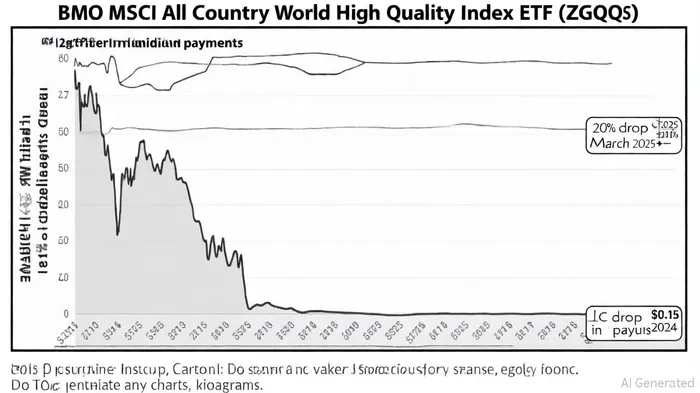
In the realm of global equity investing, dividend sustainability has emerged as a critical metric for assessing long-term value, particularly in an era marked by economic volatility and shifting market dynamics. Investors seeking resilience often turn to "quality" strategies, which prioritize companies with robust earnings, strong balance sheets, and disciplined capital allocation. The BMO MSCIMSCI-- All Country World High Quality Index ETF (ZGQ) exemplifies this approach, tracking the MSCI ACWI Quality Index—a basket of firms selected for their superior financial health and earnings consistency. However, recent trends in ZGQ's dividend payouts, including a notable 20% decline in March 2025 to CAD 0.12 per share[1], raise questions about the alignment between its dividend signal and the underlying portfolio's strength.
ZGQ's Dividend History: A Tale of Volatility
ZGQ distributes dividends quarterly, with its most recent payout of CAD 0.12 per share on July 3, 2025[2]. While the ETF has historically demonstrated periods of stability—such as consistent CAD 0.15 payouts in early 2024—its dividend trajectory has been marked by sharp fluctuations. For instance, a 66.67% increase in December 2019 contrasted starkly with a 51.35% drop in March 2019[1]. These swings suggest that ZGQ's dividend is sensitive to macroeconomic conditions and the performance of its underlying index, which includes several hundred global stocks[3].
The ETF's trailing twelve-month (TTM) dividend yield currently stands at 0.748%, with a one-year growth rate of -20.00%[2]. This places ZGQ at a disadvantage compared to peers like the iShares Core MSCI All Country World ex Canada Index ETF (XAW.TO), which offers a TTM yield of 1.51%[1]. While yield alone is not a definitive indicator of quality, ZGQ's lower yield underscores the trade-off between dividend income and exposure to firms with stronger financial metrics.
Quality Investing and Portfolio Resilience
ZGQ's investment thesis hinges on its focus on "high-quality" companies, defined by criteria such as strong return on equity (ROE), low debt-to-equity ratios, and consistent earnings growth[3]. The MSCI ACWI Quality Index, which the ETF tracks, emphasizes firms with clean balance sheets and predictable cash flows—traits that theoretically enhance dividend sustainability during economic downturns[4]. For example, companies with high ROE demonstrate efficient capital utilization, while those with low debt-to-equity ratios are less vulnerable to liquidity crises[5].
However, the lack of granular data on ZGQ's portfolio companies complicates a direct assessment of these metrics. While the ETF's prospectus highlights its emphasis on quality, specific payout ratios, debt-to-equity averages, or current ratios for its holdings remain undisclosed[2]. This opacity limits investors' ability to independently verify the financial health of the underlying firms. For context, the average debt-to-equity ratio for U.S. listed companies in 2024 was 1.02[6], suggesting that ZGQ's portfolio may include firms with similarly moderate leverage, but this remains speculative.
Dividend Sustainability: A Balancing Act
Dividend sustainability for ZGQ depends on two key factors: the earnings stability of its holdings and the ETF's ability to distribute consistent payouts despite market headwinds. While the ETF's focus on quality firms should, in theory, mitigate earnings volatility, recent declines in dividends indicate that external pressures—such as sector-specific downturns or global economic slowdowns—can still impact distributions. For instance, the 20% drop in March 2025 may reflect reduced earnings from certain portfolio sectors, even if the broader index's quality criteria remain intact[1].
Moreover, ZGQ's dividend yield of 0.748% must be contextualized within its low-risk, high-quality framework. Traditional high-yield ETFs often prioritize income over capital preservation, but ZGQ's strategy prioritizes long-term resilience over immediate returns. This aligns with the principles of quality investing, which prioritize firms capable of maintaining dividends through cyclical downturns[5]. However, investors seeking stable income may find ZGQ's yield insufficient compared to alternatives, necessitating a careful evaluation of their risk-return preferences.
Implications for Investors
For investors considering ZGQ, the ETF's dividend signal serves as a mixed indicator. On one hand, its focus on quality firms with strong balance sheets and earnings consistency provides a buffer against market turbulence—a critical advantage in uncertain environments. On the other hand, the recent volatility in dividend amounts highlights the need for caution. The absence of detailed financial metrics for underlying holdings further complicates due diligence, requiring investors to place trust in the MSCI index's curation process.
A prudent approach would involve pairing ZGQ with complementary income-generating assets to balance yield and quality. For example, investors could allocate a portion of their portfolio to ZGQ for its defensive characteristics while supplementing with higher-yield ETFs like XAW.TO for income[1]. This diversification strategy acknowledges the trade-offs inherent in quality investing while mitigating the risks of relying solely on ZGQ's dividend signal.
Conclusion
The BMO MSCI All Country World High Quality Index ETF (ZGQ) embodies the principles of quality investing, offering exposure to globally diversified, financially robust companies. However, its recent dividend trends—marked by declines and volatility—underscore the challenges of maintaining consistent payouts in a dynamic market. While the ETF's focus on earnings stability and balance sheet strength provides a foundation for long-term resilience, investors must weigh these benefits against the current yield's limitations. As global markets navigate ongoing uncertainties, ZGQ's dividend signal remains a useful, albeit imperfect, barometer of its underlying portfolio's health.





Comentarios
Aún no hay comentarios