
Dividend Sustainability in Equity ETFs: The Resilience of JPMorgan Diversified Return U.S. Equity ETF
Dividend Sustainability in Equity ETFs: The Resilience of JPMorganJPM-- Diversified Return U.S. Equity ETF
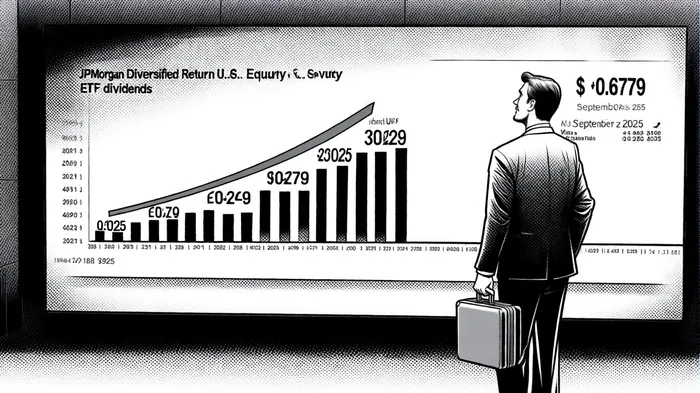
For income-focused investors, dividend sustainability is a critical metric in navigating volatile markets. The JPMorgan Diversified Return U.S. Equity ETF (JPUS) has emerged as a compelling case study in this regard. Its recent quarterly distribution of $0.6779 per share, announced on September 25, 2025, underscores a broader narrative of portfolio strength and income reliability, even amid shifting interest rate environments. This analysis explores how JPUS's strategic design and historical performance position it as a resilient option for investors seeking market-agnostic returns.
A Track Record of Consistency and Growth
JPUS has demonstrated a remarkable ability to maintain and grow its dividend payouts. As of September 2025, the ETF had increased its dividend for four consecutive years, with the annualized payout reaching $2.64 per share—a 9.28% increase compared to the prior year [1]. This growth trajectory is particularly notable given the macroeconomic headwinds of the past few years, including the aggressive interest rate hikes from 2022 to 2023.
The recent quarterly payout of $0.6779 reflects a 18.28% increase in dividend yield over the past year, outpacing the average growth of the top 25% of dividend payers in the Financial Services sector [2]. Such consistency is rare in a market where rising interest rates often pressure companies to prioritize debt servicing over shareholder returns.
Strategic Design: Diversification as a Buffer
JPUS's dividend resilience stems from its multi-factor investment strategy, which combines exposure to value, momentum, and quality factors while emphasizing sector diversification. The ETF replicates the JPMorgan Diversified Factor U.S. Equity Index, which selects large- and mid-cap U.S. equities and weights sectors by inverse volatility to reduce concentration risk [3]. This approach ensures that the portfolio is not overly exposed to cyclical sectors like technology, which can falter during rate hikes.
Defensive sectors such as consumer staples (13% weighting) and utilities (10% weighting) make up nearly 34% of the portfolio, providing a stable foundation for dividend income [4]. These sectors are historically less sensitive to interest rate fluctuations, as their demand remains consistent regardless of economic cycles. For example, during the 2022-2023 rate hikes, JPUS's defensive tilt likely cushioned its holdings from the broader market's volatility, enabling the fund to maintain its dividend schedule despite a -8.47% total return in 2022 [5].
Navigating Interest Rate Shifts: A Case Study
The 2022-2023 period offers a critical test of JPUS's dividend sustainability. During this time, the Federal Reserve raised interest rates by over 500 basis points, a move that typically pressures equity valuations and corporate earnings. However, JPUS's inverse volatility weighting and equal stock weighting mitigated sector-specific risks. For instance, while tech stocks underperformed, the ETF's emphasis on utilities and consumer staples helped stabilize its income stream.
Data from 2023 shows that JPUS's dividend payments fluctuated but remained robust: a high of $0.8010 per share in December 2023 and a low of $0.3565 in March 2023 [6]. These variations reflect the fund's exposure to a broad range of companies, but the overall trend—four consecutive years of dividend increases—demonstrates its ability to adapt to macroeconomic shifts.
Strategic Implications for Income Investors
For investors prioritizing income reliability, JPUSJPUS-- offers several advantages:
1. Market-Agnostic Returns: By balancing growth and income through factor-based diversification, the ETF reduces reliance on any single economic driver.
2. Low Expense Ratio: At a competitive cost, JPUS provides access to a professionally managed portfolio that would otherwise require significant active management.
3. Resilience in Rising Rate Environments: The fund's defensive sector allocations and risk-mitigated structure make it a rare option for income seekers during periods of monetary tightening.
However, investors should remain mindful of the ETF's mixed long-term performance. While it rebounded with a 10.98% return in 2023 and a 13.48% return in 2024, its five-year average dividend growth rate of 7.36% [7] suggests that aggressive growth expectations may not align with its strategy.
Conclusion: A Model for Sustainable Income
JPUS's recent quarterly dividend of $0.6779 is more than a number—it is a testament to the fund's strategic design and operational discipline. By leveraging a diversified, factor-driven approach and emphasizing defensive sectors, the ETF has navigated recent interest rate turbulence without compromising its dividend commitments. For income-focused investors, this resilience positions JPUS as a compelling tool to balance risk and reward in an increasingly uncertain market.
As interest rates continue to evolve, the ability to generate reliable income without sacrificing capital preservation will remain a key differentiator. JPUS's track record suggests that it is well-equipped to meet this challenge, offering a blueprint for sustainable equity investing in a shifting rate environment.





Comentarios
Aún no hay comentarios