
Dividend Sustainability in Core Equity ETFs: Analyzing Dimensional International Core Equity Market ETF's Resilience
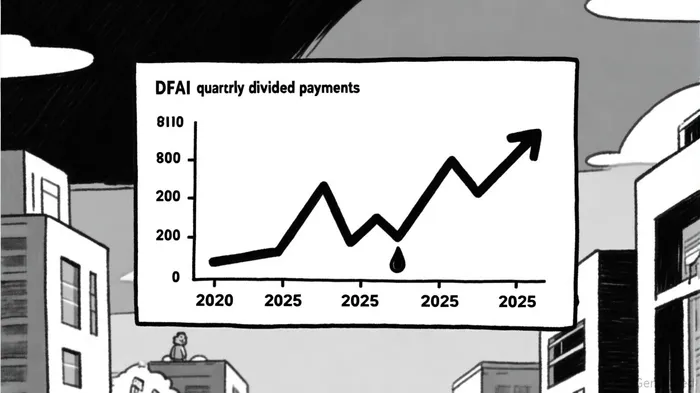
For income-focused investors, dividend sustainability in core equity ETFs is a critical metric. The Dimensional International Core Equity Market ETF (DFAI) offers a compelling case study, particularly with its recent $0.0977 per share payout on March 27, 2025, which marked a 57.11% decline from the prior quarter's $0.2278 [1]. This volatility raises questions about the fund's resilience and long-term income potential, yet its structure and historical behavior suggest a nuanced picture.
Historical Dividend Volatility and Resilience
DFAI's dividend history reveals pronounced fluctuations. For instance, during the 2020 pandemic, the ETF paid a mere $0.024541 per share in December 2020 [4], yet maintained quarterly payouts despite the crisis. By 2021, dividends surged to $0.215278 per share [2], reflecting recovery in underlying holdings. However, 2024 brought renewed turbulence, with a 71.96% drop in one quarter [5], followed by a partial rebound in mid-2025. The March 2025 payout, while sharply lower than December 2024's amount, was succeeded by a June 2025 payment of $0.44108 per share [2], illustrating the fund's ability to adapt to shifting market conditions.
Fund Structure: Diversification and Active Management
DFAI's resilience stems partly from its structure. As an actively managed ETF, it invests in a broad basket of 3,830 international equities across developed and emerging markets, spanning large-, mid-, and small-cap stocks. This diversification mitigates sector-specific risks, while the fund's focus on size, value, and profitability factors enhances its exposure to firms with stable cash flows [4]. The 0.18% expense ratio [6] further supports efficiency, allowing more capital to be reinvested or distributed to shareholders.
Navigating Downturns: Lessons from 2020
During the 2020 pandemic, DFAI's dividends contracted but did not cease. The December 2020 payout of $0.024541 [4] occurred amid global market turmoil, yet the fund's active management likely preserved liquidity and adjusted exposures to stabilize income. While specific data on the 2008 financial crisis is unavailable, the fund's consistent quarterly payouts since 2020 suggest a disciplined approach to dividend continuity [5].
Payout Ratio and Sustainability: A Missing Metric
A critical gap in assessing DFAI's sustainability is the absence of a disclosed payout ratio. Without knowing what proportion of earnings or net asset value is distributed, it is challenging to gauge the fund's capacity to maintain dividends during prolonged downturns. However, the June 2025 payout of $0.44108 [2]—a 350% increase from March 2025—hints at flexibility in adjusting distributions based on market opportunities. This adaptability, combined with the fund's low costs and diversified holdings, provides a buffer against volatility.
Conclusion: Balancing Risk and Reward
While DFAI's dividend history is marked by sharp swings, its active management, global diversification, and historical resilience during crises position it as a viable option for long-term income seekers. The recent $0.0977 payout underscores the importance of monitoring market conditions, but the fund's ability to recover in subsequent quarters demonstrates its potential to adapt. Investors should weigh the lack of a clear payout ratio against the fund's structural strengths, recognizing that DFAI's dividend sustainability hinges on both its strategic design and the broader economic environment.





Comentarios
Aún no hay comentarios