
Dividend Sustainability in the Consumer Staples Sector: Evaluating Vanguard Consumer Staples ETF's Resilience
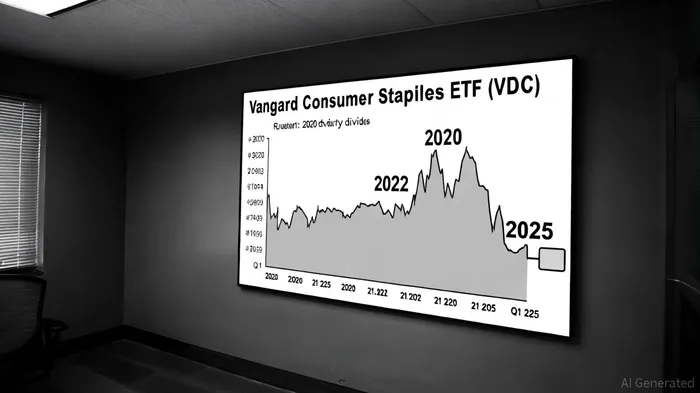
The consumer staples sector has long been a cornerstone for income-focused investors, offering stability amid economic volatility. As of September 2025, the Vanguard Consumer Staples ETF (VDC) has drawn renewed attention following its March 2025 distribution of $1.1306 per share—a figure that, while slightly lower than prior quarters, reflects broader sector dynamics and raises questions about dividend sustainability. This analysis examines VDC's recent performance, its top holdings' financial health, and the sector's resilience to external pressures like tariffs and inflation.
VDC's Dividend Trends: A Mixed Signal
VDC's dividend history reveals a pattern of volatility. In 2020, the ETF surged by 80.47% in December, only to see a 32.41% drop by September 2020[1]. More recently, the fund's trailing twelve-month (TTM) dividend yield stands at 2.30%, but its one-year dividend growth rate is negative at -5.80%[3]. The March 2025 payout of $1.1306 marked a 3.27% decline from the previous quarter's $1.24 distribution[5], signaling potential strain on the ETF's ability to maintain consistent growth.
However, context is critical. The consumer staples sector is projected to grow earnings by approximately 10% annually through 2025, driven by stable demand for essential goods[1]. While VDC's recent dip may concern income investors, it aligns with broader challenges such as rising tariffs and inflation, which have impacted companies like PepsiCo and Kimberly-Clark in Q1 2025[3].
Sector Fundamentals: Strength in Diversity
VDC's resilience hinges on its top holdings, which include industry giants like Walmart, Costco, Procter & Gamble (P&G), Coca-Cola, and PepsiCo. These companies collectively account for 63.25% of the ETF's assets[5], and their financial health provides insight into the fund's long-term sustainability.
- Walmart (12.90% weighting): Despite a dividend payout ratio of 54.55%[4], Walmart's free cash flow (FCF) and scale position it to weather economic headwinds. Its localized supply chains and pricing power mitigate inflationary pressures[3].
- Costco (10.80% weighting): With a payout ratio of 27.8%—well below the sector average of 57.6%[6]—Costco retains ample flexibility to sustain and grow dividends, even as tariffs impact margins[3].
- P&G (10.43% weighting): A 68.89% FCF payout ratio[4] suggests moderate risk, though the company's recent earnings revisions highlight exposure to trade costs[3].
- Coca-Cola and PepsiCo (7.94% and 4.87% weightings): Coca-Cola's 100% FCF payout ratio[4] raises concerns about sustainability, while PepsiCo's 71% ratio[4] appears more balanced. Both companies have shown mixed Q1 2025 results, with PepsiCo revising full-year guidance downward due to currency and tariff impacts[3].
Sector Outlook: Navigating Challenges
The consumer staples sector's ability to adapt to macroeconomic pressures is a key determinant of VDC's future performance. While tariffs have squeezed margins for some players, others—like Coca-Cola—leverage localized production to offset costs[3]. Additionally, the sector's P/E ratio of 22.85 as of September 2025[3] suggests it remains fairly valued, offering a buffer against volatility.
Dividend growth within the sector has been uneven. Anheuser-Busch InBev, Sysco, and Unilever have boosted payouts by 20%, 6%, and 11%, respectively[5], underscoring the sector's capacity to reward shareholders. However, companies with high payout ratios, such as Coca-Cola, may struggle to maintain growth if earnings falter.
Conclusion: A Prudent Bet with Caveats
VDC's recent $1.1306 distribution, while lower than prior quarters, does not necessarily signal long-term instability. The ETF's exposure to a diversified basket of resilient companies—many with conservative payout ratios—supports its role as a reliable income vehicle. However, investors should monitor high-risk holdings like Coca-Cola and sector-wide challenges such as trade policy shifts.
For now, the consumer staples sector's fundamental strength and VDC's low expense ratio of 0.10%[5] make it an attractive option for those seeking steady dividends. Yet, as with any investment, prudence lies in balancing income potential with an eye on sustainability metrics and macroeconomic trends.





Comentarios
Aún no hay comentarios