
Can Dividend Stocks Like CVS Health and Amgen Sustain Outperformance in 2026?
The allure of dividend stocks has long captivated income-focused investors, but in 2026, the question remains: Can established healthcare giants like CVS Health and Amgen maintain their outperformance amid shifting market dynamics? To answer this, we must dissect their valuation metrics, business strategies, and the sustainability of their dividend payouts.
Valuation Metrics: Attractive or Overpriced?
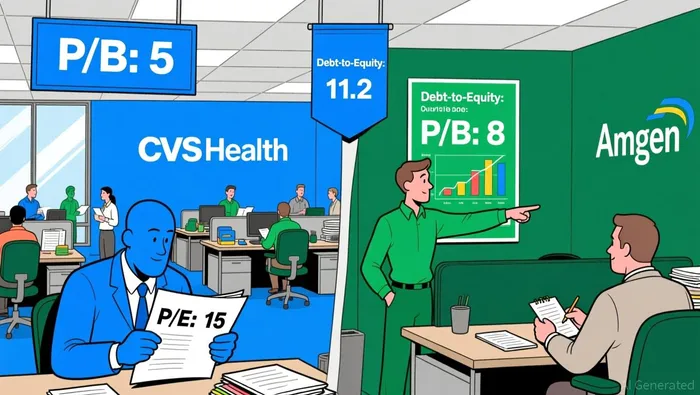
CVS Health's forward price-to-earnings (P/E) ratio of 11.2 positions it as a relatively affordable option for long-term investors, especially when compared to Amgen's P/E of 43.48. This disparity reflects divergent market perceptions: CVSCVS-- is valued for its stable, diversified healthcare services, while Amgen's premium valuation hinges on its biotech pipeline and regulatory progress.
Debt-to-equity ratios further highlight their contrasting financial profiles. CVS's Q4 2025 debt-to-equity ratio of 88.2% suggests a manageable leverage burden, with equity ($73.1 billion) comfortably covering debt ($64.5 billion). Conversely, Amgen's 567.49% debt-to-equity ratio signals significant reliance on debt, raising concerns about its ability to service obligations amid rising interest rates.
Price-to-book (P/B) ratios also diverge sharply. CVS's P/B of 1.40 indicates a modest premium over its book value, while Amgen's P/B of 18.40 reflects investor optimism about its intangible assets and future earnings potential.
Business Strategies: Diversification vs. Innovation
CVS Health's strategy centers on leveraging its diversified healthcare ecosystem. The company's recent guidance of $400.0 billion in 2025 revenue underscores its strength in retail pharmacy, insurance (via Aetna), and healthcare services. Its projected mid-teens adjusted EPS CAGR through 2028 hinges on operational efficiency and strategic investments in digital health. However, its high dividend payout ratio of 665%-far exceeding the healthcare sector average of 35.9%-raises questions about reinvestment capacity.
 Amgen, meanwhile, is navigating biotech innovation and patent cliffs. The loss of exclusivity for denosumab threatens near-term revenue, but its pipeline offers hope. Products like Repatha (for cholesterol) and Tezspire (for asthma) have driven double-digit sales growth, while regulatory approvals for eczema and thyroid eye disease treatments could offset biosimilar pressures. Analysts project a 1.9% EPS increase in 2026, but Amgen's success will depend on its ability to commercialize new therapies and manage R&D costs.
Dividend Sustainability: A Tale of Two Models
CVS Health's dividend yield of 3.32% is attractive, but its payout ratio of 665% is unsustainable in the long term. This metric suggests the company is paying out more in dividends than it earns, relying on cash reserves and debt to fund payouts. While its 2025 dividend hike to $0.665 per share reflects confidence in its turnaround, investors must monitor its free cash flow generation and debt management.
Amgen's dividend story is more nuanced. Despite a trailing payout ratio of 126.09%, analysts project this will drop to 68% by 2026, supported by strong free cash flow of $4.2 billion in Q3 2025 and a recent dividend increase to $2.52 per share. Its 3.1% yield is competitive, and its 12% CAGR in dividend growth since 2016 demonstrates a commitment to shareholder returns. However, its high debt load could strain flexibility if earnings falter.
Conclusion: Can They Outperform in 2026?
CVS Health appears well-positioned for steady, if unspectacular, growth in 2026. Its low P/E and moderate debt levels make it a defensive play, though its dividend sustainability remains a risk. Investors should watch for signs of earnings resilience and strategic reinvestment in its healthcare ecosystem.
Amgen offers higher growth potential but with greater volatility. Its premium valuation and debt burden are justified by a robust pipeline and strong free cash flow. If its new therapies gain traction and biosimilar impacts moderate, AmgenAMGN-- could outperform. However, its dividend sustainability hinges on earnings growth and disciplined capital allocation.
For income-focused investors, both stocks present opportunities-but with distinct risk profiles. CVS offers stability, while Amgen demands patience and a tolerance for near-term challenges.





Comentarios
Aún no hay comentarios