
Dividend Stability in Low-Volatility Equities: A Strategic Anchor for Income-Driven Portfolios in Uncertain Markets
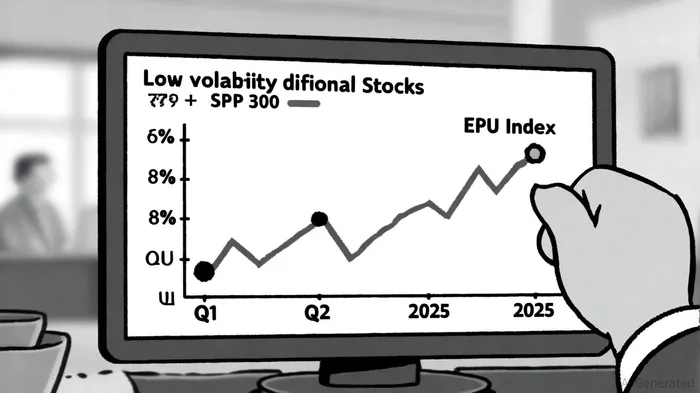
In an era marked by geopolitical tensions, inflationary pressures, and policy-driven market volatility, income-focused investors are increasingly turning to low-volatility equities with stable dividend yields to anchor their portfolios. Recent academic and industry research underscores the growing relevance of this strategy, particularly as economic policy uncertainty (EPU) reshapes corporate dividend policies and market dynamics.
The Academic Case for Dividend Stability
Economic policy uncertainty has emerged as a critical driver of corporate behavior, with studies revealing its profound impact on dividend decisions. A 2024 study published in Nature found that firms facing elevated EPU are more likely to increase cash dividend distributions to signal financial health and retain investor confidence[1]. This trend is especially pronounced among smaller firms and non-state-owned enterprises, which face higher agency costs and financing constraints. By prioritizing dividend stability, these companies aim to mitigate the negative effects of EPU on firm value while aligning with shareholder wealth-maximization goals[1].
Meanwhile, low implied equity market volatility—a phenomenon observed in 2025 despite rising geopolitical risks—has created a paradox. The European Central Bank (ECB) noted that subdued volatility, driven by investor optimism about a "soft landing" and declining stock return correlations, may mask underlying risks[2]. This environment has led to crowded short volatility positions, heightening the potential for abrupt market repricing during tail events. For income-focused investors, this underscores the importance of selecting equities with both dividend resilience and low beta characteristics.
Industry Insights: Low-Volatility Dividend Stocks in Action
The practical application of this strategy is evident in the performance of specific equities. For instance, B&G FoodsBGS-- (BGS), a consumer staples company with an 11.1% yield and a 5-year beta of 0.8, has outperformed the S&P 500 in 2025 despite sector-specific challenges[3]. Similarly, Clearway EnergyCWEN-- (CWEN) and W.P. Carey (WPC), both yielding ~5.8%, have demonstrated historical stability with betas of 0.9 and 0.8, respectively[3]. These stocks exemplify how low-volatility equities can provide downside protection without sacrificing income.
In the healthcare and utilities sectors, LTC PropertiesLTC-- Inc. (LTC) and Consolidated EdisonED-- Inc. (ED) further illustrate the appeal of dividend stability. LTC, a healthcare-focused REIT with a 6.4% yield, reported $206 million in 2024 revenue and maintains a strong balance sheet[4]. ED, a utility stock yielding 3.3%, offers consistent returns through its essential services, making it a staple for risk-averse portfolios[4].
Strategic Considerations for Investors
While low-volatility dividend stocks offer compelling advantages, investors must remain vigilant. The ECB's analysis highlights that persistently low equity volatility could understate financial risks, particularly if macroeconomic assumptions falter[2]. Diversification across sectors and geographies, combined with rigorous valuation discipline, is essential to avoid overexposure to crowded positions.
Moreover, the interplay between EPU and corporate behavior suggests that dividend policies may shift in response to policy changes. For example, companies in sectors like energy and real estate may adjust payouts based on regulatory developments, requiring investors to monitor macroeconomic signals closely[1].
Conclusion: Balancing Income and Resilience
As markets grapple with uncertainty, dividend stability in low-volatility equities provides a dual benefit: steady income streams and reduced downside risk. By leveraging academic insights on EPU and industry examples of resilient stocks, investors can construct portfolios that navigate volatility while prioritizing long-term capital preservation. However, success hinges on proactive risk management and a nuanced understanding of the macroeconomic forces shaping corporate behavior.







Comentarios
Aún no hay comentarios