
Dividend Stability and Income Potential of Mulvihill Canadian Bank Enhanced Y ETF
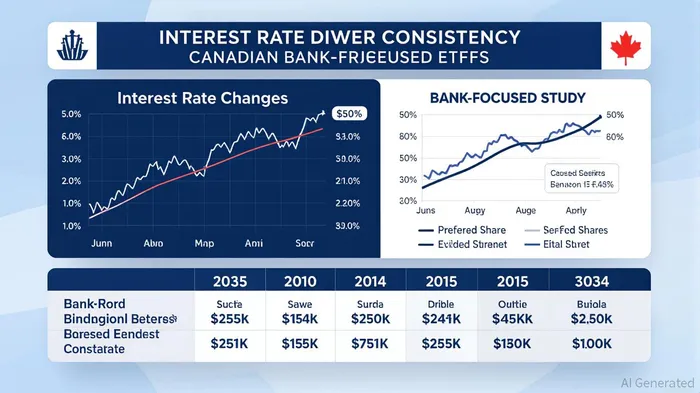
The Mulvihill Canadian Bank Enhanced Y ETF (SPFD) has emerged as a niche player in the Canadian income-investment landscape, promising monthly dividends of CAD 0.0583 per share while leveraging a unique blend of preferred shares and options-based strategies to balance yield and risk [1]. For income-focused investors, the ETF’s structure raises critical questions: How does its dividend stability hold up in shifting interest rate environments? And can its innovative approach deliver consistent returns compared to traditional dividend ETFs?
The SPFD Strategy: A Structural Overview
SPFD’s investment thesis hinges on two pillars: preferred shares of Canadian split-share corporations and options-based yield enhancement. Preferred shares, which typically offer fixed dividends and priority in liquidation, form the core of the ETF’s holdings. These instruments are less sensitive to interest rate fluctuations than common equities, as their yields are often tied to fixed or semi-fixed coupon rates [1]. Additionally, the ETF employs options strategies—such as covered calls or short-term equity-linked notes (STELs)—to amplify returns while capping downside risk [1]. This hybrid approach aims to generate a “floor” of income even in volatile markets.
However, the absence of historical performance data for SPFD complicates direct analysis. Unlike U.S.-listed dividend ETFs like the Global X SuperDividend U.S. ETF (DIV), which has a 10-year track record of monthly payouts and a 6.5% yield [2], SPFD’s reliability remains untested in prolonged rate hikes or deepening recessions. This gap in data forces investors to infer stability from the ETF’s structural design rather than empirical evidence.
Interest Rates and Dividend Dynamics
Interest rates exert a dual influence on dividend-focused ETFs. In low-rate environments, high-yield assets like preferred shares and dividend-paying equities become more attractive as investors seek income alternatives to bonds. Conversely, rising rates can pressure preferred shares, as their fixed dividends lose appeal relative to higher-yielding bonds [1]. SPFD’s options strategies may mitigate this risk by dynamically adjusting exposure to rate-sensitive sectors.
For context, consider the performance of gold and bond ETFs in 2025. Gold surged 25% amid a Federal Reserve pause on rate cuts, outperforming the flat S&P 500 [3]. Meanwhile, U.S. government bonds stagnated despite slowing inflation, highlighting the fragility of traditional safe-haven assets [4]. SPFD’s focus on Canadian banks—historically more resilient than their U.S. counterparts—could offer a middle ground. Canadian banks, with their conservative capital structures and regulated markets, have historically maintained stable dividends even during global downturns [1].
Comparative Insights: SPFD vs. Traditional Dividend ETFs
The Global X SuperDividend U.S. ETF (DIV) provides a useful benchmark. While DIV’s 6.5% yield appears robust, its dividend growth rate has declined by 6.62% annually over five years [2]. This trend reflects broader challenges in U.S. dividend stocks, where concentrated holdings in a few “Magnificent Six” tech firms have skewed returns [3]. In contrast, SPFD’s focus on Canadian banks and preferred shares avoids such concentration risks, though it also limits exposure to high-growth sectors.
A critical distinction lies in dividend consistency. DIV’s monthly payouts have remained uninterrupted for 11 years [2], a testament to its diversified U.S. equity holdings. SPFD, however, lacks a comparable track record. Its CAD 0.0583 monthly dividend is theoretically sustainable given the stability of Canadian bank preferred shares, but unanticipated macroeconomic shocks—such as a housing market correction or regulatory changes—could strain this model.
Risks and Limitations
The primary risk for SPFD lies in its novelty. Unlike established dividend ETFs, SPFD’s options-based strategies and focus on split-share corporations are less liquid and harder to value. During periods of market stress, liquidity constraints could force the ETF to reduce dividends or increase fees to cover losses [1]. Additionally, the Canadian banking sector, while historically resilient, is not immune to systemic risks. A prolonged low-interest-rate environment could compress bank margins, indirectly affecting preferred share yields [1].
Another concern is the lack of transparency. Mulvihill’s website provides little granular data on SPFD’s holdings or hedging strategies [1], making it difficult to assess how the ETF would perform in a 2008-style crisis. By contrast, U.S. dividend ETFs like DIVDIV-- disclose detailed quarterly reports, enabling investors to track dividend trends and portfolio adjustments [2].
Conclusion: A Cautious Case for SPFD
For income-focused investors, SPFD represents a compelling but cautious bet. Its structural design—leveraging preferred shares and options—offers a unique approach to balancing yield and risk, particularly in a low-rate environment. However, the absence of historical performance data and the complexity of its strategies necessitate a higher degree of due diligence.
In a world where traditional dividend ETFs face headwinds from rate volatility and market concentration, SPFD’s Canadian banking focus and alternative strategies could provide a differentiated income stream. Yet, investors should treat it as a complementary rather than core holding, given the uncertainties surrounding its long-term reliability. As the Fed’s policy trajectory remains unpredictable, SPFD’s true test will come not in calm markets but in the next economic downturn.
**Source:[1] Mulvihill | Wealth that works for you [https://www.mulvihill.com/][2] SuperDividend® U.S. ETF (DIV) [https://www.globalxetfs.com/funds/div/][3] Gold 2025 Midyear Outlook: A High(er) for Long ... [https://www.ssga.com/au/en_gb/institutional/insights/gold-2025-midyear-outlook-a-higher-for-long-gold-price-regime][4] 2025 Market Outlook: Why Stocks and Bonds Are Signaling ... [https://io-fund.com/broad-market/market-updates/2025-market-outlook-stocks-bonds-volatility-signals]







Comentarios
Aún no hay comentarios