
Dividend Stability in the Healthcare REIT Sector: Analyzing American Healthcare REIT's $0.25 Payout as a Barometer of Resilience and Income Potential
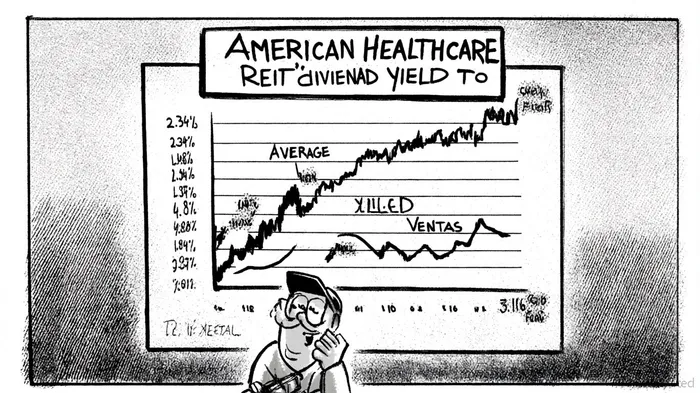
The healthcare REIT sector has long been a cornerstone for income-focused investors, offering a blend of stable cash flows and exposure to demographic tailwinds. American HealthcareAHR-- REIT, Inc. (NYSE: AHR) recently reaffirmed its position in this space by declaring a $0.25 per share quarterly dividend for Q3 2025, maintaining its annual payout of $1.00 per share and a yield of 2.34%[1]. This consistency, however, must be evaluated through the lens of operational resilience and sector dynamics.
AHR's Dividend: A Signal of Operational Resilience
American Healthcare REIT's recent dividend announcement aligns with its historical payout pattern, reflecting confidence in its financial performance. For Q2 2025, the company reported earnings per share (EPS) of $0.42, exceeding estimates by $0.02, while revenue surged to $542.50 million, surpassing forecasts[2]. These results, coupled with an updated FY 2025 EPS guidance of $1.64–$1.68, underscore the company's ability to generate consistent cash flows.
Operational metrics further reinforce this resilience. As of June 30, 2025, AHR's net debt-to-annualized adjusted EBITDA ratio improved to 3.7x from 4.5x in March 2025[4], signaling progress in deleveraging. Occupancy rates also rose, with Integrated Senior Health Campuses (ISHC) reaching 88.5% and Senior Housing Operating Properties (SHOP) hitting 85.5%[2]. These gains, alongside a 13.9% Same-Store Net Operating Income (NOI) growth in Q2 2025, highlight the company's ability to capitalize on rising demand for senior housing and outpatient care[4].
Sector Context: AHR's Position Amid Peers and Trends
While AHR's 2.34% yield trails the sector average of 4.8%[3], its payout ratio raises sustainability concerns. The company distributes 90.68% of earnings and 287.33% of free cash flow as dividends[2], a level that outstrips even high-yield peers like National HealthNHI-- Investors (NHI) and Medical Properties TrustMPW-- (MPW), which balance higher yields with more conservative payout ratios[2].
This contrast underscores a broader sector trend: larger healthcare REITs like WelltowerWELL-- (WELL) and VentasVTR-- (VTR) prioritize stability over yield, offering 1.87% and 3.16% yields respectively, while smaller players trade higher yields for elevated risk[2]. AHR's position between these extremes—moderate yield but aggressive payout—requires scrutiny. Analysts note its low Dividend Sustainability Score and limited growth prospects[4], suggesting investors should monitor its ability to maintain payouts amid potential economic headwinds.
Balancing Strengths and Risks
AHR's operational improvements, including $188.6 million raised via its at-the-market (ATM) program in Q2 2025[4], demonstrate financial flexibility. However, the lack of dividend growth over the past year[2] and a payout ratio exceeding free cash flow highlight vulnerabilities. In a sector where demographic trends favor long-term growth, AHR's ability to reinvest in its portfolio while sustaining dividends will be critical.
Historical backtesting of AHR's performance around dividend announcements reveals mixed signals for investors. Over the past three years, the stock has experienced price pressure in the first trading week after the ex-date, with a win rate below 35% and an average return of approximately -2.5% at five days post-event. However, by day 30, the average cumulative return recovers to +5.9%, though it still lags the benchmark's +9.9% performance. These findings suggest that while short-term traders might consider buying weakness 7–10 days post-ex-date, long-only holders should not expect the ex-date itself to deliver upside alpha.
Conclusion
American Healthcare REIT's $0.25 dividend reaffirms its role as a steady income generator in the healthcare REIT sector. However, its sustainability hinges on continued operational improvements and prudent capital management. As the sector navigates an aging population and evolving healthcare needs, AHR's ability to balance growth with payout stability will define its long-term appeal for income-focused portfolios.





Comentarios
Aún no hay comentarios