
Dividend Growth Strategies in a Volatile Macro Environment: Navigating Fiscal Deficits and AI-Driven Market Shifts
Fiscal Deficits and the Rising Cost of Debt
The U.S. fiscal deficit widened to $284 billion in October 2025, driven by the shifting of military and healthcare expenditures into the month. While adjusted for these shifts, the deficit would have been $180 billion-a 29% reduction year-over-year-this still signals a broader trend of debt accumulation. The Dallas Federal Reserve's 2025 report underscores the sensitivity of interest rates to fiscal deficits, noting that a 1 percentage point increase in the deficit-to-GDP ratio correlates with a 17 basis point rise in long-term interest rates. With U.S. federal debt projected to climb to 102.2% of GDP by 2026, the risk of higher borrowing costs looms large, potentially squeezing corporate margins and investor returns.
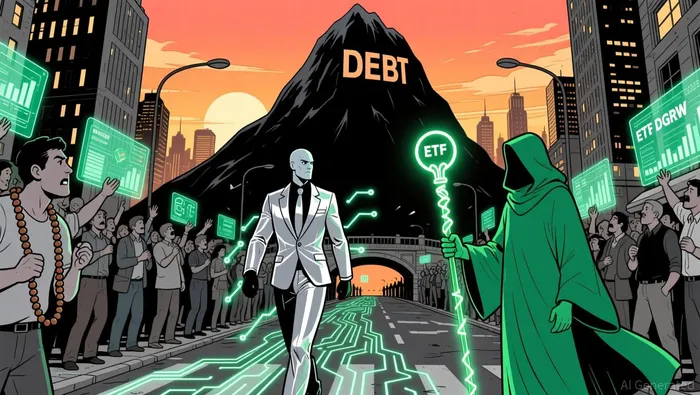
Similar pressures are evident in other major economies. Bahrain's fiscal deficit is expected to widen to 7.6% of GDP in 2025, with net government debt reaching 139% of GDP by 2028. While such cases highlight the fragility of fiscal sustainability, they also reveal investor behavior patterns: despite downgrades, markets continue to fund high-debt nations through bond refinancing, reflecting a nuanced balance between risk and reward.
High-Yield ETFs: Resilience Amid Volatility
DGRW has demonstrated resilience in this environment, with a 94.4% dividend increase in 2025, raising its payout to $0.175 per share. This growth is underpinned by WisdomTree's strategic focus on AUM expansion and margin improvement. In Q1 2025, the firm reported $3 billion in net inflows and operating margins of 31.6%, up 190 basis points from the prior year. Institutional confidence in DGRW has also surged, with Goldman Sachs and Jane Street Group increasing stakes in the ETF.
The ETF's success stems from its disciplined approach to quality screening, emphasizing earnings yield, return on equity, and forward earnings growth. This strategy allows DGRW to integrate AI-driven companies like Meta or Alphabet when they initiate dividends, bridging the gap between growth and income investing. By prioritizing firms with durable competitive advantages, DGRW mitigates the risks of sector-specific volatility while capitalizing on long-term compounding.
AI-Driven Market Shifts: Opportunities and Challenges
AI advancements in 2025 are reshaping corporate dividend policies and ETF strategies. For instance, AI platforms like PetVivo.ai have demonstrated potential to boost profitability through cost reduction and scalable business models, with gross margins of 80–90%. Such innovations could enhance dividend sustainability for portfolio companies. However, the sector's volatility-exemplified by sharp declines in AI-focused firms like C3.ai-highlights the risks of overvaluation.
DGRW's strategy adapts to these dynamics by incorporating AI-driven analysis into portfolio rebalancing and risk management. While the ETF does not directly focus on AI, its inclusion of high-quality dividend payers ensures exposure to companies leveraging AI for operational efficiency. This approach aligns with broader market trends, as 95% of senior business leaders report AI investments, with 30% allocating over $10 million annually.
Strategic Adaptations and Long-Term Outlook
The ETF's forward-looking strategy is further reinforced by its parent company's financial strength. WisdomTree's share repurchase authorization of $150 million is projected to add 2–3% in EPS growth annually, while its diversified asset mix-19% in fixed income and 22% in commodities-provides a buffer against market swings. These factors position DGRW to outperform in a low-growth, high-volatility environment.
However, challenges persist. The U.S. government's ability to maintain low borrowing costs hinges on political and economic stability, with deficits exceeding 4.5% of GDP posing a risk to long-term interest rates. Similarly, AI-driven market shifts may create valuation bubbles, requiring ETFs to balance innovation with prudence.
Conclusion
Dividend growth strategies in 2025 must navigate a dual challenge: mitigating the risks of fiscal deficits while harnessing the opportunities of AI-driven markets. DGRW exemplifies this balance, leveraging disciplined quality screens, strategic AI integration, and institutional confidence to deliver resilient returns. As fiscal pressures and technological disruptions continue to evolve, high-yield ETFs that prioritize adaptability and long-term sustainability will remain critical for investors seeking income in a volatile macro environment.





Comentarios
Aún no hay comentarios