
Dividend Fund Selection: Balancing Risk-Adjusted Returns and Portfolio Sustainability in SCHD vs. FDVV
Investors seeking income generation through dividend-paying equities face a critical decision: prioritizing high current yields or long-term sustainability. The Schwab U.S. Dividend Equity ETF (SCHD) and the Fidelity High Dividend ETF (FDVV) represent two distinct approaches to dividend investing, each with unique risk profiles and sector exposures. This analysis evaluates their performance, risk-adjusted returns, and dividend stability to determine which aligns better with a sustainable, income-focused portfolio.
Performance and Risk Metrics: A Tale of Two Strategies
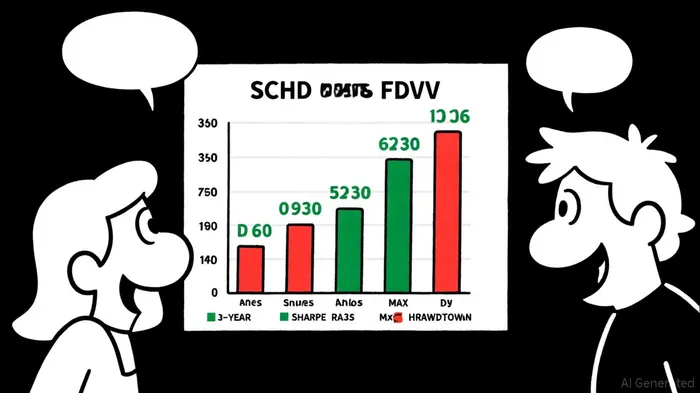
FDVV has outperformed SCHD in absolute returns over the past three years, delivering an annualized return of 18.92% compared to SCHD's 8.70% [1]. However, this outperformance comes at a cost: FDVV's maximum drawdown of -40.25% during market downturns far exceeds SCHD's -33.37% [1]. While FDVV's Sharpe ratio (0.84) and Sortino ratio (1.33) suggest superior risk-adjusted returns, these metrics mask its higher volatility in growth-oriented sectors like technology [1]. Conversely, SCHD's lower Sharpe ratio (0.16) reflects its focus on defensive sectors, which prioritize stability over aggressive growth [1].
Sector Exposure: Growth vs. Stability
FDVV's portfolio is heavily tilted toward high-growth sectors such as Finance (30.82%) and Electronic Technology (19.47%), with significant allocations to companies like NVIDIANVDA-- and AppleAAPL-- [4]. These holdings drive capital appreciation but expose the fund to sector-specific risks, including earnings volatility and interest rate sensitivity [4]. In contrast, SCHD emphasizes defensive sectors like Consumer Non-Durables (15.98%) and Health Technology (15.88%), with key holdings in Coca-ColaKO-- and ChevronCVX-- [4]. This structure provides resilience during economic downturns but limits upside potential in bull markets [4].
Dividend Stability: Yield vs. Growth
SCHD has demonstrated consistent dividend growth, with a 10-year compound annual growth rate (CAGR) of 12% and a trailing twelve-month (TTM) yield of 5.56% [2]. Its focus on high-quality, cash-flow-generating companies ensures predictable income streams [2]. FDVV, while offering a lower TTM yield of 2.96%, has shown uneven dividend growth, averaging 5–6% annually with periods of stagnation [3]. Its exposure to tech stocks, which prioritize share buybacks over dividend hikes, further limits its appeal for income-focused investors [3].
Portfolio Sustainability: Aligning with Investor Objectives
For investors prioritizing capital preservation and stable income, SCHD's defensive sector mix and consistent dividend growth make it a more sustainable choice. Its lower volatility and drawdowns align with conservative strategies, particularly in uncertain macroeconomic environments [1]. Conversely, FDVV suits investors willing to tolerate higher risk for capital appreciation and moderate income, leveraging its tech-heavy exposure to benefit from innovation-driven growth [4].
Conclusion
The choice between SCHD and FDVV hinges on an investor's risk tolerance and income objectives. While FDVV's aggressive growth strategy delivers superior returns in bull markets, its higher volatility and sector-specific risks may undermine long-term sustainability. SCHD, with its balanced approach to yield and stability, offers a more resilient foundation for income portfolios. As markets evolve, diversifying across both strategies could provide a middle ground, balancing growth potential with downside protection.





Comentarios
Aún no hay comentarios