
Dividend ETFs for Retirement Income: DGRO's Strategic Edge in a Low-Yield World
In today's low-yield environment, retirees face a daunting challenge: how to generate consistent income without sacrificing capital preservation or exposing their portfolios to excessive risk. Traditional fixed-income assets, once the cornerstone of retirement planning, now offer paltry returns, forcing investors to rethink their strategies. Enter dividend growth ETFs like the iShares Core Dividend GrowthDGRO-- ETF (DGRO), which combine the stability of dividend-paying equities with the compounding power of reinvested growth. This article examines DGRO's strategic advantages in a low-yield world, supported by performance data, market trends, and income-generation frameworks.
DGRO's Core Strategy: Quality Over Yield
DGRO distinguishes itself by targeting companies with a proven track record of increasing dividends for at least five consecutive years. This focus on sustained growth rather than immediate high yields aligns with the needs of retirees seeking long-term income resilience. As of September 2025, DGRO's expense ratio stands at 0.08%, one of the lowest in its category, according to the CompaniesMarketCap expense page, ensuring minimal drag on returns. While its current yield of 2.2% lags behind high-yield alternatives like the iShares Preferred and Income Securities ETF (PFF, 6.34%), DGRO's emphasis on dividend growth creates a compounding effect that outperforms static yields over time.
For example, a $25,000 investment in DGRODGRO-- in 2016 would have generated dividend income rising from approximately $2,500 to $6,500 by 2025-without additional contributions-demonstrating the power of reinvested growth. This compounding dynamic is particularly valuable in low-yield environments, where retirees must rely on capital appreciation and dividend reinvestment to offset stagnant interest rates.
Performance in a Low-Yield Environment
DGRO's historical performance underscores its appeal. Over the past year, the ETF delivered a 12.56% total return, including dividends, according to the StockAnalysis overview, while its 5-year total return of 91.99% outpaces both the S&P 500 and many high-yield alternatives, per CompaniesMarketCap. These results reflect its exposure to financially stable, shareholder-friendly companies that thrive even in economic uncertainty.
Moreover, DGRO's 9% average annual dividend growth rate over the past decade, according to The Gaming Dividend, positions it as a reliable income generator. In contrast, monthly dividend ETFs like the Amplify CWP Enhanced Dividend Income ETF (DIVO, 4.51% yield) or the Invesco S&P 500 High Dividend Low Volatility ETF (SPHD, 3.58% yield) prioritize immediate income but lack DGRO's long-term growth trajectory. For retirees, this trade-off between current yield and future growth is critical: DGRO offers a sustainable income stream that adapts to inflation and market cycles.
Strategic Advantages for Retirement Portfolios
DGRO's low turnover strategy (averaging 5% annually, per CompaniesMarketCap) enhances its tax efficiency, a key consideration for taxable accounts. Its diversified portfolio, spanning sectors like healthcare, technology, and consumer staples, further mitigates risk. In a low-yield environment, where retirees often overallocate to high-yield bonds or preferred securities, DGRO provides a balanced alternative that reduces exposure to interest rate volatility.
Consider its role in a diversified retirement portfolio:
- Complementary to High-Yield ETFs: Pairing DGRO with monthly payers like SPHD or DIVO creates a hybrid approach-immediate income from high-yield funds and compounding growth from DGRO.
- Risk Mitigation: DGRO's focus on dividend growth companies, which typically have strong balance sheets and consistent cash flows, reduces the likelihood of dividend cuts during downturns.
- Long-Term Resilience: With a projected dividend CAGR of 8.54% over the next decade, according to DRIPCalc, DGRO aligns with the 30+ year time horizons of many retirees.
Market Trends and Income-Generation Frameworks
The shift toward dividend growth ETFs reflects broader demographic and economic trends. As the U.S. population ages, demand for income-generating assets has surged, a pattern noted by CompaniesMarketCap. However, retirees must navigate a landscape where traditional bonds yield less than 2% and equities face valuation pressures. DGRO's strategy addresses these challenges by leveraging the dividend discount model (DDM), which values stocks based on future dividend expectations. In low-yield environments, where alternative investments are scarce, the DDM becomes a powerful tool for identifying undervalued, high-quality equities.
Additionally, DGRO's low expense ratio and tax efficiency align with modern portfolio theory (MPT), which emphasizes minimizing costs to maximize long-term returns. For retirees, this means more capital remains available for reinvestment, compounding income over time.
Conclusion: A Compelling Case for DGRO
While high-yield ETFs like PFF or DIVO offer immediate income, DGRO's focus on dividend growth makes it a superior choice for retirees prioritizing long-term sustainability. Its low expense ratio, historical performance, and compounding potential position it as a cornerstone of a resilient retirement portfolio. In a world where yields are constrained, DGRO exemplifies how strategic, growth-oriented investing can turn limitations into opportunities.
For investors seeking to balance income generation with capital preservation, DGRO is not just an ETF-it's a blueprint for navigating the challenges of a low-yield era.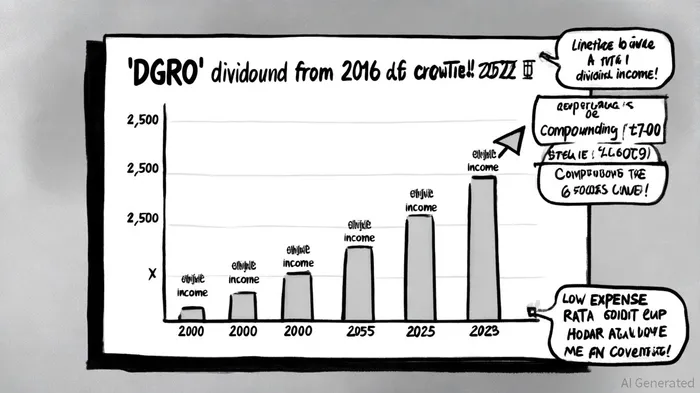





Comentarios
Aún no hay comentarios