
AT&T's Dividend Declaration: A Signal of Financial Stability and Long-Term Value for Income Investors
For income-focused investors navigating a high-yield environment, AT&T's (T) recent dividend declaration of $0.2775 per share—maintaining an annual payout of $1.11—serves as a critical signal of the company's financial stability and long-term value proposition. While the telecom giant's dividend yield of 6.8–7.34%[1] outpaces peers like Verizon (6.3–6.84%) and T-Mobile (1.46%)[2], the sustainability of this yield hinges on AT&T's ability to balance its high debt load with disciplined capital allocation and strategic reinvestment.
Dividend Reliability: A Mixed but Improving Picture
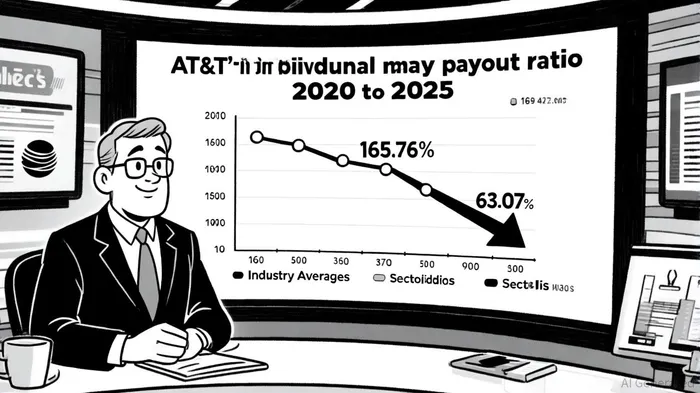
AT&T's dividend payout ratio, a key metric for assessing sustainability, has shown meaningful improvement. As of August 21, 2025, the company's trailing twelve months (TTM) payout ratio stood at 63.07%, calculated by dividing dividends per share ($1.11) by TTM earnings per share ($1.76)[3]. This marks a sharp decline from its 5-year average of 165.76%—a period marred by negative or near-zero earnings—and a 3-year average of 77.33%[3]. While 63.07% remains elevated relative to the sector median of 43.68%, it is lower than the industry median of 75.67%, suggesting a more conservative approach to dividend distribution[3].
However, AT&T's payout ratio based on free cash flow (FCF) tells a different story. At 40.51%, this metric is significantly lower than its 3-year average of 47.04%, indicating that the company's FCF—TTM of $1.34 per share[4]—is sufficient to cover dividend obligations with room to spare. This divergence highlights the importance of using FCF rather than earnings alone to assess dividend sustainability, particularly for capital-intensive industries like telecom.
Strategic Debt Reduction and Capital Allocation
AT&T's financial health is inextricably tied to its aggressive debt reduction plans. The company's debt-to-equity ratio, which peaked at 1.64 in June 1997 and 1.62 in December 2022, has declined to 1.43 as of June 30, 2025[5]. This reduction is part of a broader strategy to achieve a net-debt-to-adjusted EBITDA ratio of 2.5x by mid-2025—a target the company intends to maintain through 2027[6]. To fund this, AT&TT-- has generated over $50 billion in financial capacity through asset sales (e.g., $5.4 billion from the DIRECTV stake sale) and operational efficiency[6].
Critically, AT&T's credit ratings—BBB from S&P and Baa2 from Moody's—remain stable, with both agencies acknowledging the company's progress in reducing leverage[7]. Moody's, however, has placed AT&T on a downgrade review, citing concerns about rising debt levels amid increased capital expenditures for 5G and fiber infrastructure[7]. This underscores the delicate balance AT&T must strike between reinvesting in growth and maintaining debt discipline.
Competitive Positioning: Fiber and 5G as Growth Drivers
AT&T's strategic investments in fiber and 5G are pivotal to its long-term value proposition. The company plans to spend $22 billion to connect 80% of U.S. homes with fiber by 2030[8], a move that complements its 5G network expansion, which now covers 210 million people[8]. These initiatives are not merely defensive; they position AT&T to outgrow rivals like Verizon and T-Mobile in the race for broadband and wireless dominance. For instance, AT&T added 1.1 million net fiber customers in 2023, outpacing Verizon's growth[8], while its acquisition of 50 MHz of mid-band spectrum from EchoStar enhances its 5G capabilities[9].
Industry Comparisons: Yield vs. Sustainability
While AT&T's dividend yield is attractive, its payout ratio of 63.07% remains higher than Verizon's 59%[10] and T-Mobile's 33.21%[11]. This disparity reflects differing capital allocation strategies: Verizon's 100% payout ratio[10] leaves little room for reinvestment, whereas T-Mobile's low payout ratio prioritizes growth over immediate shareholder returns. AT&T's middle-ground approach—retaining enough earnings to fund infrastructure while maintaining a robust yield—appeals to income investors seeking a balance between current income and long-term stability.
Conclusion: A Prudent Bet for Income Investors?
AT&T's dividend declaration in 2025 signals a company in transition. The reduction in its payout ratio and debt-to-equity ratio, coupled with strategic investments in fiber and 5G, suggests a path toward sustainable growth. However, the high debt load and Moody's downgrade review necessitate caution. For income investors, AT&T offers a compelling combination of yield and strategic reinvestment, but its success will depend on executing its debt reduction plans while maintaining competitive differentiation in a rapidly evolving telecom landscape.
Historical backtesting of AT&T's dividend announcements from 2022 to 2025 reveals mixed but nuanced insights. A simple buy-and-hold strategy following these events showed an average 30-day excess return of +0.45 percentage points (2.12% vs. 1.67% benchmark), though this was not statistically significant at the 5% level. The win rate improved over time, rising from 65% on Day 1 to 69% by Day 30, with positive drift emerging only after the second week. These findings suggest that while short-term market reactions to dividend announcements have been muted, patient investors may benefit from a gradual positive trend.





Comentarios
Aún no hay comentarios