
Diversifying Beyond the Dollar: The Case for Allocating to Gold and Bitcoin
The U.S. dollar, long the bedrock of global finance, is facing a quiet but significant erosion of its dominance. As of 2024, the dollar accounted for 58% of global official foreign exchange reserves, down from a peak of 72% in 2001, according to the Federal Reserve's 2025 edition. While this decline is gradual, it reflects a broader shift in how central banks and investors are rethinking risk in an era of geopolitical uncertainty, fiscal strain, and the rise of alternative assets. For investors, this signals a need to diversify beyond the dollar-not as a rejection of its enduring strength, but as a strategic hedge against its potential vulnerabilities.
The Dollar's Decline: A Structural Shift or a Cyclical Blip?
The dollar's share of global reserves has fallen to its lowest level in 30 years, standing at 57.7% in Q1 2025, according to an IMF update. This trend is driven by central banks diversifying their holdings into gold, nontraditional currencies, and even cryptocurrencies. Gold's share in reserves has surged to over 23% by 2025, partly due to rising prices but also as a response to geopolitical risks and skepticism about dollar-denominated assets, a trend the Federal Reserve's 2025 edition documents. Meanwhile, the Chinese renminbi, Australian dollar, and Canadian dollar have gained traction as central banks seek to reduce overreliance on any single currency, as J.P. Morgan observes.
The dollar's resilience, however, remains formidable. Its role in global trade, deep financial markets, and the lack of credible alternatives ensure it retains a commanding position. Yet, as a CoinDesk analysis notes, the dollar's dominance is no longer taken for granted. Central banks are increasingly viewing diversification as a prudent strategy to mitigate risks from U.S. fiscal imbalances and geopolitical tensions.
Gold: The Timeless Hedge
Gold has reemerged as a critical component of reserve diversification. In 2025, central banks added record amounts of gold to their portfolios, with emerging markets leading the charge. Gold's appeal lies in its historical role as a store of value and its near-zero correlation with equities. For instance, during the 2022 market downturn, gold prices rose even as the S&P 500 fell, reinforcing its status as a safe-haven asset, as shown in a BlackRock analysis.
BlackRock's analysis underscores gold's utility in modern portfolios: its low correlation to traditional assets (e.g., -0.01 with the S&P 500) makes it an effective diversifier, particularly during periods of inflation or geopolitical stress, a point reinforced by a Mooloo analysis. In 2025, gold hit an all-time high of $3,433 per ounce, driven by central bank demand and expectations of Federal Reserve rate cuts, as Kanalcoin reported.
Bitcoin: The Digital Counterbalance
Bitcoin, often dubbed "digital gold," is increasingly being positioned as a hedge against dollar de-risking. Its fixed supply of 21 million coins creates a predictable scarcity, contrasting with the U.S. dollar's inflationary trajectory. In 2025, BitcoinBTC-- surged past $116,592, fueled by spot ETF approvals and tightening supply, according to Forbes. While its 30-day volatility exceeds 50%-far higher than gold's 12%-Bitcoin's low correlation to equities (0.15 over 10 years) and its inverse sensitivity to the U.S. dollar index (DXY) make it a compelling addition to diversified portfolios, as reported by Analytics Insight.
Bitcoin's performance during the U.S. Treasury market dysfunction in April 2025 further highlighted its unique role. Unlike gold, which typically acts as a flight-to-safety asset during equity selloffs, Bitcoin decoupled from traditional markets, outperforming in high-risk environments, a dynamic explored in a Bitwise update. Institutional adoption has also accelerated, with U.S. spot Bitcoin ETFs attracting significant inflows. BlackRock's iShares Bitcoin Trust (IBIT) alone managed hundreds of thousands of BTC, signaling growing acceptance among institutional investors, as noted by CoinDesk.
Strategic Allocation: Balancing Gold and Bitcoin
For investors seeking to hedge against dollar de-risking, a balanced approach that includes both gold and Bitcoin offers distinct advantages. Gold's stability and regulatory clarity make it a reliable long-term store of value, while Bitcoin's digital nature and inverse correlation to the dollar provide exposure to a rapidly evolving asset class.
BlackRock recommends allocating 1–2% of a portfolio to Bitcoin, while Ray Dalio has long advocated for gold as a cornerstone of wealth preservation, a point covered in a Morningstar piece. However, the optimal allocation depends on an investor's risk tolerance and time horizon. In 2025 Q3, gold outperformed Bitcoin, reaching $3,895 per ounce, driven by central bank demand and geopolitical uncertainties, as FXStreet reported. Yet Bitcoin's potential for capital appreciation, particularly in a de-dollarization scenario, cannot be ignored.
The Road Ahead
The dollar's dominance is unlikely to vanish overnight, but its gradual decline necessitates a reevaluation of portfolio strategies. As central banks continue to diversify reserves and investors seek alternatives to fiat currencies, gold and Bitcoin will play increasingly important roles. While gold offers time-tested resilience, Bitcoin represents a structural shift in how value is stored and transferred in a digital age.
For now, the key is to balance these assets within a broader diversification strategy. As the Federal Reserve and other central banks cautiously navigate macroeconomic headwinds, investors who embrace both gold and Bitcoin may find themselves better positioned to weather the uncertainties of a post-dollar dominance era.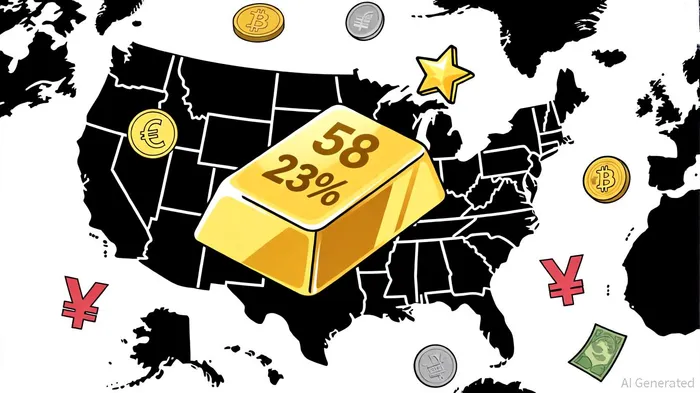





Comentarios
Aún no hay comentarios