
The Diverging Trajectory of California’s Onshore vs. Offshore Oil Sectors and Investment Implications
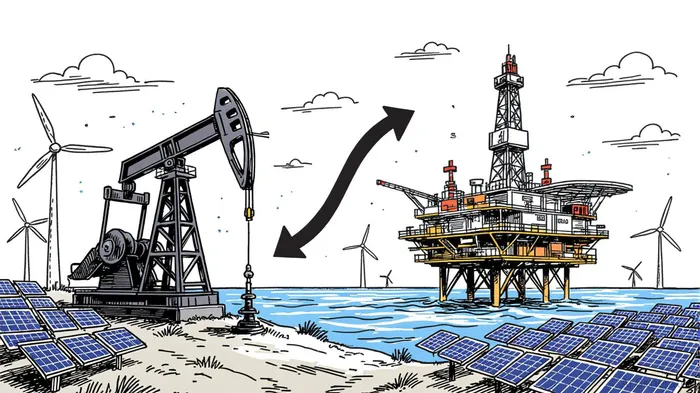
The California oil sector in 2024-2025 is bifurcating into two distinct trajectories: onshore operations grappling with stringent climate regulations and declining production, and offshore development benefiting from federal lease expansions and stable production. This divergence creates a compelling case for strategic sector rotation in energy assets, as investors weigh regulatory risks, capital efficiency, and long-term viability.
Regulatory Divergence: Onshore vs. Offshore
California’s onshore oil sector is increasingly constrained by state-level climate policies. The California Air Resources Board (CARB) has prioritized the implementation of the Climate Corporate Data Accountability Act (CCDA) and Climate-Related Financial Risk Act (CFRA), requiring large corporations to disclose greenhouse gas emissions and climate-related financial risks [1]. While these laws do not directly regulate oil production, they indirectly pressure the sector by incentivizing decarbonization and aligning corporate practices with California’s 2045 net-zero goals. Concurrently, the Low Carbon Fuel Standard (LCFS) has been updated to reduce transportation fuel carbon intensity by 90% by 2045, further eroding demand for petroleum-based products [2].
In contrast, California’s offshore oil sector operates under a federal regulatory framework. The U.S. Congress’s P.L. 119-21 (July 2025) mandates additional offshore lease sales beyond the 2024-2029 program, signaling federal support for expanding offshore development [3]. This divergence in regulatory environments—state-level decarbonization for onshore versus federal-enabled expansion for offshore—creates asymmetrical risks and opportunities.
Economic Performance and Investment Trends
Onshore production in California has continued its long-term decline, with May 2025 output hitting a new low of 262,000 barrels per day (b/d), down 27 kb/d year-over-year [4]. Regulatory compliance costs, including methane emission controls and flaring restrictions, have further strained onshore operators. However, companies like California Resources Corporation (CRC) have demonstrated resilience through cost-cutting and shareholder returns. In Q2 2025, CRCCRC-- raised its production guidance to 136 MBoe/d, reported a net income of $172 million, and returned $287 million to shareholders via dividends and buybacks [5].
Offshore production, meanwhile, remains more insulated from state-level climate policies. Federal lease programs and deepwater projects—such as Shell’s Appomattox and Chevron’s Ballymore—have attracted capital due to their longer production lifespans and technological maturity. The Gulf of Mexico, though not part of California, exemplifies the sector’s potential: new developments added 100,000 b/d of capacity in 2025, offsetting onshore declines [6]. California’s offshore reserves (estimated at 10.13 billion barrels) could similarly benefit from directional drilling and carbon capture technologies, though environmental opposition remains a hurdle [7].
Strategic Rotation Opportunities
The regulatory and economic asymmetry between onshore and offshore sectors suggests a strategic shift in capital allocation. Onshore operators face rising compliance costs and declining demand, while offshore projects offer stable returns and federal backing. For investors, this implies:
1. Reducing exposure to onshore assets in favor of offshore projects with clearer regulatory pathways.
2. Prioritizing companies like CRC that balance onshore resilience with cost discipline but also exploring offshore-focused E&P firms (e.g., those with Gulf of Mexico holdings).
3. Monitoring legal challenges to climate policies, such as the Supreme Court’s Diamond Alternative Energy v. EPA ruling, which could reshape regulatory landscapes for both sectors [8].
Conclusion
California’s onshore oil sector is increasingly a victim of its own climate ambitions, while offshore development remains a federal priority. For energy investors, the path forward lies in hedging against regulatory uncertainty by rotating capital toward offshore assets with clearer growth trajectories. As the state’s onshore production declines and offshore projects mature, the divergence will only deepen—making strategic sector rotation a necessity rather than an option.
Source:
[1] California's Climate Laws: CARB Sets the Stage, but Final Rules Delayed [https://www.bakerdonelson.com/californias-climate-laws-carb-sets-the-stage-but-final-rules-delayed]
[2] CARB Updates the Low Carbon Fuel Standard to Increase Access to Cleaner Fuels and Zero-Emission Infrastructure [https://ww2.arb.ca.gov/news/carb-updates-low-carbon-fuel-standard-increase-access-cleaner-fuels-and-zero-emission]
[3] Five-Year Offshore Oil and Gas Leasing Program [https://www.congress.gov/crs-product/R44692]
[4] US May Oil Production Hits New High, Again [https://peakoilbarrel.com/us-may-oil-production-hits-new-high-again/]
[5] California Resources CorporationCRC-- Reports Second Quarter 2025 Financial and Operating Results [https://stocknews.ai/ai-news/california-resources-corporation-reports-second-quarter-2025-financial-and-operating-results/68926afc4c496acb3c6c807a]
[6] Oil & Gas in 2025: Which Basin Will Dominate U.S. Energy [https://rextag.com/blogs/blog/oil-gas-in-2025-which-basin-will-dominate-u-s-energy-and-what-s-behind-the-105-billion-in-oil-deals-1?srsltid=AfmBOooC1-OFWpGwfnRWL4yAHwbCgxnPYjFewEN2z5sIeUxY2yxLiVx0]
[7] The Benefits and Costs of Oil and Gas Development in California [https://californiapolicycenter.org/the-benefits-and-costs-of-oil-and-gas-development-in-california/]
[8] Supreme Court Clarifies Standing for Regulatory Challenges [https://www.hklaw.com/en/insights/publications/2025/06/supreme-court-clarifies-standing-for-regulatory-challenges]





Comentarios
Aún no hay comentarios