
Diverging Investor Sentiment: Cryptocurrencies vs. Precious Metals in the Age of Fiscal Instability
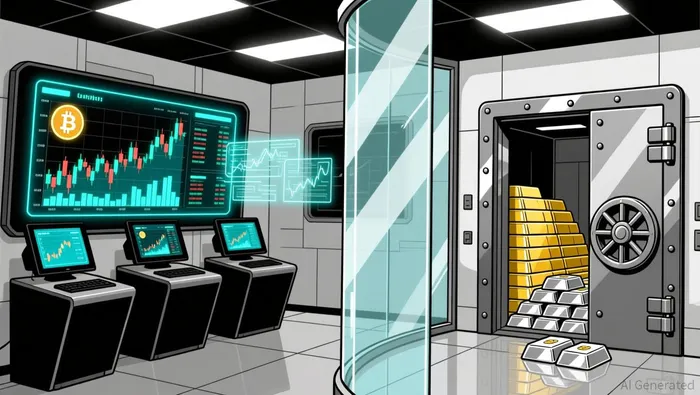
In 2025, the global investment landscape is defined by a stark divergence in investor sentiment between cryptocurrencies and precious metals. Systemic credit risks, fiscal instability, and the erosion of trust in fiat currencies have driven a structural reallocation of capital toward hard assets. While cryptocurrencies like BitcoinBTC-- and XRPXRP-- show signs of stabilization and institutional adoption, precious metals-particularly gold and silver-are surging as safe-haven assets. This analysis explores the drivers of this divergence, the implications for portfolio strategy, and the role of central bank actions in shaping the future of these markets.
Cryptocurrencies: Stabilization Amid Volatility
The cryptocurrency market has entered a phase of cautious optimism in 2025. Ripple (XRP) has maintained an uptrend, with whale activity signaling renewed confidence, while Bitcoin's three-wave recovery has drawn both retail and institutional attention. However, technical indicators suggest Bitcoin may face a potential decline, highlighting its inherent volatility. Grayscale Investments' decision to pursue an IPO underscores growing institutional interest, yet the firm's declining assets under management ($30.6 billion as of September 2025) reflect competitive pressures from lower-cost ETFs.
Stablecoins, meanwhile, have emerged as a critical narrative. The passage of the GENIUS Act in July 2025 provided a regulatory framework for stablecoins, spurring adoption by traditional financial institutions. EthereumETH--, ChainlinkLINK--, and SolanaSOL-- outperformed Bitcoin in Q3 2025, with Ethereum surging 65% and stablecoin assets surpassing $275 billion. This shift reflects investor demand for assets that balance innovation with relative stability, even as Bitcoin remains a polarizing "digital gold."
Precious Metals: The Debasement Trade Accelerates
Precious metals have become the cornerstone of the "debasement trade," as investors hedge against fiscal dominance and monetary debasement. Gold and silver reached all-time highs in 2025, driven by central bank purchases, industrial demand, and a flight to tangible assets. Q3 2025 data reveals ETF inflows of 221.7 tonnes of gold, with central banks adding 220 tonnes-a 28% increase from the prior quarter. The reclassification of gold as a Tier 1 HQLA under Basel III regulations has further solidified its role in liquidity management.
Physical ownership of gold and silver offers distinct advantages over cryptocurrencies. Unlike digital assets, which rely on exchanges and access credentials, precious metals are immune to technological failures and counterparty risk. Silver's dual role as an industrial commodity-used in electronics, solar panels, and medical devices-provides additional demand support. For conservative investors, these attributes make precious metals a more reliable store of value during systemic crises.
Systemic Risks and Fiscal Instability: Catalysts for Reallocation
Systemic credit risks and fiscal instability have intensified in 2025, particularly in emerging markets. Mozambique's central bank cut interest rates to historic lows to address delayed government debt payments, exacerbating concerns over sovereign solvency. In such environments, investors increasingly favor assets that retain value independent of government or corporate creditworthiness.
Central banks are also playing a pivotal role. Strategic gold purchases by institutions like the Bank of Bolivia and the People's Bank of China reflect a global trend toward reserve diversification. Meanwhile, the rise of CBDCs has introduced regulatory uncertainty, further boosting demand for privacy-focused alternatives like physical metals.
The Road Ahead: Strategic Implications for Investors
The diverging trajectories of cryptocurrencies and precious metals highlight the importance of asset allocation in a high-risk environment. While cryptocurrencies offer innovation and growth potential, their speculative nature and regulatory uncertainties make them unsuitable for conservative portfolios. Precious metals, by contrast, provide a proven hedge against inflation, geopolitical risks, and systemic failures in digital infrastructure.
For investors navigating 2025's fiscal challenges, a balanced approach that incorporates both asset classes may offer the best risk-adjusted returns. However, the growing institutionalization of crypto and the regulatory clarity surrounding stablecoins suggest that digital assets will continue to evolve as a complementary, rather than competing, safe-haven option.






Comentarios
Aún no hay comentarios