
Diverging Investor Behavior in Digital Assets: Why Altcoins Outperform BTC/ETH in Fund Flows
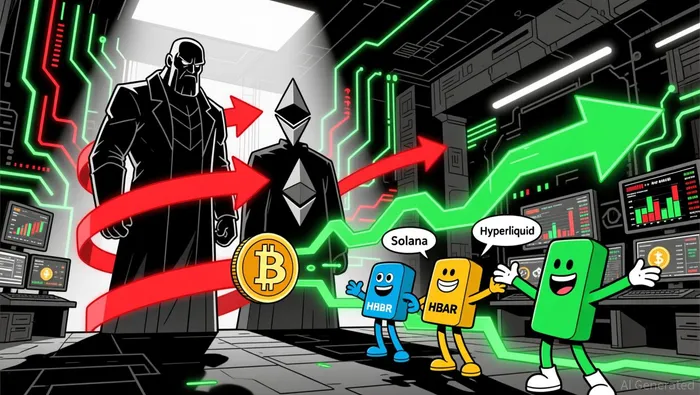
In Q4 2025, a striking divergence emerged in digital asset fund flows: BitcoinBTC-- and EthereumETH-- investment products faced outflows totaling $932 million and $438 million, respectively according to financial reports, while altcoins like SolanaSOL--, HBARHBAR--, and Hyperliquid attracted inflows of $118 million, $26.8 million, and $4.2 million according to market data. This intra-crypto rotation reflects a broader shift in investor behavior, driven by regulatory clarity, macroeconomic dynamics, and the evolving utility of altcoins.
Regulatory Clarity and Altcoin Adoption
The EU's Markets in Crypto-Assets (MiCA) Regulation, fully effective in 2025, and the U.S. GENIUS Act-establishing federal oversight for stablecoin issuers-have reshaped the crypto landscape according to industry analysis. These frameworks have created a more structured environment for altcoin investments, encouraging institutional participation in stablecoin issuance, custody, and trading according to market research. For instance, MiCA-compliant stablecoins gained traction in Europe, while U.S. regulators restricted foreign-issued stablecoins, pushing capital toward compliant alternatives according to regulatory updates.
This regulatory clarity has also spurred innovation in tokenized assets, with altcoins benefiting from their integration into decentralized finance (DeFi) and asset tokenization platforms according to industry reports. Solana, for example, saw sustained inflows as investors bet on its high-throughput blockchain for DeFi applications according to market data. Meanwhile, smaller altcoins struggled with compliance costs, but larger projects with robust governance structures, like HBAR (Hashgraph), attracted capital due to their regulatory adaptability according to market analysis.
Macroeconomic Drivers: Fed Policy and Inflation
The Federal Reserve's monetary policy in 2025 played a pivotal role in shaping crypto allocations. Restrictive policies in October 2025 led to a 35.3% drop in the Internet ComputerICP-- (ICP) token, while a November pivot toward easing triggered a 78.9% rebound according to macroeconomic data. Bitcoin's price also showed a strong inverse correlation with inflation: a 3.7% cooling in October 2025 spurred an 86.76% gain in seven days according to market analysis.
Lower interest rates, including six Fed cuts since September 2024, reduced the cost of borrowing and incentivized risk-on allocations. Altcoins like Ethereum and Solana surged 65% and 32% in Q3 2025 following the September rate cut, as investors sought higher returns in speculative assets according to market reports. Conversely, elevated rates (projected at 5.5% in 2025) redirected capital to traditional assets, dampening Bitcoin's appeal according to economic forecasts.
Intra-Crypto Rotation: A Tale of Two Markets
The rotation from BTC/ETH to altcoins was further amplified by institutional adoption of altcoin-specific products. Solana and XRPXRP-- ETPs attracted $156 million and $73.9 million in Q4 2025, driven by enthusiasm for niche use cases like cross-border payments and smart contracts according to market data.
This shift was not without risks. The Altcoin Season Index, which measures whether 75% of the top 100 altcoins outperform Bitcoin, stood at 19 in Q4 2025, indicating a Bitcoin-centric market according to market analysis. However, Ethereum ETF inflows and institutional interest in Solana suggested a potential reversal if macroeconomic conditions stabilized according to market analysis.
Conclusion: Navigating the New Normal
The Q4 2025 rotation underscores a maturing crypto market where regulatory clarity and macroeconomic signals increasingly dictate fund flows. While Bitcoin remains a store of value, altcoins are carving niches in DeFi, stablecoin ecosystems, and tokenized assets. Investors must weigh regulatory tailwinds against macroeconomic volatility, as central bank policies and geopolitical tensions continue to shape intra-crypto dynamics.
For now, the data suggests a bifurcated market: Bitcoin as a hedge against inflation and altcoins as vehicles for innovation. As 2026 approaches, the interplay between these forces will likely define the next chapter of digital asset investing.






Comentarios
Aún no hay comentarios