
The Diverging Fates of BTC and ETH ETFs: Implications for Crypto Portfolio Allocation
The crypto market in 2025 has witnessed a stark divergence between BitcoinBTC-- (BTC) and EthereumETH-- (ETH) ETFs, with implications that extend far beyond their price charts. As institutional adoption accelerates and retail investors recalibrate their strategies, the contrasting trajectories of these ETFs reveal critical insights into asset resilience and shifting investor sentiment.
Investor Sentiment: From Frenzy to Caution
Bitcoin ETFs have cemented their role as a cornerstone of institutional portfolios, with BlackRock's iShares Bitcoin Trust (IBIT) leading the charge. According to a Blockchain Reporter report, IBITIBIT-- alone attracted $300 million in net inflows on September 3, 2025, despite a $332.6 million outflow in the same fund earlier in the year. This volatility underscores a broader trend: Bitcoin ETFs have consistently drawn inflows, even amid macroeconomic uncertainty. By October 2025, U.S. Bitcoin ETFs saw $3.552 billion in inflows, driven by a Fear & Greed Index reading of 64-a clear signal of institutional "greed" amid softening monetary policy, according to the Weekly Fundamental Analysis Report.
Ethereum ETFs, however, tell a different story. While they initially captured 19% of U.S. Ethereum trading volume in late 2024, as noted in a 2025 scorecard, their inflows began to wane in early 2025. A $38.1 million net outflow in January 2025 marked a turning point, as investors grew wary of Ethereum's complex ecosystem of smart contracts and decentralized applications, according to a Crypto ETF Performance Comparison. By October, Ethereum dominance had fallen to 12.80%, a stark contrast to Bitcoin's 59% market dominance, as reported in the Weekly Fundamental Analysis Report.
Asset Resilience: Price Correlation and Institutional Trust
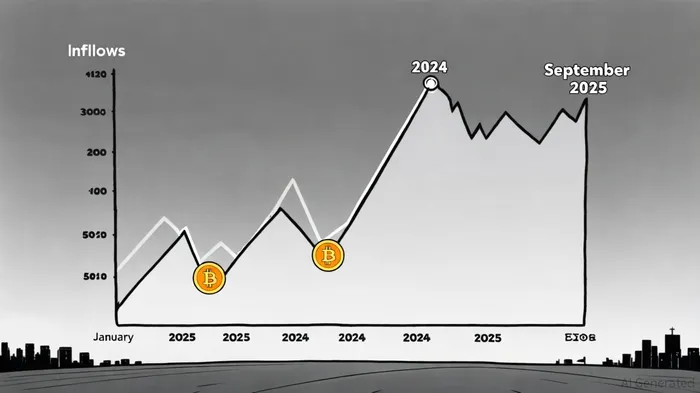
Bitcoin's ETF-driven price resilience is undeniable. Data from Dropstab, cited in Blockchain Reporter, shows that inflows of $2.57 billion in early 2024 and $3.38 billion in late 2024 directly correlated with record highs of $101,000 and $124,474, respectively. This pattern repeated in August 2025, when Ethereum ETF inflows surged to $2.27 billion, pushing ETH's price to $4,739-a 215% gain from April 2025, as described by Blockchain Reporter. However, Ethereum's price movements remain less tightly linked to ETF flows compared to Bitcoin, suggesting a gap in institutional confidence.
BlackRock's dominance in both markets further highlights this divide. As of early 2025, the firm held 548,505 BTCBTC-- and 1,071,415 ETHETH--, according to Blockchain Reporter, yet its Bitcoin ETFs outperformed Ethereum counterparts in risk-adjusted returns. Bitcoin ETFs delivered a 27.49% year-to-date return in 2025 with a Sharpe ratio of 2.05, while Ethereum ETFs posted a -10.78% return and a Sharpe ratio of -0.09, per the Crypto ETF Performance Comparison. This disparity reflects Bitcoin's "digital gold" narrative, which resonates more strongly with risk-averse investors than Ethereum's innovation-driven but volatile ecosystem.
Portfolio Implications: Balancing Exposure
For investors, the diverging fates of BTC and ETH ETFs demand a nuanced approach. Bitcoin's ETFs offer a stable, high-conviction bet on institutional adoption, particularly as BlackRockBLK-- and other providers continue to dominate inflow trends. However, Ethereum's recent outflows and lower Sharpe ratio suggest caution. While its price rebounded in August 2025, technical indicators now point to a bearish short-term trend, with moving averages aligning in a downward configuration, as noted in a CoinDesk analysis.
A balanced portfolio might allocate 60–70% to Bitcoin ETFs for resilience and 30–40% to Ethereum ETFs for growth potential, hedging against Ethereum's volatility while capitalizing on its innovation-driven upside. This strategy mirrors the broader market's shift toward Bitcoin as a store of value, while Ethereum remains a speculative play on decentralized finance and smart contract adoption.
The Road Ahead
As 2025 progresses, both BTC and ETH ETFs will remain barometers of crypto market sentiment. Regulatory clarity and macroeconomic stability could reignite Ethereum ETF inflows, but Bitcoin's entrenched position as a hedge against uncertainty is unlikely to wane. For now, investors must navigate the duality of these assets: Bitcoin as a fortress and Ethereum as a frontier.





Comentarios
Aún no hay comentarios