
Diverging Analyst, Institutional, and Insider Signals at U.S. Bancorp: A Contrarian Opportunity Amid Uncertainty?
The investment landscape for U.S. Bancorp (NYSE: USB) in late 2025 is marked by a striking divergence between bullish analyst and institutional signals and cautionary insider selling, alongside evolving credit risks. This divergence raises a critical question: Is U.S. Bancorp a contrarian opportunity, or does the market's optimism mask underlying vulnerabilities?
Bullish Analyst Upgrades and Institutional Confidence
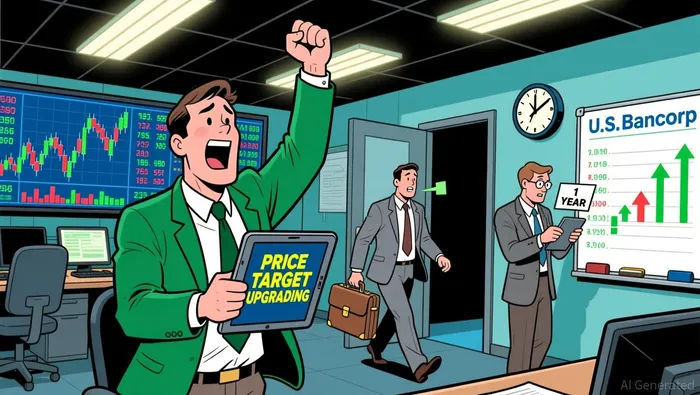
Analysts have largely reinforced their optimism about U.S. Bancorp in 2025. Keefe, Bruyette & Woods upgraded the stock with a raised price target from $53 to $58, while Citigroup and Oppenheimer adjusted their targets to $70 and $64, respectively, maintaining or enhancing their "buy" or "outperform" ratings according to MarketBeat. The consensus "Moderate Buy" rating, with an average target price of $54.63, reflects confidence in the bank's fee-income growth, digital transformation, and stable deposit base as reported. Institutional investors have mirrored this sentiment, with firms like Cannell & Spears LLC and Parcion Private Wealth LLC increasing holdings in Q3 2025, collectively adding over $3.8 million in value according to MarketBeat.
Fitch Ratings' affirmation of U.S. Bancorp's 'A+' credit rating with a stable outlook further underlines its financial resilience, citing 200 basis points of positive operating leverage in 2025 according to Fitch. These signals suggest a bank well-positioned to capitalize on its operational strengths, even as broader industry risks loom.
Insider Selling: A Cautionary Note
Despite the external optimism, insider selling by key executives has raised eyebrows. EVP James L. Chosy reduced his ownership by 10.62% through the sale of 26,909 shares, while Chairman Andrew Cecere sold 140,445 shares, trimming his stake by 9.36% according to MarketBeat. Such concentrated selling by top executives, particularly in a stock with strong institutional backing, often signals private concerns or hedging against perceived risks. While insider transactions are not inherently bearish, the magnitude and timing of these sales contrast sharply with the bullish analyst narrative, creating a layer of uncertainty for investors.
Credit Risks: A Double-Edged Sword
U.S. Bancorp's third-quarter 2025 results-$7.329 billion in net revenue and a 16.7% year-over-year net income increase-highlight its operational efficiency according to U.S. Bank. However, the broader banking sector faces mounting credit risks, particularly in commercial real estate (CRE). U.S. banks' private credit exposure has surged to nearly $300 billion, with office loans accounting for over 11.76% of delinquent CRE balances according to Reuters. While U.S. Bancorp has not disclosed granular CRE delinquency rates, industry data show that CRE loan delinquencies remain above 10-year averages, with office properties disproportionately affected according to Reuters.
Fitch acknowledges these risks but argues that U.S. Bancorp's 10.9% CET1 capital ratio and strong earnings profile provide a buffer according to Fitch. Yet, analysts project that 2026 could see provisions for loan losses rise to 24% of net revenue, up from 20.8% in 2025, as CRE pressures intensify according to Reuters. This suggests that while U.S. Bancorp's fundamentals are robust, its exposure to a volatile sector could amplify downside risks in a downturn.
Contrarian Opportunity or Overlooked Risk?
The interplay of these signals creates a nuanced picture. On one hand, U.S. Bancorp's strong capital position, digital investments, and fee-income growth align with long-term value creation. On the other, insider selling and sector-specific credit risks-particularly in CRE-introduce asymmetry. For contrarian investors, the stock's 37.8% undervaluation (per the Excess Returns model) and "Moderate Buy" consensus according to Yahoo Finance could represent an entry point, provided they are prepared to navigate near-term volatility.
However, the lack of transparency on U.S. Bancorp's specific CRE delinquency rates and loan-loss provisions remains a gap according to The Bancorp. Until the bank provides more granular data, investors must weigh the bullish analyst and institutional signals against the broader industry headwinds.
Conclusion
U.S. Bancorp's stock in late 2025 embodies a classic case of divergent signals. Analysts and institutions see a resilient regional bank poised for growth, while insiders and credit risks hint at caution. For investors, the key lies in balancing these perspectives: leveraging U.S. Bancorp's operational strengths while hedging against sector-specific vulnerabilities. In a market where certainty is elusive, this divergence may yet prove to be a fertile ground for contrarian opportunities.





Comentarios
Aún no hay comentarios