
Disruptive Utility-Driven Tokenomics: Assessing Binance Alpha's PALU in the DeFi Ecosystem
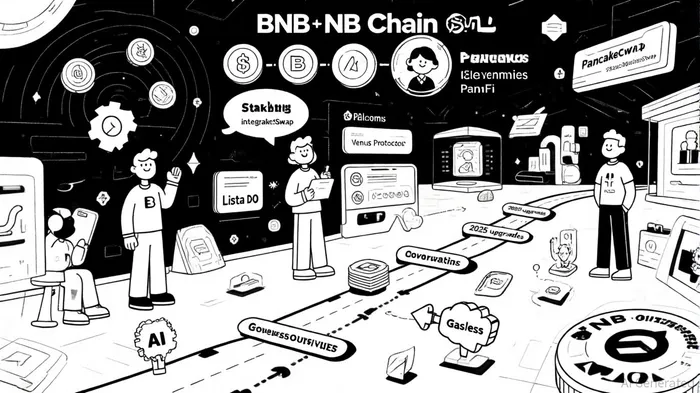
In the rapidly evolving landscape of decentralized finance (DeFi), tokens are no longer just speculative assets-they are the lifeblood of ecosystems that aim to redefine traditional financial systems. Binance Alpha's PALUPALU-- token, a memeMEME-- coin on the BNBBNB-- Chain, has emerged as a case study in utility-driven tokenomics, blending speculative appeal with functional design. While its origins as a community-driven meme coin may seem at odds with the rigor of DeFi, PALU's integration into Binance's pre-listing platform and its alignment with BNB Chain's 2025 roadmap suggest a strategic pivot toward real-world utility.
The Tokenomics of Scarcity and Staking
PALU's tokenomics model, as outlined in its documentation, incorporates deflationary mechanics designed to reduce circulating supply over time. According to MEXC tokenomics, the token's maximum supply is capped, with mechanisms such as token burns and transaction fee allocations likely to drive scarcity. This mirrors broader industry trends, where projects like BitcoinBTC-- and EthereumETH-- use halving events and fee burns to create long-term value appreciation, according to a BingX roundup. While specific details on PALU's burn schedule remain opaque, the general framework aligns with the principles of sustainable tokenomics-balancing scarcity with ecosystem growth.
Staking rewards further reinforce PALU's utility. Data from Gate.ioIO-- indicates that tokens like GARA (Coingarage) offer daily staking rewards of up to 31% APY, a model that could be replicated to incentivize long-term holding and network participation, according to a CoinMarketCap analysis. For PALU, staking might not only secure the network but also grant users access to premium features or governance rights, creating a feedback loop of demand and utility, as noted in the BingX roundup. However, the absence of concrete staking parameters for PALU underscores the need for caution; investors must await official disclosures before committing capital.
DeFi Integration and BNB Chain's Strategic Edge
The BNB Chain's 2025 roadmap-emphasizing faster transaction speeds, gasless transactions, and AI integration-positions it as a fertile ground for DeFi innovation, as argued in the CoinMarketCap analysis. PALU's potential integration into this ecosystem could mirror the trajectories of established projects like PancakeSwapCAKE-- and VenusXVS-- Protocol, which leverage BNB Chain's low fees and high scalability to offer services such as yield farming and lending, as described in the BingX roundup. For instance, if PALU were to be listed on PancakeSwap, it could tap into the platform's liquidity pools, enabling users to stake PALU for trading fees or governance votes.
Moreover, BNB Chain's institutional adoption is a critical tailwind. As stated by a 2025 analysis from BingX, the chain's partnerships with corporate entities and its focus on AI-driven financial tools are attracting a new wave of institutional investors. This trend could amplify PALU's utility, particularly if it becomes a collateral asset in lending protocols or a governance token for decentralized autonomous organizations (DAOs). However, the lack of confirmed partnerships or use cases for PALU in Q3 2025 means that these scenarios remain speculative, per MEXC.
Real-World Applications and Risks
The real-world applications of PALU hinge on its ability to transcend its meme coin origins. While the token's cultural significance and community-driven adoption are undeniable, its value proposition must evolve to include tangible use cases. For example, real-world asset (RWA) tokenization-a trend that saw tokenized assets grow from $5 billion in 2022 to $24 billion in 2025-could provide a pathway for PALU to gain utility, according to a Forbes article. If Binance or third-party platforms tokenize physical assets (e.g., real estate, commodities) and integrate PALU as a governance or fee token, the project could bridge the gap between DeFi and traditional finance.
Yet, the risks are substantial. Meme coins are inherently volatile, and PALU's price-currently at $0.05138, with an all-time high of $0.056866, per MEXC-reflects this instability. Furthermore, the absence of a verified smart contract audit from CertiK's Skynet Project Insight raises concerns about security, according to MEXC. While Binance Alpha's credibility boost is valuable, it does not eliminate the inherent risks of speculative assets.
Conclusion: A Balancing Act
PALU's disruptive potential lies in its ability to merge meme coin virality with DeFi's functional rigor. Its tokenomics, while still under development, align with industry best practices for scarcity and utility. However, the absence of concrete partnerships, audited smart contracts, and detailed staking mechanics means that investors must approach with a healthy dose of skepticism. For now, PALU remains a high-risk, high-reward proposition-its future will depend on Binance's strategic support, BNB Chain's technological advancements, and the broader market's appetite for utility-driven tokens.





Comentarios
Aún no hay comentarios