
The Disruptive Potential of XPIN's $1 USDT/GB eSIM Plan in the Global Telecom Sector
The global eSIM market is undergoing a seismic shift, driven by 5G expansion, IoT proliferation, and the rise of decentralized infrastructure. At the forefront of this transformation is XPIN Network, a DePIN (Decentralized Physical Infrastructure Network) project offering a $1 USDT/GB eSIM plan that challenges traditional telecom models. This article evaluates XPIN's disruptive potential, its strategic positioning in a $21.91 billion market by 2030, according to a Mordor Intelligence report, and its viability as an investment in emerging connectivity infrastructure.
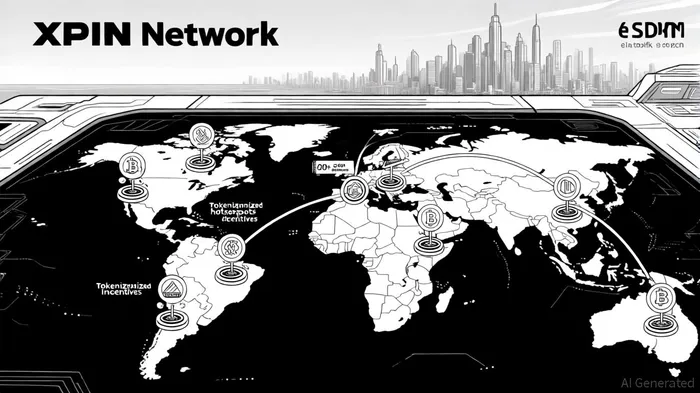
Market Dynamics and XPIN's Pricing Innovation
The eSIM market's growth is fueled by regulatory mandates (e.g., eCall and UN-R155) and the automotive sector's adoption of embedded connectivity, as shown in MobiliseGlobal statistics. By 2025, eSIM-compatible smartphones accounted for 60% of global shipments, with 25% of the eSIM market tied to automotive applications according to MobiliseGlobal. Against this backdrop, XPIN's $1 USDT/GB plan-offering Permanent GB, Daily Unlimited, and Monthly Unlimited data-positions itself as a cost-effective alternative to traditional roaming and eSIM providers.
For context, MobiliseGlobal reports Airalo charges $5 for 1GB of data in select regions, while Roamless offers 1GB for $8.95. XPIN's pricing model, combined with its decentralized infrastructure and tokenized incentives (e.g., dNFTs, staking rewards), creates a compelling value proposition for frequent travelers and IoT operators. The platform's integration of AI-driven rewards, such as the Xtella.AI agent, further enhances user retention by aligning token utility with real-world usage, as noted in a FINRA report.
Competitive Differentiation in a Crowded Market
XPIN faces competition from established players like 1GLOBAL, Airalo, and Thales, as well as emerging challengers such as Saily and Roamless, a landscape discussed in a Coincodex price prediction. However, its decentralized model and gamified DePIN + GameFi ecosystem set it apart. Unlike centralized providers, XPIN leverages blockchain to enable cross-border network switching, tokenized staking, and hardware-based incentives (e.g., PowerLink devices). This creates a self-sustaining economic loop where users earn XPIN tokens for contributing to the network, reducing reliance on traditional telecom infrastructure, a risk area also highlighted by the FINRA report.
Key differentiators include:
1. Decentralized Infrastructure: XPIN's network spans 200+ countries, avoiding the need for users to manually switch eSIMs or lose unused data, according to an XPIN tokenomics analysis.
2. Tokenomics: A total supply of 100 billion XPIN tokens, with annual halving and an 8% airdrop weighted by user activity, incentivizes long-term participation (as noted by Coincodex).
3. Regulatory Tailwinds: The shift toward Open RAN and network virtualization aligns with XPIN's decentralized model, reducing dependency on single vendors (per the XPIN tokenomics analysis).
Investment Potential and Strategic Positioning
XPIN's strategic partnerships with AI-driven ecosystems like CARV and its focus on PayFi (payment infrastructure) position it to capture a share of the $1 trillion telecom market, a trend supported by MobiliseGlobal. The platform's expansion into underdeveloped regions-where satellite and cellular convergence is expanding connectivity-further strengthens its growth narrative, as reported by Mordor Intelligence.
Financially, XPIN's token price is projected to trade between $0.000772 and $0.001095 in October 2025, with an average of $0.000868 (Coincodex). While short-term volatility is expected (e.g., a -24.52% drop to $0.000827 by November 13, 2025), long-term forecasts suggest a 192.44% increase by July 2026 (per the XPIN tokenomics analysis). This volatility reflects broader market dynamics but is mitigated by XPIN's ecosystem-driven demand, including a $50K trading competition and airdrop campaigns, as listed in CoinMarketCap updates.
Challenges and Risks
Despite its strengths, XPIN faces headwinds. Regulatory fragmentation and cybersecurity risks-projected to cost the global economy $10.5 trillion in 2025 according to the FINRA report-could impact compliance costs. Additionally, traditional telecom operators are expected to launch their own eSIM services in 2026, intensifying competition (CoinMarketCap lists these developments). Token inflation from high staking rewards also poses a risk, though XPIN's halving mechanism aims to counteract this (as outlined by Coincodex).
Conclusion
XPIN Network's $1 USDT/GB eSIM plan represents a disruptive force in the telecom sector, leveraging DePIN, AI, and tokenized incentives to redefine global connectivity. While challenges like regulatory complexity and competition persist, its strategic alignment with 5G, IoT, and decentralized infrastructure positions it as a compelling investment in emerging connectivity. For investors, the key lies in balancing short-term volatility with long-term growth potential, as XPIN's ecosystem-driven model seeks to outpace traditional telecoms in agility and innovation.






Comentarios
Aún no hay comentarios