
Disney's Strategic Position in China Amid U.S.-China Tensions: Assessing Long-Term Investment Potential
The Walt Disney Company's strategic footprint in China has long been a focal point for investors, given the country's status as the world's second-largest theatrical market and a critical hub for global entertainment consumption. As U.S.-China tensions persist and regulatory dynamics evolve, Disney's dual investments in film market access and theme park expansion present both opportunities and risks. This analysis evaluates Disney's long-term investment potential in China, drawing on recent performance data, regulatory shifts, and geopolitical considerations.
Film Market Access: Navigating Regulatory Constraints and Cultural Resonance
Disney's film division has demonstrated resilience in China despite stringent regulatory barriers. In 2025, Zootopia 2 became the highest-grossing imported film in China, earning $575 million and accounting for nearly 39% of its global box office revenue. This success underscores Disney's ability to adapt to local preferences through culturally resonant storytelling. For instance, Zootopia 2 incorporated elements of the Chinese zodiac and themes of urbanization, aligning with domestic audiences' values. Such strategies have allowed Disney to maintain a foothold in a market where Hollywood's share is capped at approximately 5% due to annual import quotas.
 However, this success is not without challenges. The Chinese film industry is increasingly dominated by domestic studios, which captured 79.7% of the 2025 box office. Local animated films like Ne Zha 2-which grossed $2.21 billion globally-highlight China's growing technical and creative capabilities. While Disney's animated offerings continue to thrive, the company must contend with a competitive landscape where local studios are not only collaborators but also global competitors. Regulatory risks, such as sudden policy shifts or geopolitical tensions, further complicate long-term projections. For example, Japanese anime releases faced disruptions in 2025 due to political tensions, illustrating the market's sensitivity to external factors.
Theme Park Expansion: A Pillar of Stability Amid Uncertainty
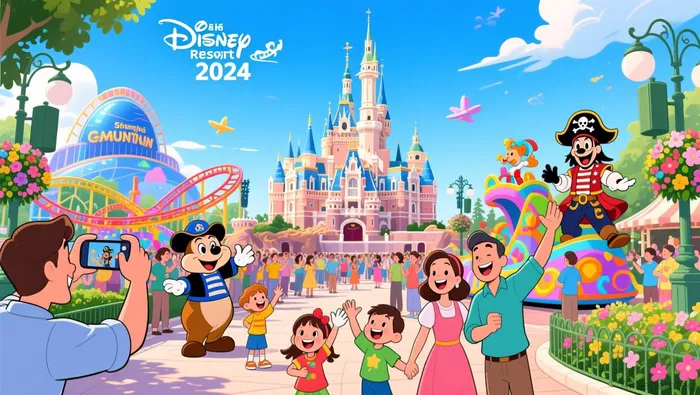
Disney's Shanghai Disney Resort has emerged as a cornerstone of its China strategy, offering a more politically resilient asset compared to its film division. In 2024, the resort welcomed 14.7 million visitors, securing its position as the fifth most-visited theme park globally. This growth has been fueled by ambitious expansion projects, including a fourth themed hotel and the expansion of Disney Town, a mixed-use entertainment hub. The resort's partial co-ownership with Chinese state entities also provides a buffer against geopolitical risks, as noted by former CEO Bob Iger during negotiations in the 2010s.
Despite U.S.-China trade tensions, Disney has not reported material disruptions to its theme park operations. The company's confidence stems from strong consumer demand and its brand's deep-rooted popularity in China. However, broader economic trends-such as U.S. companies cutting investments in China to record lows-raise questions about the sustainability of such ventures. For Disney, the resort's physical assets and recurring revenue streams from tourism and merchandise offer a degree of stability, even as supply chain adjustments and potential tariff escalations remain concerns.
Long-Term Risks and Strategic Adaptations
The interplay of U.S.-China tensions and regulatory changes poses significant risks for Disney's long-term investments. While the company has diversified its focus toward theme parks and immersive experiences, the film industry remains constrained by China's 10-film annual import quota. This policy has reduced Hollywood's box office share to 5%, forcing Disney to prioritize localized content and partnerships with state-run entities. Additionally, geopolitical uncertainties could impact future projects, such as a potential second theme park in China, which would require navigating complex regulatory and political landscapes.
Despite these challenges, Disney's leadership has expressed optimism. CEO Bob Iger has emphasized the company's commitment to China, citing Vice Premier Ding Xuexiang's encouragement for continued investment. This alignment with Chinese authorities, coupled with the resort's financial performance, suggests a strategic pivot toward assets less vulnerable to geopolitical volatility.
Conclusion: Balancing Opportunities and Risks
Disney's strategic position in China reflects a delicate balance between leveraging its global brand and adapting to a rapidly evolving market. While the film division faces regulatory headwinds and fierce competition from domestic studios, the Shanghai Disney Resort exemplifies the company's ability to create sustainable value through physical assets and localized experiences. For investors, the key lies in assessing Disney's capacity to navigate geopolitical risks while capitalizing on China's growing appetite for premium entertainment. As U.S.-China tensions persist, Disney's long-term success will hinge on its agility in aligning with Chinese regulatory priorities and cultural expectations.





Comentarios
Aún no hay comentarios