
Disney's Strategic Move into AI via OpenAI Stake and Sora: Long-Term Investor Implications and Generational Audience Re-Engagement
The Walt DisneyDIS-- Company's $1 billion equity investment in OpenAI and its licensing partnership with Sora, OpenAI's generative AI video platform, represent a bold strategic pivot into artificial intelligence. This move, announced in late 2025, positions Disney at the forefront of AI-driven content creation while addressing critical investor concerns about long-term growth and audience retention. By integrating Sora's capabilities into its ecosystem, Disney aims to redefine entertainment production, enhance streaming engagement, and secure its relevance across generational demographics.
Strategic Partnership and Financial Implications
Disney's partnership with OpenAI includes a three-year licensing agreement that grants Sora the ability to generate user-prompted videos featuring over 200 Disney, Marvel, Pixar, and Star Wars characters. These videos, available on Disney+, allow fans to create and share content featuring iconic figures like Mickey Mouse and Luke Skywalker, fostering a participatory culture. Beyond content licensing, Disney will leverage OpenAI's APIs to develop new tools for employees and deploy ChatGPT for internal workflows, streamlining operations and creative processes.
Financially, the deal aligns with Disney's broader AI strategy. OpenAI, valued at $300 billion as of 2025, projects $100 billion in revenue by 2028, driven by advancements in tools like Sora and enterprise AI adoption. While OpenAI anticipates significant losses through 2028, its long-term profitability goals and Disney's $1 billion stake signal confidence in the partnership's scalability. For Disney, the investment mitigates risks associated with stagnant streaming subscriber growth and declining linear TV revenue, offering a pathway to monetize AI-driven content innovation.
Generational Audience Re-Engagement
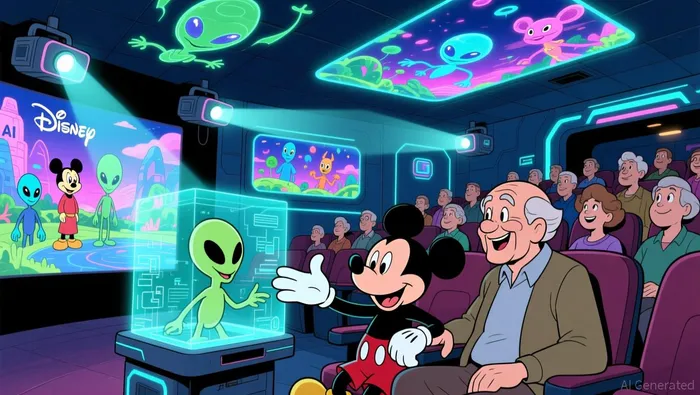 Disney's AI initiatives are explicitly designed to re-engage younger audiences while retaining older demographics. The company's AI Screenwriting System, which co-created Frozen 3, achieved a 91% audience satisfaction rating and $3.2 billion in box office revenue, demonstrating AI's potential to accelerate production and ensure cultural relevance. Similarly, the live-action Lilo & Stitch grossed $1 billion globally, with AI-driven marketing amplifying its cross-generational appeal.
User-generated content on Disney+ further underscores this strategy. By enabling fans to create and share AI-generated videos featuring Disney IP, the platform taps into Gen Z's preference for interactive, social media-like experiences. This aligns with MBLM's 2025 Brand Intimacy Study, which ranked Disney as the most emotionally resonant brand across age groups, leveraging nostalgia for older audiences and inclusive storytelling for younger ones. Enhanced recommendation algorithms and personalized streaming experiences also contribute to higher retention rates, particularly among millennials and Gen Z.
Long-Term Investor Considerations
For investors, Disney's AI integration presents both opportunities and risks. The company's DTC segment, including Disney+ and Hulu, reported a 39% increase in operating income for Q4 2025, driven by improved engagement metrics and advertising revenue. However, the Entertainment segment faced a 6% revenue decline, highlighting challenges in theatrical performance and linear TV. Disney's $24 billion content investment for 2026, coupled with its shift away from disclosing subscriber numbers (following Netflix's lead), signals a focus on profitability over growth metrics.
OpenAI's projected $12.7 billion revenue in 2025 and $100 billion by 2028 suggest Disney's stake could yield substantial returns, though its $74 billion operating losses through 2028 pose short-term uncertainties. Additionally, Disney's theme park segment, a $6.4 billion revenue driver in Q3 2025, benefits from AI-enhanced robotics and personalized guest experiences, reinforcing its competitive edge.
Risks and Ethical Considerations
Despite its potential, Disney's AI strategy faces challenges. Intellectual property concerns, ethical use of generative tools, and workflow integration complexities could delay ROI. OpenAI's emphasis on "responsible AI" and Disney's Global Values Assessment Framework, ensuring cultural sensitivity in AI-generated content, highlight the need for robust governance. Investors must also weigh the risk of market saturation in AI-driven entertainment, as competitors like Netflix and Warner Bros. explore similar technologies.
Conclusion
Disney's partnership with OpenAI and Sora marks a transformative step in its AI journey, addressing both investor demands for innovation and the need to re-engage a fragmented audience. By leveraging AI for content creation, personalization, and user interactivity, Disney strengthens its position in a rapidly evolving entertainment landscape. While financial risks and ethical challenges persist, the company's strategic alignment with OpenAI's growth trajectory and its demonstrated ability to adapt to generational preferences position it as a compelling long-term investment.





Comentarios
Aún no hay comentarios