
Disney's Strategic AI Alliances and Legal Battles: A New Paradigm for IP and AI Investment
Disney's 2025 strategic pivot in artificial intelligence (AI) has redefined the intersection of intellectual property (IP) and technology, positioning the entertainment giant as a trailblazer in shaping the future of AI-driven content creation. By simultaneously forging high-profile licensing partnerships and launching aggressive legal actions against AI firms, Disney has established a dual strategy that not only protects its vast IP portfolio but also monetizes it in the age of generative AI. This approach sets a precedent for how entertainment companies-and investors-should navigate the evolving AI landscape.
Licensing as a Strategic Monetization Tool
Disney's $1 billion equity investment in OpenAI, which grants the AI firm access to its iconic characters for use in the Sora video generation platform, exemplifies a calculated shift from adversarial litigation to structured licensing. 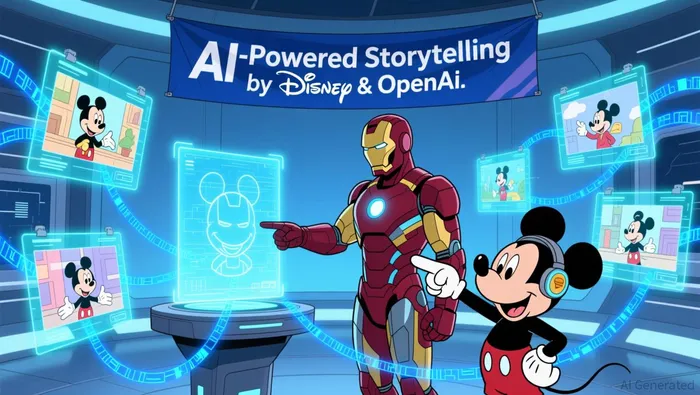 This partnership allows users to create AI-generated videos featuring characters like Iron Man and R2-D2, while Disney retains strict control over commercial usage and secures recurring licensing revenue. According to a report by Forbes, the deal reflects Disney's broader vision of leveraging AI to enhance storytelling and engage younger audiences on platforms like Disney+.
The financial rationale behind this move is clear: by licensing its IP rather than outright selling it, Disney maintains ownership and flexibility to adapt to future market demands. As stated by Bloomberg, the company's fiscal 2025 results-$94.4 billion in revenue and a 12% rise in operating income-underscore its financial strength to make such bold investments while prioritizing long-term returns. This model also aligns with industry trends, as seen in Warner Music Group's November 2025 settlement with Suno, which established artist compensation mechanisms and opt-in licensing frameworks.
Legal Aggression: Protecting IP in the AI Era
While Disney has embraced licensing, it has not shied away from litigation to defend its IP. In 2025, the company sent a cease-and-desist letter to Google, accusing its Gemini AI of copyright infringement by using Disney characters to train its models and distribute unauthorized content. The letter criticized Google's AI services as a "virtual vending machine" for mass-scale IP reproduction according to Deadline. Similarly, Disney joined forces with NBCUniversal and Warner Bros.WBD-- Discovery to sue Midjourney, alleging "calculated and willful" infringement involving unauthorized images of characters like Elsa and Darth Vader.
These legal actions are not merely defensive but strategic. By challenging AI firms' claims of "transformative use" under U.S. fair use law, Disney is shaping judicial interpretations of how AI-generated content interacts with copyright protections. A landmark ruling in Bartz v. Anthropic-where Judge Alsup clarified that legally purchased books could be used for AI training but pirated ones could not-highlights the legal gray areas Disney is actively trying to define.
Implications for Industry Standards and Investment
Disney's dual strategy signals a paradigm shift in how IP-centric AI investments are structured. By monetizing its IP through licensing while enforcing strict legal boundaries, the company is setting a template for other entertainment firms. For instance, the Writers Guild of America (WGA) has criticized Disney's OpenAI deal for "sanctioning" AI's "theft of our work," underscoring the tension between AI innovation and creator rights. However, Disney's approach also demonstrates how IP can be a strategic asset: its partnerships with Nvidia, Google, and Epic Games to develop specialized AI applications reinforce its AI flywheel strategy, where enhanced storytelling generates high-quality data to refine future models.
From an investment perspective, Disney's strategy carries both risks and rewards. While its 0.2% stake in OpenAI (compared to Microsoft's 27%) limits immediate financial upside, the company's focus on IP control ensures long-term value retention according to Forbes. Analysts at Klover.ai note that Disney's AI-driven efficiencies-such as AI-enhanced animation techniques reducing production costs by 30%-could yield indirect financial benefits over time. However, the legal battles also highlight the growing complexity of AI regulation. New state laws, like California's restrictions on unauthorized digital replicas, and federal bills like the TAKE IT DOWN Act, add layers of compliance risk.
Conclusion: A Blueprint for the Future
Disney's 2025 AI strategy-combining licensing innovation with legal rigor-has positioned it as a leader in redefining IP-centric AI investments. By monetizing its IP through partnerships while aggressively defending its rights in court, the company is not only protecting its legacy but also shaping the rules of the AI-driven entertainment economy. For investors, this dual approach underscores the importance of balancing technological adoption with legal foresight. As AI spending is projected to exceed $3 trillion by 2030, Disney's model offers a blueprint for how to navigate this high-stakes landscape while safeguarding creative value.





Comentarios
Aún no hay comentarios