
Disney's Strategic AI Alliance with OpenAI: A Transformative Catalyst for Media and Entertainment
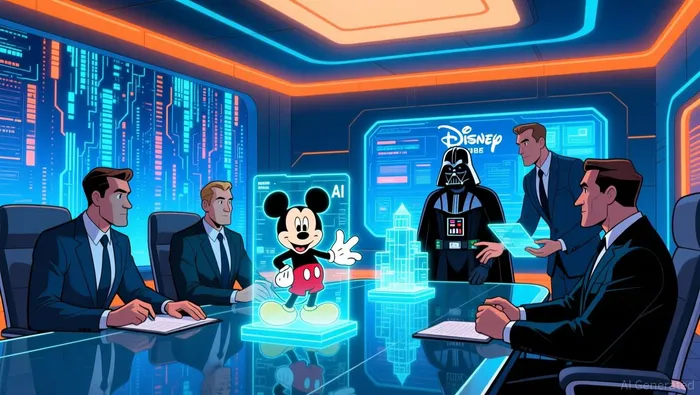
The Walt DisneyDIS-- Company's recent $1 billion equity investment in OpenAI, coupled with a three-year licensing agreement, marks a pivotal moment in the evolution of generative artificial intelligence (AI) as a transformative force in media and entertainment. By granting OpenAI access to over 200 iconic characters from its vast intellectual property (IP) portfolio-including Disney, Marvel, Pixar, and Star Wars-this partnership not only redefines audience engagement but also signals a strategic recalibration of how entertainment giants leverage AI to secure competitive advantage. As the industry grapples with the dual challenges of technological disruption and creative preservation, Disney's move offers a blueprint for balancing innovation with ethical responsibility.
Strategic Rationale: Monetizing IP Through AI-Driven Creativity
Disney's collaboration with OpenAI centers on integrating Sora, OpenAI's video generation tool, with its legendary characters. Fans will soon be able to create and share short AI-generated videos featuring figures like Mickey Mouse, Luke Skywalker, and Black Panther via text prompts, with select content distributed on Disney+. This approach transforms passive consumption into participatory creation, expanding the lifecycle of Disney's IP while fostering deeper emotional connections with audiences.
 Disney's financial implications are equally compelling. By becoming a major customer of OpenAI, Disney is positioning itself to harness AI for operational efficiency and product innovation. For instance, the company plans to deploy ChatGPT for internal employee tools and utilize OpenAI APIs to develop new subscriber experiences. Such applications align with broader industry trends: generative AI is projected to reduce production costs by up to 30% in sectors like visual effects and scriptwriting, enabling studios to allocate resources toward high-value creative endeavors.
Market Impact: A Catalyst for AI-Driven Entertainment Growth
Disney's partnership has already triggered a measurable market response. Following the announcement, Walt Disney stock rose by over 1%, reflecting investor optimism about the company's AI-forward strategy. This aligns with macroeconomic trends: AI-linked shares, particularly in infrastructure and cloud computing, have outperformed broader indices in 2025, with companies like Nvidia and Microsoft benefiting from surging demand for AI processing power.
The entertainment sector's embrace of AI is not merely speculative. Morgan Stanley analysts note that generative AI is reshaping creative workflows, from AI-driven recommendation engines that boost user engagement to tools that enable real-time personalization in streaming platforms. For Disney, the ability to monetize user-generated content-while retaining control over character usage-creates a scalable revenue stream. By excluding talent likenesses and voices from the licensing deal, Disney mitigates legal risks while focusing on animated assets, a decision that underscores its calculated approach to IP management.
Broader Industry Implications: Investment Opportunities in AI Infrastructure
Disney's alliance with OpenAI is emblematic of a larger shift in the entertainment industry, where AI is transitioning from a disruptive novelty to a foundational infrastructure component. According to a Q3 2025 global AI report, venture capital and private equity investments in AI infrastructure have surged, with AI accounting for 51% of global VC deal value in 2025. This trend is expected to accelerate as agentic AI-systems capable of autonomous workflows-gains traction, with enterprise spending projected to rise from under $1 billion in 2024 to $51.5 billion by 2028 according to the same report.
Investors are increasingly prioritizing platforms that integrate AI to enhance user experience and operational efficiency. Disney's move to leverage OpenAI's technology for employee tools and content creation aligns with this preference. Moreover, the company's aggressive stance against unauthorized AI training-such as its cease-and-desist letter to Google-highlights the importance of IP governance in an AI-driven era, a factor that could influence regulatory frameworks and industry standards.
Ethical and Regulatory Considerations: Navigating the AI Dilemma
While the economic potential of AI is vast, ethical and regulatory challenges remain. Concerns about labor displacement, authorship rights, and the authenticity of AI-generated content are intensifying debates within creative industries. Disney's emphasis on "responsible AI use," including safeguards for user safety and creator rights, positions it as a leader in addressing these concerns . Such commitments are critical for maintaining public trust, particularly as AI-generated content becomes indistinguishable from human-created work.
Conclusion: A Strategic Bet on the Future of Entertainment
Disney's partnership with OpenAI is more than a financial transaction; it is a strategic bet on the future of entertainment. By aligning with a leading AI innovator, Disney is not only future-proofing its IP but also redefining how audiences interact with its content. For investors, this alliance underscores the growing importance of AI infrastructure and platforms in the entertainment sector. As generative AI continues to blur the lines between creation and consumption, companies that can scale AI solutions while navigating ethical complexities will dominate the next era of media. Disney's move is a clear signal that the age of AI-driven entertainment is not just emerging-it is accelerating.







Comentarios
Aún no hay comentarios