
Disney and OpenAI: A $1 Billion Bet on AI-Driven Entertainment Monetization
The Walt Disney Company's $1 billion equity investment in OpenAI, announced in late 2025, marks a seismic shift in the entertainment industry's approach to artificial intelligence. By licensing over 200 of its most iconic characters-including Mickey Mouse, Iron Man, and Yoda-to OpenAI's Sora video-generation platform and ChatGPT Images, Disney is not only monetizing its intellectual property (IP) in novel ways but also positioning itself at the forefront of generative AI adoption in media. This partnership, described by analysts as a "dividing line between pre-AI and post-AI content creation", underscores Disney's strategic pivot toward AI-driven storytelling and user engagement.
Strategic Rationale: Monetizing IP in the AI Era
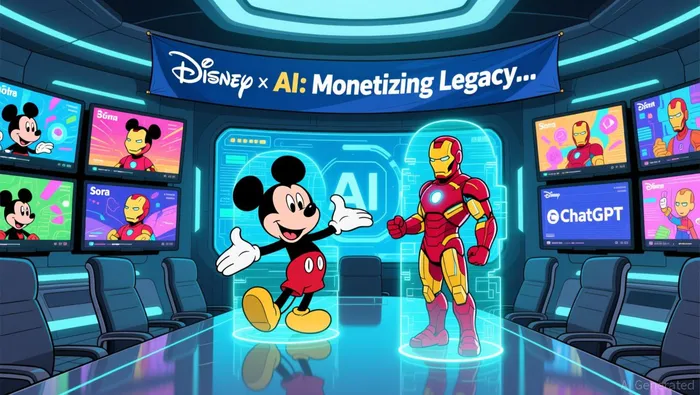 Disney's collaboration with OpenAI is rooted in a dual objective: expanding the reach of its IP while securing a stake in the future of AI-driven content creation. By granting OpenAI access to its vast character library, Disney enables fans to generate short-form AI videos and images via Sora and ChatGPT, creating a new revenue stream through user-generated content (UGC). According to a report by , this move allows Disney to "leverage its legacy IP in the AI age," where the value of pre-AI catalogs like Star Wars and Pixar films becomes incrementally more valuable as they fuel AI innovation.
The partnership also includes Disney using OpenAI's APIs to develop new tools for Disney+, including AI-driven personalization and interactive features. As stated by , CEO Bob Iger envisions Disney+ evolving into a "portal to all things Disney," integrating AI-generated content creation and social media-like sharing. This aligns with broader industry trends: 75% of workers now report improved output speed or quality via AI tools, and enterprise AI adoption is accelerating, with ChatGPT Enterprise users sending 30% more messages on average.
Financial and Monetization Implications
While Disney's Q1 2025 financial results did not explicitly quantify the OpenAI partnership's contribution, the company's overall performance highlights its strategic importance. Total revenue rose 5% year-over-year to $24.7 billion, with the DTC segment turning profitable for the first time in years, reporting $293 million in operating income. Analysts suggest that Disney's IP licensing deal with OpenAI could generate revenue through a "revenue-sharing" model, where Disney benefits from a portion of profits as OpenAI develops monetization strategies for Sora and other tools. , the competitive advantage in AI is increasingly tied to access to unique datasets and IP, making Disney's $1 billion investment a hedge against obsolescence in a saturated AI landscape. By embedding its characters into AI workflows, Disney ensures its IP remains relevant in an era where user-generated content is reshaping audience expectations.
Challenges and Ethical Considerations
Disney's AI ambitions are not without risks. The company previously faced internal resistance to AI integration, exemplified by the dismissal of its former Vice President of AI and Machine Learning in 2024 due to cultural and technical challenges. This highlights the broader industry debate over AI's ethical implications, including concerns about job displacement and the devaluation of human creativity. However, Disney's partnership with OpenAI includes strict guardrails to protect creators' rights, emphasizing "responsible AI practices" that prioritize safety and artistic integrity.
### Industry-Wide Impact and Investment Thesis
Disney's collaboration with OpenAI sets a precedent for how legacy entertainment companies can adapt to AI-driven monetization. By treating its IP as a foundational asset for AI innovation, Disney is not only preserving its brand equity but also creating new avenues for audience interaction. notes, the deal signals a "strategic realignment between AI and Hollywood," where the value of exclusive data and IP becomes a key differentiator.
For investors, Disney's proactive approach to AI adoption-coupled with its strong Q1 2025 financials-suggests a long-term growth strategy that balances technological disruption with brand protection. While concrete metrics on the OpenAI partnership's financial impact remain pending, the broader trend of AI-driven entertainment monetization is undeniable. As generative AI tools become more sophisticated, Disney's early-mover advantage in licensing IP for AI content creation could yield significant returns, particularly as user engagement on platforms like Disney+ continues to evolve.





Comentarios
Aún no hay comentarios