
Disney's Brand Resilience Amid Political and Legal Risks: Strategic Stock Positioning in a Polarized Era
In an era marked by political polarization and regulatory turbulence, The Walt Disney CompanyDIS-- has emerged as a case study in balancing brand integrity with investor expectations. Recent developments—including Florida's SB 1718, strategic rebranding, and recalibrations of diversity, equity, and inclusion (DEI) initiatives—have tested Disney's resilience while offering critical insights for investors navigating the media and entertainment sector.
Political and Legal Challenges: A Double-Edged Sword
Disney's opposition to Florida's SB 1718, a law restricting discussions of gender identity in schools, triggered immediate backlash from conservative stakeholders and lawmakers. The company's $17 billion investment plan for Walt DisneyDIS-- World, announced in September 2024, initially caused a 2.35% stock price drop to $81.94, reflecting investor concerns over regulatory pushback and operational risks [1]. However, this volatility masked a broader narrative: Disney's long-term commitment to its Florida footprint. By framing the investment as a “game-changer” for its Parks, Experiences, and Products segment, the company signaled confidence in its ability to weather political headwinds through capital-intensive growth [4].
The law's indirect economic impacts on Florida's immigrant communities—such as increased job insecurity and labor market instability—also raised questions about regional economic risks for Disney [3]. Yet, the company's strategic pivot to international expansion, including reimagined attractions like EPCOT's Test Track and plans for a potential Texas resort, underscores its efforts to diversify geographic exposure and mitigate localized political risks [1].
Rebranding and DEI: Navigating Investor and Consumer Tensions
Disney's decision to scale back DEI initiatives in early 2025, under pressure from activist investors like Trian Partners, exemplifies the delicate balancing act between profitability and brand identity. The stock price surged to $117.20 in February 2025 following the announcement, reflecting investor approval of cost-cutting measures [2]. However, this move sparked criticism from advocacy groups and internal dissent, with fears of alienating younger, diverse demographics.
This duality highlights a key challenge for investors: Disney's stock performance is increasingly tied to its ability to reconcile short-term financial gains with long-term brand loyalty. While the Direct-to-Consumer (DTC) segment turned a $293 million profit in Q1 2025—driven by pricing hikes and reduced programming costs—the suspension of “Jimmy Kimmel Live!” and subsequent #CancelDisneyPlus social media campaigns revealed vulnerabilities in its content-driven strategy [5].
Strategic Stock Positioning: Resilience in a Polarized Climate
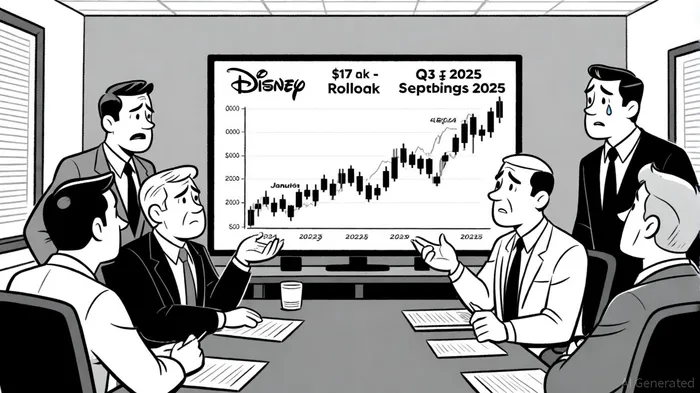
Disney's stock has demonstrated resilience amid these challenges, with a 20.77% annual increase as of September 2025 and a price-to-earnings ratio of 17.7x, below the S&P 500 average [3]. Analysts project a 15% upside, with a consensus “Strong Buy” rating and an average price target of $130.48 [2]. This optimism is underpinned by:
1. Operational Turnarounds: The Parks segment reported a 22% operating income increase in Q3 2025, driven by international demand and new attractions like Villains Land [4].
2. Streaming Profitability: The DTC segment's transition from a $138 million loss in 2024 to a $293 million profit in 2025 signals improved cost management [5].
3. Capital Allocation: A $60 billion investment in global entertainment infrastructure, including cruise ships and international parks, positions Disney to capitalize on long-term demand for immersive experiences [4].
However, risks persist. The company's exposure to polarized political climates—exemplified by Florida SB 1718 and the Kimmel controversy—requires vigilant governance and crisis management. Additionally, streaming competition and macroeconomic headwinds could pressure margins, particularly if subscriber growth plateaus.
Notably, a backtest of Disney's earnings release performance from 2022 to 2025 reveals mixed signals for investors relying on earnings dates as timing triggers. Over 15 events, the average cumulative return peaked at +1.6% on day 4 post-earnings but declined to negative territory by day 17, with no statistically significant excess returns at the 95% confidence level. This suggests that, historically, Disney's earnings releases have not provided a reliable directional edge for a simple buy-and-hold strategy within a 30-day window .
Conclusion: A Calculated Bet on Resilience
For investors, Disney represents a nuanced opportunity. Its ability to innovate in parks and streaming, coupled with strategic cost discipline, offers a buffer against political and legal volatility. Yet, the company's stock valuation must be weighed against risks such as overextension in capital projects and reputational damage from polarizing stances. In a polarized world, Disney's resilience hinges on its capacity to adapt its brand narrative without sacrificing core values—a challenge that will define its trajectory in the years ahead.





Comentarios
Aún no hay comentarios