
Disney's $1 Billion OpenAI Investment: A Strategic Bet on AI-Driven Entertainment
The Walt DisneyDIS-- Company's $1 billion equity investment in OpenAI, announced in December 2025, represents a bold and calculated move to secure its position in the rapidly evolving AI-driven entertainment landscape. By licensing over 200 of its iconic characters-including those from Marvel, Pixar, and Star Wars-for use in OpenAI's Sora video generation tool, Disney is not only embracing the transformative potential of artificial intelligence but also hedging against the risks of obsolescence in an industry increasingly shaped by generative AI. This partnership, however, raises critical questions about its long-term value creation and Disney's ability to sustain market leadership amid intensifying competition.
Strategic Rationale: Balancing Innovation and IP Protection
Disney's decision to partner with OpenAI is rooted in a dual imperative: leveraging AI to expand storytelling possibilities while safeguarding its intellectual property (IP). The agreement explicitly excludes character voices and extends strict guardrails to protect Disney's creative assets, reflecting a defensive strategy that aligns with the company's recent legal actions against Google over AI-related IP concerns according to Axios. CEO Bob Iger emphasized that the deal "respects and honors creators" while enabling user-generated content creation, a move that could democratize access to Disney's IP and foster deeper audience engagement according to Forbes.
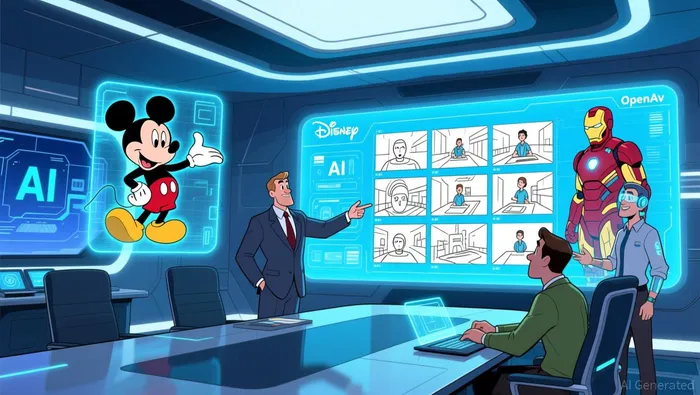 From a financial perspective, Disney's 0.2% stake in OpenAI (valued at $500 billion) offers limited direct upside but serves as a strategic hedge. Analysts like Ark Invest's Nicholas Grous argue that Disney's rich pre-AI catalog-such as Star Wars and Marvel-gains renewed value in an era where AI-generated content floods the market, creating a "feedback loop" where popular AI-generated ideas can be elevated to professionally produced projects according to Reuters. This approach mirrors the "YouTube moment" for video production, where democratized tools drive mass creativity and identify scalable opportunities according to Fortune.
Market Dynamics: AI-Driven Entertainment's Explosive Growth
The AI-driven entertainment market is projected to grow from $12.35 billion in 2022 to $77.96 billion by 2030, expanding at a 25.9% compound annual growth rate according to Future Data Stats. Disney's partnership with OpenAI positions it to capitalize on this growth by integrating AI into its core operations, from theme parks (e.g., AI-driven predictive analytics for guest experiences) to streaming platforms (e.g., AI-assisted storytelling on Disney+) according to HFTP. The deal also aligns with broader industry trends, such as Netflix's use of AI to streamline production costs and manage labor risks, though Disney's focus on IP protection sets it apart according to Kavout.
However, Disney's competitive positioning is not without challenges. While the company excels in leveraging its fortress IP, it lags behind Netflix in internal AI capabilities, relying on external partnerships to bridge the gap according to Panmore. This dynamic underscores the importance of strategic alliances in an era where technological agility and IP ownership are equally critical.
Financial Projections and Value Creation
Despite the strategic benefits, the financial impact of Disney's OpenAI investment is expected to be modest. Morningstar analysts note that the deal is unlikely to significantly alter Disney's fair value estimate of $120 per share according to CNN. The partnership's value lies in its indirect benefits, such as enhanced user engagement on Disney+ and the potential to monetize AI-generated content through curated streaming offerings according to Yahoo Finance.
Long-term value creation will depend on Disney's ability to balance innovation with IP control. By allowing AI-generated content to test market demand for new character interactions and storylines, Disney can reduce the risks associated with full-scale productions. This approach transforms nostalgia-laden IP into flexible assets, enabling the company to adapt to post-AI creative paradigms according to Next Word.
Market Leadership and Competitive Sustainability
Disney's partnership with OpenAI could set a precedent for legacy media companies navigating the AI revolution. By securing access to cutting-edge AI tools while retaining control over its IP, Disney is positioning itself as a leader in shaping the ethical and creative boundaries of AI-driven entertainment according to The Walt Disney Company. This strategy contrasts with competitors like Netflix, which prioritize operational efficiency over IP-centric innovation according to Business Model Analyst.
However, sustainability will require continuous adaptation. The AI-driven entertainment landscape is highly competitive, with companies vying for dominance through technological agility and IP ownership. Disney's ability to maintain its market leadership will hinge on its capacity to innovate beyond partnerships, such as by investing in internal AI capabilities and expanding its IP licensing ecosystem according to Wall Street Journal.
Conclusion: A Calculated Bet with Uncertain Payoffs
Disney's $1 billion investment in OpenAI is a strategic bet on the future of entertainment, combining the company's unparalleled IP portfolio with AI's transformative potential. While the financial upside is limited, the partnership's long-term value lies in its ability to future-proof Disney's creative assets and drive engagement in an AI-saturated market. As the industry evolves, Disney's success will depend on its ability to balance innovation with IP protection, ensuring that its legacy remains relevant in an era defined by algorithmic creativity.







Comentarios
Aún no hay comentarios