
Diodes Incorporated's Q3 2025 Earnings Outlook: A Strategic Play in the Resilient Semiconductor Supply Chain
The semiconductor industry in 2025 is navigating a transformative phase, driven by surging demand for generative AI chips, data center expansions, and the electrification of vehicles. Against this backdrop, Diodes IncorporatedDIOD-- (DIOD) stands out as a strategic player, leveraging its hybrid manufacturing model, geographic diversification, and targeted investments in high-growth sectors to fortify its earnings outlook. With Q3 2025 guidance pointing to 12% year-over-year revenue growth, according to Marketscreener, the company's ability to align with macroeconomic tailwinds and supply chain innovations positions it as a compelling case study in semiconductor resilience.
Q3 2025 Guidance: Building on a Foundation of Consistency
Diodes' Q3 2025 revenue guidance of $392 million (±3%) reflects a continuation of its four-quarter streak of year-over-year growth, a rare feat in a cyclical industry. This trajectory follows Q2 2025 results, where revenue surged 14.5% year-over-year to $366.2 million, driven by robust demand in AI-related computing applications and the automotive sector, as noted in Diodes' Q2 press release. The company's non-GAAP earnings per share (EPS) of $0.32 in Q2 exceeded consensus estimates by 33%, underscoring its operational efficiency, per Investing.com's earnings page.
Crucially, Diodes' guidance for Q3 2025 assumes a 12% year-over-year revenue increase, with gross margins projected at 31.6% (GAAP) and non-GAAP operating expenses at 26% of revenue, as shown in Investing.com's Q2 slides. These metrics highlight disciplined cost management and pricing power, particularly in high-margin automotive and industrial markets, which accounted for 42% of first-quarter 2025 revenue according to Diodes' Q1 press release.
Strategic Positioning: Hybrid Manufacturing and Geographic Resilience
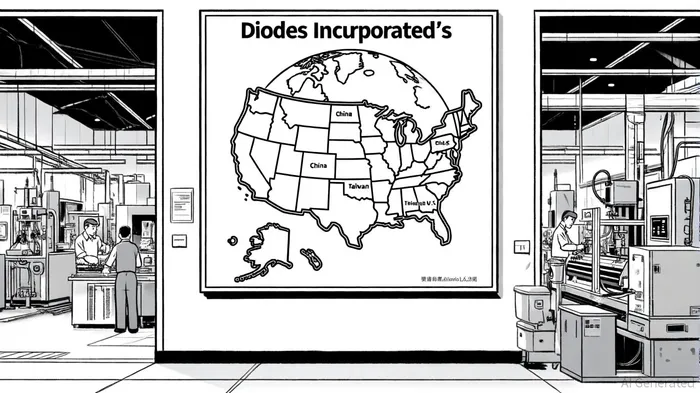
Diodes' ability to deliver consistent growth stems from its hybrid manufacturing model, which combines internal fabrication facilities in the U.S., China, Taiwan, and the U.K. with external foundry partnerships, as detailed in a Financial Times announcement. This approach mitigates regional supply chain risks while enabling flexible capacity allocation. For instance, the company's 2020 acquisition of Lite-On Semiconductor's automotive and industrial business has allowed it to capitalize on the EV boom, particularly in China, where demand for advanced driver-assistance systems (ADAS) and power management solutions is accelerating, according to a growth strategy analysis.
Moreover, DiodesDIOD-- has prioritized AI-enhanced forecasting and second-source qualification for critical raw materials, as noted in a SWOT analysis, reducing exposure to volatility in global logistics. These efforts align with broader industry trends: the semiconductor sector is projected to generate $697 billion in sales in 2025, with AI chips alone accounting for over 20% of this growth, per the Deloitte outlook. By focusing on energy-efficient, high-performance semiconductors for AI servers and EVs, Diodes is not only capturing market share but also future-proofing its revenue streams.
Investment in Innovation: Fueling Long-Term Growth
Beyond operational resilience, Diodes is investing heavily in R&D to address emerging demand. Its focus on power management solutions, sensor interface technologies, and IoT integration, as discussed in the Baird conference transcript, positions it to benefit from the industrial automation and smart infrastructure waves. For example, the company's expanded fab utilization and product qualification efforts, according to a BeyondSPX release, are expected to drive margin expansion as it scales production of advanced analog and mixed-signal components.
These innovations are particularly relevant in a market where customers increasingly prioritize partners with end-to-end capabilities. Diodes' strategic partnerships with industrial IoT platform providers, as noted in a Databridge whitepaper, further underscore its commitment to ecosystem-driven growth, ensuring alignment with the evolving needs of automotive and industrial clients.
Risks and Considerations
While Diodes' positioning is robust, investors should remain cognizant of macroeconomic headwinds, including potential slowdowns in consumer electronics demand and geopolitical tensions affecting trade flows. However, the company's focus on industrial and automotive markets-sectors with more stable growth profiles-mitigates these risks. Additionally, its hybrid model and geographic diversification provide a buffer against regional disruptions, a critical advantage in an industry still reeling from the 2020–2023 supply chain crisis.
Conclusion: A Model of Strategic Agility
Diodes Incorporated's Q3 2025 earnings outlook reflects a company that has mastered the art of balancing short-term execution with long-term strategic vision. By leveraging its hybrid manufacturing model, expanding into high-growth sectors, and investing in innovation, Diodes is not only navigating the current semiconductor landscape but also shaping its future. For investors, the company's disciplined approach to supply chain resilience and margin management offers a compelling case for inclusion in portfolios targeting the next phase of the AI and EV revolutions.





Comentarios
Aún no hay comentarios