
Dime Community Bancshares' Dividend Strategy: A Balancing Act Between Investor Confidence and Financial Sustainability
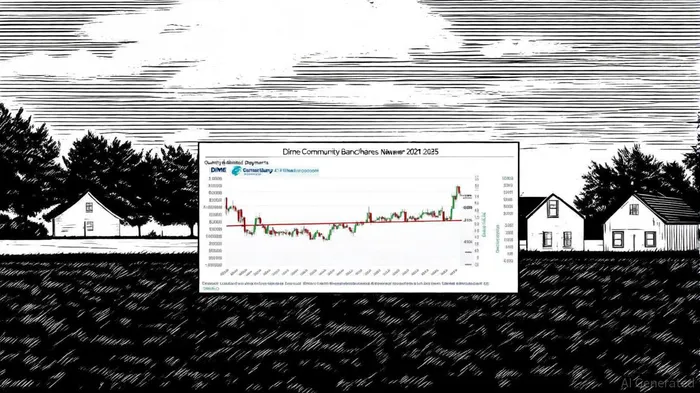
Dime Community Bancshares (NASDAQ: DCOM) has long been a fixture in the dividend-paying banking sector, with its latest quarterly payout of $0.25 per share—declared on September 23, 2025 and payable October 24, 2025—continuing a 29-year streak of uninterrupted dividends[1]. This consistency, coupled with a current yield of 3.23%, has positioned DCOMDCOM-- as a compelling option for income-focused investors. Yet, beneath the surface of this seemingly robust dividend policy lies a nuanced interplay of financial health, market expectations, and sustainability risks that warrant closer scrutiny.
Dividend Consistency and Investor Confidence
Dime's unwavering commitment to shareholder returns has clearly bolstered investor confidence. According to a report by KBW, the firm reiterated an “Outperform” rating for DCOM in September 2025, citing its strategic expansion in commercial lending and leadership under Tom Geisel[2]. This confidence is further reinforced by historical performance: DCOM's stock surged 24.04% over the past 12 months, outpacing many regional banks[3]. Analysts project a 51.3% upside potential, with a consensus price target of $29.25 compared to its current $19.33 price[4].
The dividend itself, while modest in growth (a 1.37% average annual increase over three years[5]), has become a cornerstone of Dime's appeal. For context, the company's payout ratio—while contentious—has been reported at 169.5% based on trailing earnings[6], a figure that raises eyebrows. However, this stark number contrasts with a more sustainable 39.06% payout ratio based on Q2 2025 operating cash flow, which rose 104% year-over-year[7]. This duality underscores the importance of methodology in assessing dividend sustainability.
Financial Health and Analyst Optimism
Dime's financials tell a story of resilience. In Q2 2025, the bank exceeded earnings expectations, reporting $0.64 per share versus $0.63 forecast[8]. Projected return on tangible common equity (ROTCE) of 13.5% in 2026—nearing the peer median of 14.0%—suggests improving efficiency[9]. Meanwhile, its P/E ratio of 5.45 is significantly below both sector and market averages, hinting at undervaluation[10].
Analysts appear to share this optimism. KBW's $36 price target implies a 86% upside from current levels, driven by Dime's commercial lending expansion and cost discipline[11]. Additionally, the bank's liquidity and capital position—bolstered by a $88.5 million cash flow surge in H1 2025—provide a buffer against near-term risks[12].
The Payout Ratio Paradox: Earnings vs. Cash Flow
The most contentious issue in Dime's dividend analysis is its payout ratio. While some sources cite a 169.5% earnings-based ratio[13], others highlight a 105.62% trailing twelve-month (TTM) figure[14]. These numbers, far exceeding the Financial Services sector average of 44.8%, suggest a precarious balance between rewarding shareholders and retaining earnings for growth[15].
However, cash flow metrics paint a rosier picture. The 39.06% Q2 2025 payout ratio, combined with a 104% year-over-year cash flow increase, indicates that Dime's dividends are underpinned by robust operational performance[16]. This divergence highlights a critical nuance: earnings-based ratios can be misleading for banks, where non-cash items (e.g., loan loss provisions) heavily influence reported profits.
Long-Term Value: Risks and Rewards
For long-term investors, Dime's dividend strategy presents both opportunities and risks. On the one hand, its 29-year streak of uninterrupted payouts and community-focused initiatives (e.g., the McCarren 5K charity event[17]) enhance its appeal as a socially responsible investment. On the other, the high earnings-based payout ratio raises concerns about vulnerability to economic downturns or interest rate volatility.
KBW's “Outperform” rating and Dime's projected ROTCE improvements suggest management is navigating these challenges effectively[18]. Yet, investors must remain vigilant. A prolonged economic slowdown could strain Dime's ability to maintain its dividend, particularly if loan defaults rise or interest margins compress.
Conclusion: A Dividend Powerhouse with Caveats
Dime Community Bancshares' dividend policy is a double-edged sword. Its consistency and yield have solidified investor confidence, supported by strong cash flow and strategic growth. However, the high earnings-based payout ratio necessitates a closer look at the quality of its earnings and liquidity reserves. For those willing to accept the risks, DCOM offers a compelling blend of income and growth potential. But for risk-averse investors, the bank's reliance on cash flow rather than earnings to fund dividends may warrant caution.
In the end, Dime's story is a reminder that dividend investing is not just about yield—it's about understanding the financial architecture behind the payout.





Comentarios
Aún no hay comentarios