
DIH Holding US, Inc. and the Nasdaq Delisting Dilemma: A Deep Dive into Compliance and Market Readiness
The Compliance Crisis: A Perfect Storm of Rules
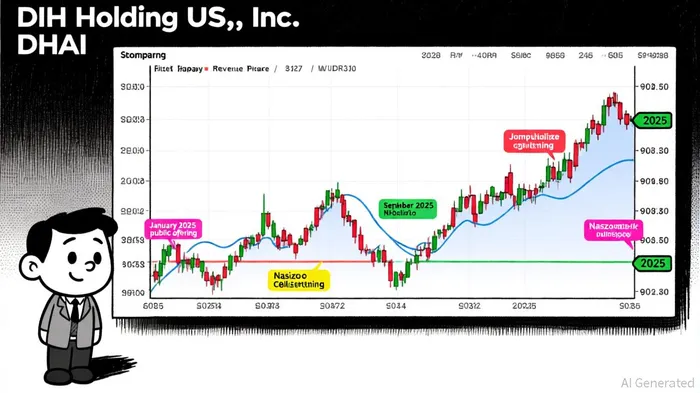
DIH Holding US, Inc. (NASDAQ: DHAI) now faces a critical juncture after receiving a Nasdaq Staff Determination to delist its shares due to repeated violations of listing requirements. According to a report by Nasdaq, the company has failed to meet the Market Value of Listed Securities (MVLS) Rule (minimum $50 million market cap) and the Bid Price Rule (minimum $1.00 per share) for continued listing on the Nasdaq Global Market [1]. These deficiencies were first flagged in March 2025, with a 180-day compliance window that expired without resolution [2].
Compounding the issue, DIHDHAI-- also missed filing deadlines for its Form 10-Q (Q2 2025) and Form 10-K (FY 2024), triggering a Reports Rule violation under Nasdaq Listing Rule 5250(c)(1) [3]. The company has until September 29, 2025, to submit a compliance plan, with potential extensions of up to 360 days for the Reports Rule [4].
The Company's Response: A High-Stakes Hearing
DIH has requested a hearing before the Nasdaq Hearing Panel to appeal the delisting decision and seek additional time to regain compliance. During the hearing, the company plans to present a strategy to address the MVLS, Bid Price, and Reports Rules [5]. While the Panel may grant up to 180 days for the MVLS and Bid Price Rules, there is no guarantee of approval [6].
The company's recent financial performance offers a glimmer of hope. In Q2 2025, DIH reported a 39% year-over-year revenue increase to $18.2 million, with device revenue growing 49% to $15.0 million [7]. However, these operational gains have not translated into improved stock price or market capitalization. As of September 2025, the stock trades well below $1.00, and the company's market cap remains far below the $50 million threshold [8].
The $4.6 Million Public Offering: A Double-Edged Sword
In January 2025, DIH raised $4.6 million through a public offering of 5,937,100 units, with each unit consisting of one share of Class A common stock and a warrant to purchase an additional share [9]. The company stated that proceeds would be allocated to capital expenditures, working capital, and general corporate purposes [10]. However, no specific strategies were disclosed to directly address the MVLS or Bid Price Rules. For example, the funds could be used for share buybacks to boost the stock price or liquidity improvements to increase market capitalization, but such plans were not outlined in the offering materials [11].
This lack of clarity raises concerns. While the offering provided much-needed capital, it does not appear to have been tailored to resolve the immediate compliance issues. As noted by Bloomberg, DIH's failure to link the public offering to its Nasdaq compliance strategy underscores the company's precarious position [12].
Market Readiness: A Question of Execution
DIH's ability to regain compliance hinges on its capacity to execute a multi-pronged strategy. First, the company must file its delinquent financial reports to address the Reports Rule violation. Second, it needs to raise the stock price above $1.00 and increase market capitalization to $50 million. This could involve a combination of operational improvements (e.g., revenue growth, margin expansion), capital structure adjustments (e.g., buybacks, debt financing), and strategic partnerships.
However, the timeline is extremely tight. Even if the Nasdaq Hearing Panel grants an extension, DIH will need to demonstrate rapid progress. For context, the company's Q2 2025 gross margin improved to 52.6% [13], but this alone is insufficient to bridge the gap between its current market cap and the $50 million threshold.
Investor Implications: High Risk, High Uncertainty
For investors, DIH's situation presents a high-risk scenario. The company's operational performance is strong, but its regulatory and compliance challenges could lead to delisting, which would severely limit liquidity and investor access. As stated by Reuters, delisted stocks often trade on over-the-counter (OTC) markets at a significant discount, further eroding shareholder value [14].
The outcome of the Nasdaq Hearing Panel's decision on September 29, 2025, will be pivotal. If the Panel denies the extension or DIH fails to meet revised deadlines, the company may face delisting by late 2025. Conversely, a favorable ruling could provide a lifeline, allowing DIH to focus on long-term growth while addressing compliance requirements.
Conclusion: A Race Against Time
DIH Holding US, Inc. is in a race against time to avoid delisting. While its recent public offering and Q2 2025 financial results demonstrate operational resilience, the company must now pivot to address regulatory requirements. The absence of a clear compliance strategy tied to the $4.6 million raise raises red flags, and the upcoming Nasdaq Hearing Panel decision will be a critical inflection pointIPCX--. Investors should closely monitor DIH's ability to execute its compliance plan and the Panel's response, as the stakes for the company—and its shareholders—have never been higher.





Comentarios
Aún no hay comentarios