
DigitalOcean's Strategic Position in the Cloud Infrastructure Market
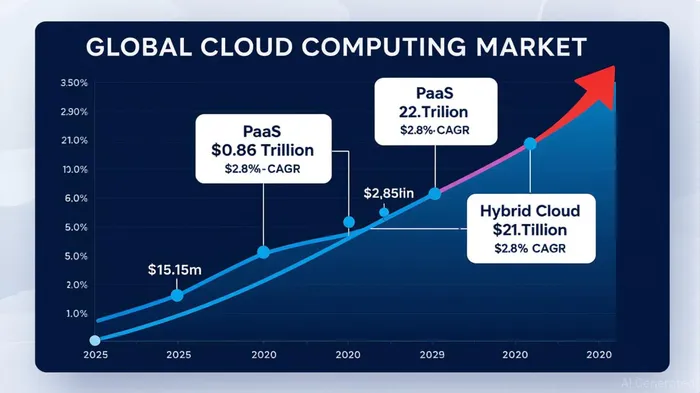
DigitalOcean (DOCN) has long positioned itself as a developer-centric alternative to the sprawling, complex ecosystems of AmazonAMZN-- Web Services (AWS) and MicrosoftMSFT-- Azure. As the cloud infrastructure market enters a pivotal phase of growth post-2025, the company's strategic focus on AI, enterprise expansion, and operational efficiency offers a compelling case for investors. With the global cloud computing market projected to surge from $0.86 trillion in 2025 to $2.26 trillion by 2030[1], DigitalOcean's ability to balance simplicity with scalability will determine its success in capturing a meaningful share of this expanding pie.
Market Growth and Strategic Alignment
The cloud infrastructure sector is being reshaped by two megatrends: the proliferation of generative AI workloads and the rise of hybrid cloud adoption. According to a report by Mordor Intelligence, the global cloud computing market is expected to grow at a robust pace, driven by SaaS adoption and AI-driven compute demands[1]. Specifically, Platform-as-a-Service (PaaS) is forecasted to compound at 23.2% annually from 2025 to 2030, as enterprises seek tools to accelerate application development and integrate AI capabilities[1]. DigitalOcean's recent investments in AI infrastructure, including its Atlanta data center expansion to support high-growth inferencing workloads[4], align directly with this trajectory.
The company's Q1 2025 results underscore its momentum: revenue reached $211 million, reflecting 14% year-over-year growth[3], with enterprise-focused customers contributing 41% more revenue compared to the prior year[4]. This shift toward larger clients—those spending over $100,000 annually—demonstrates DigitalOcean's capacity to scale beyond its traditional base of startups and SMEs.
Competitive Differentiation: Simplicity and Developer Experience
DigitalOcean's core strength lies in its ability to simplify cloud infrastructure. While AWS and Azure offer vast but complex toolkits, DigitalOceanDOCN-- has carved a niche by prioritizing developer experience through intuitive interfaces, transparent pricing, and streamlined workflows[5]. This approach resonates with SMEs and startups, which constitute a significant portion of the $78.30 billion application hosting market expected to grow at 12.7% CAGR through 2030[5].
The company's financial discipline further enhances its appeal. With gross margins of 61% and EBITDA margins of 41%[4], DigitalOcean maintains a lean cost structure that supports reinvestment in AI and hybrid cloud capabilities. Its $360 million cash balance[4] provides flexibility to fund expansions or strategic acquisitions, a critical advantage in a sector where capital intensity is rising.
Navigating Challenges and Emerging Opportunities
Despite its strengths, DigitalOcean faces headwinds. The dominance of AWS and Azure in the enterprise space, coupled with the growing demand for hybrid cloud solutions, necessitates a strategic pivot. The hybrid cloud market, projected to grow at 22.8% CAGR[1], requires providers to offer seamless integration between public and private environments. DigitalOcean's recent focus on flexible deployment options[1] positions it to capitalize on this trend, particularly as enterprises prioritize data sovereignty and compliance.
Another key challenge is vendor lock-in. As enterprises seek to avoid dependency on proprietary ecosystems, DigitalOcean's commitment to open standards and portability tools[2] could become a differentiator. By enabling easier migration and interoperability, the company can attract clients wary of being trapped in AWS or Azure's ecosystems.
Conclusion: A Positioned for Long-Term Growth
DigitalOcean's strategic alignment with AI and enterprise expansion, combined with its developer-friendly ethos, positions it as a formidable player in the post-2025 cloud landscape. While the market remains dominated by giants, the company's focus on simplicity, affordability, and operational efficiency offers a clear path to differentiation. For investors, the key metrics to watch are its ability to sustain enterprise revenue growth, expand into hybrid cloud offerings, and maintain its margins amid rising competition.
As the cloud infrastructure market evolves, DigitalOcean's agility and developer-centric approach may prove to be its greatest assets.





Comentarios
Aún no hay comentarios