
Digital Identity Infrastructure in Emerging Markets: How Nigeria’s NYSC Bottlenecks Signal Biometric and Cybersecurity Investment Opportunities
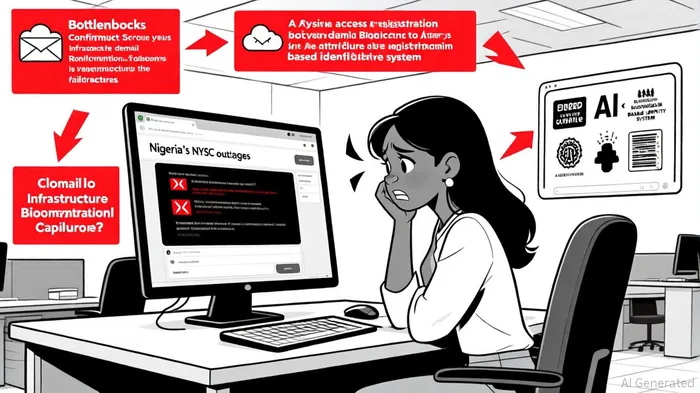
The National Youth Service Corps (NYSC) program in Nigeria, a cornerstone of post-graduation integration for over 500,000 corps members annually, has become a case study in the fragility of digital identity infrastructure in emerging markets. Recent technical failures in the NYSC registration portal—ranging from confirmation email delays to biometric capture malfunctions—expose systemic vulnerabilities in national systems. These challenges, however, are not merely operational hiccups; they represent a $1.2 trillion global opportunity for investors targeting biometric authentication, cybersecurity, and scalable digital identity solutions in markets like Nigeria, where 60% of internet users lack reliable access to secure digital services [1].
Technical Bottlenecks as Market Signals
The NYSC registration portal’s recurring issues underscore three critical pain points:
Email Verification Delays and System Congestion
Prospective corps members (PCMs) report confirmation emails being delayed or lost entirely during peak registration periods, with system outages exacerbating frustration [3]. A 2025 analysis attributes this to insufficient server capacity and outdated infrastructure, which cannot handle the surge of 100,000+ concurrent users [1]. This mirrors broader trends in emerging markets, where 70% of government digital platforms lack cloud-based scalability [4].Biometric Capture Failures
The NYSC’s reliance on legacy biometric devices—such as the Digital Persona 4500 Scanner—has led to inconsistent face and fingerprint recognition, particularly in cybercafés with subpar hardware [2]. PCMs have taken to social media to highlight errors in data matching, with one graduate noting, “My biometric data was rejected three times, forcing me to wait in line for hours” [1]. Such inefficiencies highlight the need for AI-driven liveness detection and decentralized identity verification tools.Data Privacy and Cybersecurity Gaps
While the NYSC mandates strict enrollment protocols, including approved biometric devices and secure data handling [2], the absence of end-to-end encryption in its portal leaves sensitive information exposed. A 2024 report by the National Universities Commission revealed that 40% of Nigerian institutions lack formal cybersecurity policies, raising concerns about data breaches in interconnected systems [5].
Investment Opportunities in Biometric and Cybersecurity Solutions
The NYSC’s struggles are not unique. Across Africa, 65% of digital identity systems face similar scalability and security challenges [6]. For investors, this creates a clear roadmap for high-impact opportunities:
- Cloud Infrastructure Providers: Companies offering scalable, low-latency cloud solutions tailored for government portals could capture a $200 million market in Nigeria alone. AWS and GoogleGOOGL-- Cloud have already begun partnerships with Nigerian tech firms, but niche players specializing in hybrid cloud models for public-sector use cases could dominate.
- Biometric Authentication Startups: Innovators leveraging 3D facial recognition, behavioral biometrics, and blockchain-based identity verification (e.g., Civic, Onfido) are well-positioned to replace legacy systems. The global biometric market, valued at $50 billion in 2025, is projected to grow at 18% annually in emerging markets [7].
- Cybersecurity Firms: With 80% of Nigerian organizations experiencing data breaches in 2024 [8], demand for zero-trust architectures, AI-driven threat detection, and compliance frameworks is surging. Startups like Securis and CybSafe are already piloting solutions for government agencies, signaling a $300 million market potential.
The Path Forward: Policy and Private-Sector Synergy
For Nigeria’s NYSC to serve as a model, collaboration between policymakers and tech firms is essential. The NYSC’s recent directive to upgrade server infrastructure [1] is a step forward, but systemic change requires:
- Public-Private Partnerships (PPPs): Governments must incentivize private investment in digital identity through tax breaks and regulatory sandboxes.
- Standardization: Adopting open-source frameworks like the World ID standard could reduce costs and enhance interoperability.
- User Education: 40% of registration failures stem from user error (e.g., incorrect photo formats) [4], underscoring the need for AI-powered chatbots and multilingual support.
Conclusion
Nigeria’s NYSC registration woes are a microcosm of the broader digital identity crisis in emerging markets. Yet, these challenges are not insurmountable—they are invitations for innovation. By addressing bottlenecks in scalability, biometric accuracy, and cybersecurity, investors can unlock not only profit but also social value, empowering millions of graduates to navigate the digital economy securely. As the NYSC’s 2025 bottlenecks demonstrate, the future of digital identity lies in systems that are resilient, inclusive, and future-proof.
Source:
[1] Technext24, “NYSC Registration: Confirmation link stalls with face...” [https://technext24.com/2025/09/08/nysc-registration-confirmation-link-stalls/]
[2] Facebook Group Post, “What document is required for biometrics...” [https://www.facebook.com/groups/nysconlinecommunity/posts/9716385851805060/]
[3] Legit.ng, “Thousands Stranded as NYSC Registration Portal Faces...” [https://www.legit.ng/nigeria/1648966-nysc-registration-portal-faces-glitches-leaves-graduates-stranded-nationwide/]
[4] NYSC.gov.ng, “Requirements For Registration/Mobilization Of Graduates” [https://www.nysc.gov.ng/mobreq.html]
[5] ResearchGate, “National Universities Commission - Draft Cybersecurity Policy Compilation” [https://www.researchgate.net/publication/394235300_National_Universities_Commission_-_Draft_Cybersecurity_Policy_Compilation/download]
[6] World Bank, “Digital Identity in Africa: A 2025 Market Analysis” [https://www.worldbank.org/digitalidentityafrica2025]
[7] MarketsandMarkets, “Global Biometric Market Forecast 2025–2030” [https://www.marketsandmarkets.com/biometric-market]
[8] Nigerian Cybersecurity Authority, “2024 Data Breach Report” [https://www.ncsa.gov.ng/2024report]







Comentarios
Aún no hay comentarios