
Digital Gold vs. Meme-Driven Volatility: Assessing Bitcoin and Dogecoin for 2026
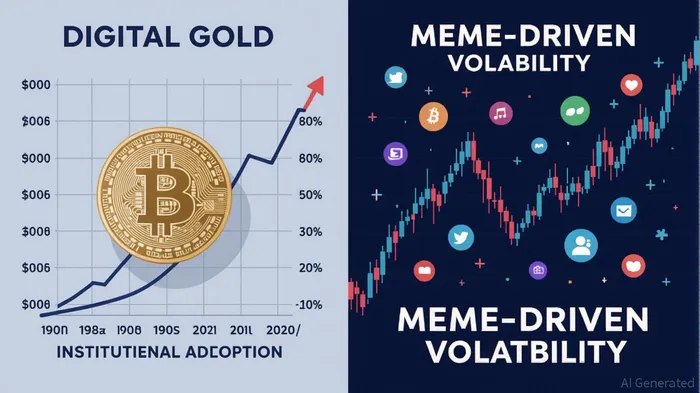
In 2026, the cryptocurrency landscape is defined by a stark dichotomy: Bitcoin's emergence as a cornerstone of institutional portfolios and Dogecoin's continued reliance on speculative fervor. As the year unfolds, the contrast between these two assets—digital gold versus meme-driven volatility—has never been more pronounced. This analysis examines how institutional adoption and speculative momentum have evolved since 2025, offering insights for investors navigating this polarized market.
Bitcoin: From Speculation to Infrastructure
Bitcoin's institutional adoption has reached a tipping point. By Q2 2025, institutions held over 410,000 BTC through ETFs, a 33% increase from Q1, with nearly 2,000 institutions reporting holdings via 13F filings [1]. Prominent allocators like Harvard Management Company and Soros Capital Management have cemented Bitcoin's role as a legitimate store of value. The approval of U.S. spot BitcoinBTC-- ETFs in early 2024 has further normalized its inclusion in traditional portfolios, with platforms like BitDa growing 400% YoY by offering institutional-grade compliance [3].
Bitcoin's volatility has also stabilized. Its 30-day rolling volatility now mirrors that of the S&P 500 and gold, a shift attributed to ETF-driven liquidity and institutional-grade custody solutions [2]. This transformation has reclassified Bitcoin from a speculative asset to a strategic one, with institutions allocating 1–5% of total assets to hedge against macroeconomic risks [3]. By 2026, Bitcoin's price trajectory—projected to reach $150,000–$200,000—reflects its growing acceptance as infrastructure within the financial system [4].
Dogecoin: The MemeMEME-- Coin Paradox
Dogecoin, by contrast, remains a product of retail speculation and social media hype. In 2025, the hashtag #dogecoin generated 11.2 billion views, with price surges often triggered by celebrity endorsements, such as Elon Musk's integration of DOGEDOGE-- into X's platform [5]. While institutional interest is nascent—Bit Origin allocated $500 million to a DOGE treasury and the CFTC reclassified it as a commodity—the asset's volatility persists, with daily swings of 8.23% in Q2 2025 [5].
The pending approval of a 21Shares DOGE ETF has introduced a glimmer of institutional credibility, but Dogecoin's fundamentals remain weak. Its unlimited supply and lack of native governance or DeFi tools make it vulnerable to newer altcoins like Layer Brett, which offer yield staking and decentralized finance utilities [5]. Analysts project a 2026 price range of $0.25–$0.60, contingent on macroeconomic conditions and social media sentiment [6]. However, bearish scenarios warn of a potential drop to $0.13 if speculative momentum wanes [5].
2026 Projections: Institutional Adoption vs. Speculative Momentum
By 2026, Bitcoin's institutional adoption is expected to outpace speculative momentum entirely. With spot ETFs now mainstream and central banks exploring Bitcoin as treasury collateral, its role as a macro hedge and settlement layer is entrenched [2]. Analysts like Cathie Wood and Michael Saylor have set audacious price targets, with Bitcoin potentially reaching $3.8 million by 2030 [6].
Dogecoin, meanwhile, faces an uncertain future. While its brand power and payment use cases (e.g., tipping ecosystems) provide a floor, its reliance on retail-driven narratives leaves it exposed to market corrections. The approval of a DOGE ETF could temporarily boost liquidity, but without structural improvements to its utility, DogecoinDOGE-- will likely remain a high-risk, high-reward asset [6].
Investment Implications
For investors, the choice between Bitcoin and Dogecoin hinges on risk tolerance and time horizon. Bitcoin's institutional adoption and reduced volatility make it a compelling addition to diversified portfolios, with allocation ranges of 1–5% recommended for growth-oriented investors [4]. Dogecoin, conversely, should be treated as a speculative bet, suitable for those with a high-risk appetite and a short-term focus on social media-driven rallies.
A balanced approach might involve pairing Bitcoin's stability with Dogecoin's potential for outsized gains, though this requires rigorous risk management. As one analyst notes, “Bitcoin is infrastructure; Dogecoin is entertainment. The former is for building portfolios, the latter for testing patience” [5].






Comentarios
Aún no hay comentarios