
Digital Currency and Geopolitical Influence: How Political Leaders Shape Market Dynamics and Investment Strategies
The intersection of digital currency and geopolitics has become a defining feature of the 21st-century financial landscape. High-profile political figures—from U.S. presidents to Chinese Communist Party leaders—have wielded unprecedented influence over crypto markets, shaping regulatory frameworks, investor sentiment, and global monetary strategies. This analysis explores how political decisions and narratives have driven digital currency adoption, volatility, and institutional integration, offering insights for investors navigating this complex terrain.
The U.S. and the TrumpTRUMP-- Administration's Pro-Crypto Pivot
The Trump administration's embrace of digital assets from 2020 to 2025 marked a seismic shift in U.S. policy. By appointing pro-crypto SEC chair Paul Atkins and introducing the Genius Act—a bill aimed at streamlining crypto regulation—Washington signaled a stark departure from earlier skepticism. These moves catalyzed Bitcoin's record-breaking surge to $109,140 in January 2025, driven by anticipation of favorable policies[3]. The administration's creation of a Strategic BitcoinBTC-- Reserve and a Digital Asset Stockpile further underscored its strategic repositioning of U.S. monetary policy[2].
Politically themed memecoins, such as $TRUMP and $MELANIA, exemplified how political narratives could directly energize retail investors. However, critics warned of regulatory ambiguity and conflicts of interest, as the administration's crypto ventures blurred governance and personal financial gain[2]. Meanwhile, institutional adoption accelerated, with ETF approvals and AI-powered smart contracts integrating crypto into mainstream finance[3].
China's Digital Yuan: A Geopolitical Counterweight
China's digital yuan (e-CNY), launched in 2020, has emerged as a strategic tool to challenge U.S. dollar dominance. Under President Xi Jinping and PBOC Governor Pan Gongsheng, the e-CNY expanded to 29 pilot cities by 2025, with cumulative transactions reaching $7.3 trillion and 180 million wallets created[1]. The CCP positions the e-CNY as a means to modernize its financial system, counter decentralized cryptocurrencies, and reduce reliance on private payment giants like Alipay[4].
Globally, the e-CNY is central to China's vision of a multipolar monetary system. Plans for a Shanghai-based international operation center and cross-border BRICS payments highlight its geopolitical ambitions[5]. Yet, adoption is constrained by China's capital controls and limited financial openness, which deter international investors[2]. Despite these hurdles, the e-CNY remains a key asset in Beijing's broader economic strategy.
The EU's Digital Euro: Privacy, Autonomy, and Strategic Sovereignty
The European Union's digital euro initiative, led by ECB President Christine Lagarde, aims to preserve monetary sovereignty amid rising private digital payment solutions. By 2025, the ECB had advanced the digital euro's preparation phase, finalizing technology contracts and emphasizing high privacy standards[1]. Lagarde has framed the digital euro as a complement to cash, addressing declining physical currency use and foreign payment dependencies[2].
The project also seeks to counter the influence of stablecoins and U.S.-dominated global finance. By fostering a competitive European payment ecosystem, the EU aims to enhance strategic autonomy while balancing privacy, financial inclusion, and market fragmentation challenges[4].
Global Tensions and Alternative Digital Currencies
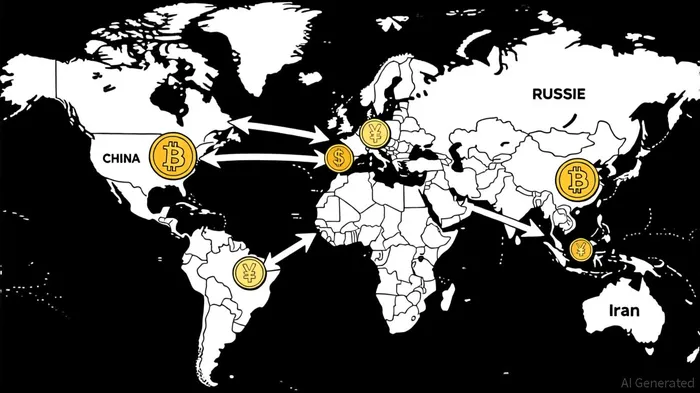
Beyond the U.S. and China, geopolitical tensions have spurred alternative digital currency strategies. Russia and Iran's collaboration on a gold-backed stablecoin reflects a broader de-dollarization effort[5]. Similarly, countries like Argentina, Venezuela, and Zimbabwe have turned to crypto to hedge against hyperinflation and sanctions[5].
High-profile political events, such as Trump's pardon of Silk Road founder Ross Ulbricht, have also shaped market sentiment. Such actions raise reputational risks for crypto, potentially deterring institutional investors[4]. Meanwhile, figures like Elon Musk continue to amplify market volatility through public statements[4].
Risks and the Road Ahead
While political influence has accelerated digital currency adoption, risks persist. Regulatory fragmentation, cybersecurity threats, and geopolitical rivalries could destabilize long-term growth[1]. Investors must weigh these factors against the potential for innovation, particularly in AI-driven smart contracts and cross-border CBDC collaborations.
Conclusion
Digital currency markets are increasingly shaped by the interplay of political ambition and technological innovation. From Trump's pro-crypto policies to China's e-CNY and the EU's digital euro, leaders are redefining global finance. For investors, understanding these dynamics is critical to navigating volatility and identifying opportunities in a rapidly evolving landscape.






Comentarios
Aún no hay comentarios