
Digital Asset Fund Outflows and Crypto Market Stability: Navigating Macroeconomic Risk-Off Sentiment in Q3 2025
The crypto market in Q3 2025 has been a study in contrasts. While institutional adoption of digital assets continues to grow-83% of institutional investors plan to increase allocations in 2025, according to an EY report-the past quarter has seen a wave of outflows from BitcoinBTC-- and EthereumETH-- ETFs, driven by macroeconomic risk-off sentiment. These outflows, totaling over $1.1 billion in late September alone, were highlighted in a FinancialContent article, and have raised critical questions about market stability, investor behavior, and the interplay between traditional and digital asset classes.
Macroeconomic Headwinds and Risk-Off Sentiment
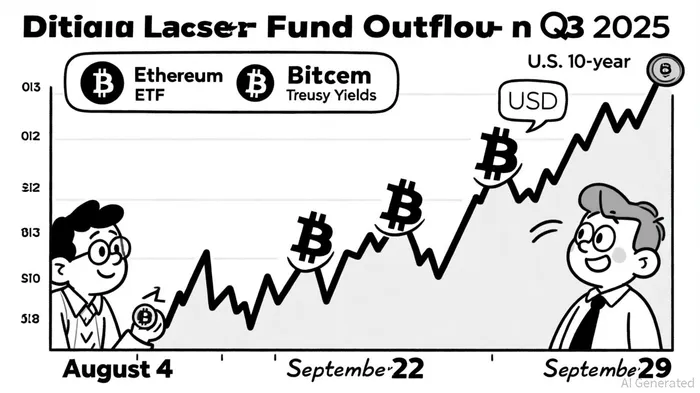
The Federal Reserve's hawkish stance and rising Treasury yields have been central to the risk-off environment. By September 2025, the U.S. 10-year yield had climbed to 4.7%, up from 4.2% in early August, the FinancialContent article noted, signaling investor flight to safety. This shift has directly impacted digital assets, which remain highly sensitive to interest rate expectations.
According to the FinancialContent article, U.S. Bitcoin spot ETFs recorded a net redemption of $363.17 million on September 22, while Ethereum ETFs saw $75.95 million in withdrawals. These figures follow similar outflows in August ($223 million) and reflect institutional caution amid tightening monetary policy. The broader market response has been a reallocation of capital to traditional safe-haven assets, exacerbating crypto's underperformance, as discussed in the EY report.
Mechanisms of Market Destabilization
The outflows have triggered a cascade of destabilizing effects. First, price volatility has spiked. For example, Ethereum's price dropped below $4,000 in late September as ETF outflows reached $800 million, with Fidelity's Ethereum ETF losing $362 million and BlackRock's shedding $200 million, according to the FinancialContent article. Second, liquidity constraints have emerged, particularly in ETFs perceived as less liquid. Fidelity's Bitcoin ETF, for instance, faced $903 million in outflows during the last week of September, compared to inflows into BlackRock's product, highlighting a shift toward products with stronger institutional backing.
Third, investor behavior has shifted dramatically. Retail and institutional investors alike are now prioritizing risk mitigation. A deleveraging event in late September forced liquidations of leveraged positions, further pressuring prices, the FinancialContent article reported. This has led to a re-evaluation of strategies across the crypto ecosystem, with Bitcoin miners and exchanges recalibrating liquidity positions.
Institutional Caution vs. Long-Term Optimism
Despite the short-term turbulence, the long-term narrative for digital assets remains intact. Year-to-date inflows into Bitcoin ETFs stand at $20 billion, the EY report notes, underscoring sustained demand. Moreover, institutional enthusiasm is undeterred: 83% of investors plan to boost allocations in 2025, driven by diversification needs and inflation hedging, as the EY report describes.
However, regulatory clarity remains a critical bottleneck. Investors are closely watching the U.S. President's working group on digital assets and the EU's MiCA framework, and the EY report suggests that until these frameworks provide certainty, macroeconomic volatility will continue to amplify short-term outflows.
Strategic Implications for Investors
For investors, the Q3 outflows highlight the importance of portfolio resilience. While digital assets offer compelling long-term value, their correlation with macroeconomic cycles necessitates hedging strategies. Diversification across asset classes and a focus on liquid ETFs (e.g., those with strong institutional backing) can mitigate risk-off impacts, as the FinancialContent article emphasizes.
Additionally, the current environment underscores the need to monitor regulatory developments. The finalization of U.S. and EU policies could catalyze renewed inflows, provided macroeconomic conditions stabilize.





Comentarios
Aún no hay comentarios