
DHT Holdings: Navigating the Storm of US-China Port Fees and Emerging Trade Corridors
The U.S.-China trade war has entered a new phase with the simultaneous imposition of retaliatory port fees on each other's vessels, effective October 14, 2025. These measures, escalating annually until 2028, target the heart of global maritime logistics, with the U.S. charging $50–$140 per net ton on Chinese-built ships and China retaliating with 400–1,120 yuan ($56–$157) per net ton on U.S. vessels, according to AP News. For dry bulk shipping, the implications are profound, as carriers scramble to restructure fleets, reroute operations, and avoid financial exposure. DHT HoldingsDHT--, a major player in the sector, has emerged as a case study in strategic adaptation, offering insights into how companies can navigate-and potentially profit-from this volatile landscape.
DHT's Fleet Reconfiguration: A Proactive Defense Against Port Fees
DHT Holdings has taken decisive action to insulate itself from the U.S. port fee regime. By divesting its entire fleet of Chinese-built very large crude carriers (VLCCs)-including the DHTDHT-- Lotus and DHT Peony, sold for $55 million each-DHT eliminated its exposure to the U.S. fees, which could have imposed over $100 million per port call on a 300,000DWT vessel, according to MFAME. Replacing these with South Korean-built VLCCs, DHT has aligned its operations with U.S. trade policies while securing newbuilds from Hanwha Ocean and HD Hyundai Samho for 2026, as reported by PortNews. This shift not only avoids immediate financial penalties but also positions DHT to benefit from U.S. policy incentives aimed at revitalizing domestic shipbuilding, albeit indirectly.
The company's ownership structure further reinforces its resilience. As a Marshall Islands-incorporated entity with a fleet operating under non-U.S. flags, DHT is shielded from both U.S. and Chinese ownership-based fees, according to a DHT statement. U.S. shareholders hold less than 25% of its voting rights, minimizing regulatory scrutiny. This structural agility allows DHT to pivot quickly in response to geopolitical shifts-a critical advantage in an industry where route adjustments and fleet repositioning can cost billions.
Risks and Opportunities in a Fragmented Market
While DHT's strategy mitigates short-term risks, long-term challenges persist. The U.S. port fees are expected to cost the top ten global carriers up to $3.2 billion in 2026, Bloomberg reports. For DHT, the transition costs of selling Chinese-built vessels and acquiring newbuilds are offset by its focus on spot market operations and time charter contracts, which allow it to capitalize on rising tanker rates driven by global crude demand, according to DCFModeling. However, the company's reliance on South Korean shipyards exposes it to potential bottlenecks in construction timelines, a risk amplified by the surge in global demand for alternative shipbuilding capacity.
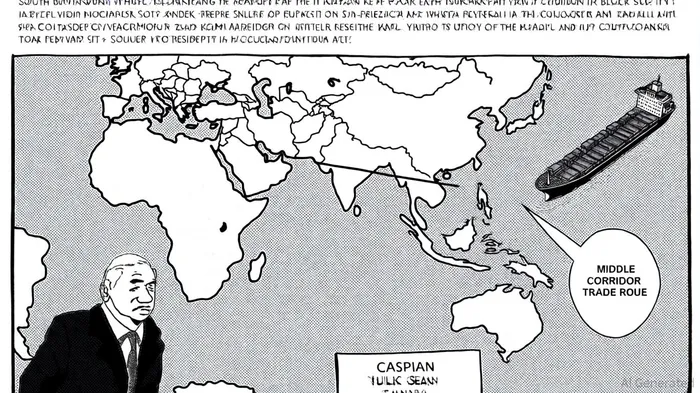
The broader industry is also grappling with route optimization. Carriers like the Premier Alliance have restructured transatlantic operations to exclude U.S. ports entirely, favoring Mediterranean routes, FullAvante reports. DHT, with its focus on crude oil transportation, may find opportunities in the Middle Corridor-a trade route connecting Asia to Europe via the Caucasus and Central Asia. This corridor, projected to handle 20% of overland trade between China and the EU by 2030, is gaining traction as an alternative to the Suez Canal and Northern Corridor, according to Georgia Today. DHT's fleet of 24 VLCCs is well-suited for long-haul crude shipments along this route, particularly as infrastructure upgrades in Georgia's Poti Port and Azerbaijan's Caspian terminals enhance efficiency, according to ShipUniverse.
Strategic Positioning for the Future
DHT's proactive approach underscores its potential to thrive in a fragmented global trade environment. By decoupling from Chinese-built vessels and aligning with U.S. policy goals, the company has minimized its exposure to retaliatory fees while maintaining operational flexibility. Its focus on the Middle Corridor and other emerging routes-such as the Trans-Pacific and Trans-Atlantic corridors with upgraded U.S. ports-positions it to capitalize on shifting trade patterns.
However, the company must remain vigilant. Geopolitical tensions, such as Red Sea disruptions and European port labor disputes, could undermine even the most well-planned strategies, according to the DHL Trade Atlas. Additionally, the long-term sustainability of the Middle Corridor depends on continued infrastructure investment and geopolitical stability in the Caucasus. DHT's ability to adapt to these variables will determine whether its current strategy translates into sustained profitability.
For investors, DHT represents a compelling case of strategic foresight in a high-stakes industry. While the U.S.-China port fees have created short-term volatility, they also highlight the importance of agility and diversification-qualities DHT has demonstrated through its fleet reconfiguration and route optimization. As global trade corridors evolve, companies that can navigate-and even exploit-these shifts will emerge as leaders in the post-trade-war era.





Comentarios
Aún no hay comentarios