
Deutsche Bank's Strategic Move into Evergreen Private Markets with Partners Group
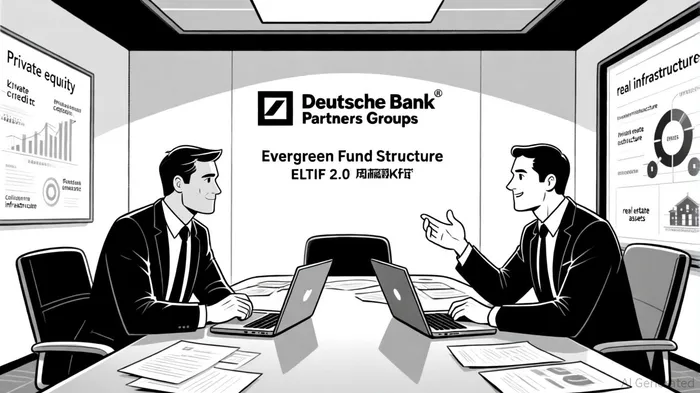
Deutsche Bank's recent partnership with Partners Group to launch its first evergreen private markets fund marks a significant strategic pivot in the European wealth management landscape. This initiative, structured under the ELTIF 2.0 regulatory framework, aims to democratize access to private assets for qualified private clients while leveraging Partners Group's institutional expertise in evergreen structures—a format the firm pioneered two decades ago [1]. The collaboration underscores a growing industry trend toward flexible, liquidity-friendly private market solutions, but its success hinges on Partners Group's proven ability to generate long-term alpha and Deutsche Bank's capacity to scale institutional credibility to retail-like clients.
Institutional Credibility: Partners Group's Track Record in Evergreen Structures
Partners Group, a global leader in private markets with $152 billion in assets under management (AUM) as of 2024, has established itself as a trusted steward of evergreen funds. The firm's expertise in this space dates back to 2001, when it first introduced the concept of perpetual, subscription-driven private market vehicles [2]. By 2024, evergreen strategies accounted for 32% of Partners Group's AUM, with $8.4 billion in new commitments—39% of the firm's total $22 billion in inflows for the year [3]. This growth trajectory reflects investor confidence in the firm's ability to navigate complex private market dynamics while maintaining transparency and governance standards.
The firm's credibility is further reinforced by its operational scale. Partners Group reported $18 billion in realizations in 2024, a 53% increase from 2023, demonstrating its capacity to execute exits and generate returns across diverse asset classes [4]. For Deutsche Bank's new fund, this translates to a portfolio manager with deep experience in balancing risk, diversification, and liquidity—a critical advantage in an evergreen structure where capital must be continuously reinvested to sustain returns.
Long-Term Alpha Generation: Advantages of Evergreen Structures
The evergreen format itself is a strategic tool for alpha generation. Unlike traditional closed-end private equity funds, which lock capital for 10+ years and face liquidity constraints, evergreen funds allow for periodic subscriptions and redemptions. This flexibility mitigates the J-curve effect—where returns are negative in early years—and enables immediate diversification across geographies, sectors, and strategies [5]. For Deutsche Bank's target clients, this means access to a “live” portfolio of private assets without the illiquidity typically associated with such investments.
Partners Group's evergreen funds also benefit from compounding mechanics. By reinvesting distributions efficiently, these vehicles can amplify returns over time. While specific net IRR figures for 2024 are not disclosed in available sources, the firm's performance fees of CHF 511 million in the year exceeded market forecasts, suggesting robust returns relative to benchmarks [6]. This aligns with the broader appeal of evergreen structures: they allow managers to deploy capital opportunistically, avoiding the rigid investment timelines of traditional funds.
Strategic Implications for Deutsche BankDB-- and Private Clients
Deutsche Bank's entry into this space is not without risks. The bank's Private Bank division, led by Claudio de Sanctis, faces the challenge of translating institutional-grade strategies into products suitable for private clients with lower minimum investments. However, the ELTIF 2.0 framework—designed to enhance liquidity and reduce regulatory friction—provides a structural advantage. By partnering with Partners Group, Deutsche Bank gains access to a firm that has already scaled evergreen solutions for institutional investors, including its flagship $17 billion US-focused Private Equity Master Fund and the $10 billion Global Value Sicav in Europe [7].
For clients, the fund's diversified approach—spanning private equity, credit, infrastructure, and real estate—offers a hedge against macroeconomic volatility. Partners Group's emphasis on cross-asset allocation and regional diversification further enhances resilience, a critical factor in an era of rising interest rates and geopolitical uncertainty.
Limitations and the Path Forward
While the partnership is well-positioned to capitalize on private markets' long-term growth, the absence of granular performance metrics (e.g., annualized returns, net IRR) for Partners Group's evergreen funds remains a gap. Investors must rely on proxy indicators such as AUM growth and realizations, which, while positive, do not fully capture alpha generation over cycles. Deutsche Bank and Partners Group will need to transparently communicate performance benchmarks post-launch to sustain client trust.
Conclusion
Deutsche Bank's collaboration with Partners Group represents a calculated bet on the future of private markets: flexible, liquidity-aware structures managed by institutions with deep expertise. By leveraging Partners Group's institutional credibility and evergreen innovation, the bank is poised to offer private clients a compelling alternative to traditional private equity. However, the fund's ultimate success will depend on its ability to deliver consistent alpha—a test that only time and transparent performance reporting can fully answer.





Comentarios
Aún no hay comentarios