
The DeSoc Stack: Oraichain, Pinlink, and RSS3 Redefine Web3 Social Media Ownership
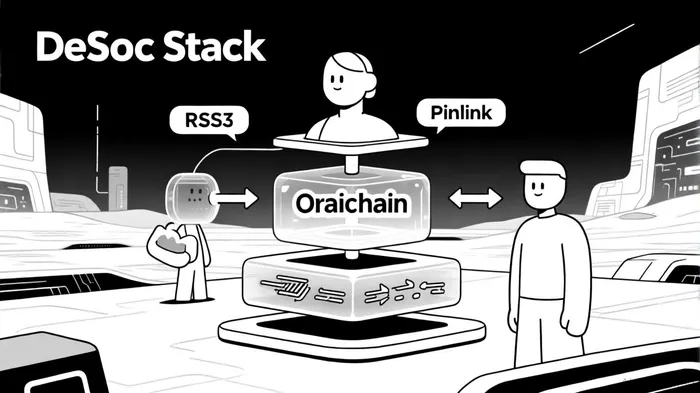
The evolution of Web3 is no longer about speculative tokens or NFT hype—it's about building infrastructure that redefines ownership, transparency, and resilience. At the forefront of this shift is the DeSoc Stack, a trio of protocols—Oraichain, Pinlink, and RSS3—that are collectively dismantling the centralized control of social media. By addressing the systemic flaws of Web2—platform lock-in, opaque algorithms, and fragile infrastructure—these projects are laying the groundwork for a user-owned, censorship-resistant social media ecosystem. For investors, this represents not just a technological revolution but a high-conviction opportunity to back the rails of the next internet era.
RSS3: The Decentralized Social Graph
At the foundation of the DeSoc Stack lies RSS3, a protocol designed to democratize social data. Traditional social media platforms hoard user connections, content, and identities, creating walled gardens that stifle innovation and lock users into ecosystems. RSS3 solves this by acting as an open information layer, indexing social activity across decentralized networks and enabling users to own and port their data freely. According to a report by Ambcrypto, RSS3's structured data framework allows developers to build cross-platform applications without relying on centralized APIs, effectively breaking the stranglehold of Web2 giants [1].
This portability is a game-changer. Imagine a user who curates a following on a decentralized platform like Mastodon or Lens Protocol. With RSS3, they can seamlessly migrate their social graph to a new app without losing followers, engagement history, or influence. For enterprises, this means access to real-time, decentralized insights on social trends and on-chain activities, enabling data-driven strategies without intermediaries [4].
Oraichain: Transparent AI for Content Curation
The second pillar of the DeSoc Stack is Oraichain, which introduces verifiable AI into the social media equation. Traditional platforms rely on opaque algorithms that prioritize engagement over authenticity, often amplifying misinformation or harmful content. Oraichain disrupts this by offering community-governed AI models for moderation, curation, and analytics. Users can choose from algorithmic feeds—such as "serendipity" or "trending"—powered by auditable AI, ensuring fairness and transparency [1].
This is more than theoretical. Oraichain's AI Layer 1 blockchain enables smart contracts to access and generate AI-driven data, creating a trust layer for decentralized applications. For instance, a social media platform built on Oraichain could use AI oracles to detect spam or hate speech while allowing users to verify the model's decisions. As stated by NewsBTC, Oraichain's collaboration with SyscoinSYS-- and its integration with ZK-Rollups further solidify its role as a scalable solution for AI-driven dApps [2].
Pinlink: Decentralized Infrastructure for Resilience
Even the best algorithms and data frameworks are meaningless without robust infrastructure. Enter Pinlink, the DeSoc Stack's decentralized hosting layer. By tokenizing real-world assets like GPUs and IoT devices, Pinlink creates a distributed marketplace for compute power and storage. This not only reduces costs for developers but also eliminates reliance on centralized cloud providers, a critical vulnerability in Web3 [5].
For example, a decentralized social media startup could leverage Pinlink's network to host user data across a global node network, ensuring censorship resistance and scalability. Meanwhile, enterprises with underutilized hardware—such as data centers or personal GPUs—can monetize their assets by contributing to the Pinlink ecosystem. As Ambcrypto highlights, partnerships with PlumePLUME-- Network and integrations with Aethir and Akash Network are already expanding Pinlink's utility, positioning it as a cornerstone of the DePIN (Decentralized Physical Infrastructure Network) movementMOVE-- [2].
Enterprise Adoption and Strategic Synergies
The DeSoc Stack's value extends beyond social media. Enterprises in finance, insurance, and supply chain management are increasingly adopting these protocols to meet regulatory demands and reduce operational costs. Oraichain's auditable AI models are ideal for risk assessment and fraud detection, while Pinlink's decentralized compute resources offer cost-efficient solutions for AI/ML workloads. RSS3's real-time data aggregation provides market intelligence that rivals traditional analytics firms [1].
Strategic partnerships further amplify this potential. Oraichain's integration with Syscoin and ZK-Rollups, Pinlink's collaborations with DeFi protocols, and RSS3's role in open data frameworks all signal a maturing ecosystem. As noted by BTCC, these synergies are not just incremental—they're foundational to a Web3 economy where trust is algorithmic, infrastructure is decentralized, and data is user-owned [5].
Conclusion: The Next Frontier in Web3
The DeSoc Stack represents a paradigm shift in how we think about social media, data ownership, and infrastructure. By combining RSS3's open social graph, Oraichain's transparent AI, and Pinlink's decentralized hosting, these projects are addressing the root causes of Web2's failures. For investors, the opportunity is clear: backing the DeSoc Stack is not just about supporting individual protocols but about funding the infrastructure that will enable the next generation of user-centric, censorship-resistant platforms.
As the lines between social media, AI, and decentralized infrastructure blurBLUR--, the DeSoc Stack is poised to become the bedrock of Web3. The question is no longer if this transition will happen—but how quickly it will accelerate.







Comentarios
Aún no hay comentarios