
Deptford, NJ's Retail Revival: A Blueprint for Commercial Value and Community Growth
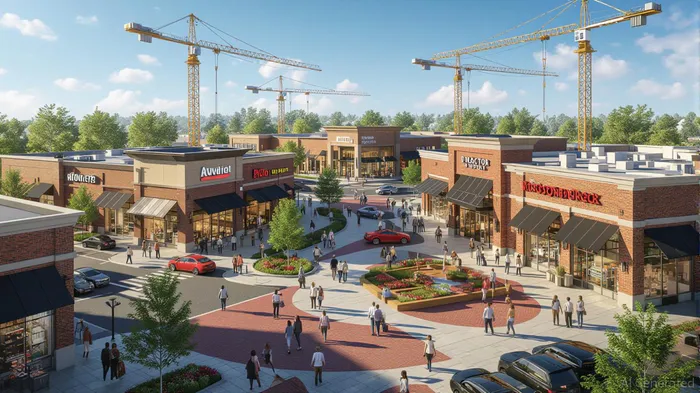
The retail real estate renaissance in Deptford, New Jersey, is more than just a local story—it's a masterclass in strategic development that could reshape how investors view secondary markets. With a $20–25 million redevelopment of the once-dormant Deptford Town Center, led by Pittsburgh-based MSP Development, this suburban hub is becoming a case study in how smart retail planning can catalyze long-term commercial value and community prosperity. Let's break down why this project is worth watching—and why it might signal a broader opportunity for investors.
The Strategic Shift: From Vacant Malls to Vibrant Hubs
The original Deptford Mall, like many post-2008 shopping centers, suffered from the bankruptcy of anchor tenants such as Bed Bath & Beyond and Sears. But instead of letting the site decay, developers pivoted to a “retail-as-destination” model. Today, the site is home to seven national tenants—including Aldi, Tractor SupplyTSCO-- Co., and Nordstrom Rack—each chosen for their ability to draw foot traffic and serve diverse consumer needs. This mix isn't accidental: Aldi's affordability, Tractor Supply's niche appeal, and Nordstrom Rack's luxury discounting create a gravitational pull that turns the center into a “must-visit” destination.
The project's success hinges on its location. Situated near major freeways (Routes 42, 55, and the NJ Turnpike) and adjacent to the existing Deptford Mall, the site taps into a densely populated retail corridor. This isn't just about convenience—it's about creating a retail gravity that radiates outward. For investors, this means the property's value isn't tied to a single tenant but to a network of synergies that enhance the entire ecosystem.
The Ripple Effect: Property Values and Economic Vitality
Retail revitalization isn't just about filling empty spaces—it's about redefining what those spaces can become. The Deptford project is expected to reuse 100,000 square feet of existing structures and add two new pad sites, boosting the total footprint to 108,000 square feet. This physical expansion is a signal to adjacent property owners: the area is becoming desirable. As a result, nearby commercial and residential real estate could see appreciation driven by increased visibility, accessibility, and the halo effect of new amenities.
Moreover, the project is projected to generate hundreds of jobs, from retail roles to construction and management. These jobs aren't just numbers—they're a multiplier effect. Workers spend their earnings locally, supporting restaurants, services, and ancillary businesses. For communities like Deptford, where retail accounts for 60% of the tax base, this means sustained revenue without a local tax increase. That's a rare win-win for both residents and investors.
Policy and Partnership: The Unsung Drivers of Success
Deptford's revitalization wouldn't be possible without policy support. Local leaders, including Mayor Paul Medany and Economic Development Director Donnie Banks, have streamlined approvals and provided incentives to attract tenants. This mirrors a broader trend in New Jersey, where groups like NAIOP NJ are pushing for reforms to land use laws and infrastructure investment. For investors, this is a critical insight: the best real estate deals thrive in environments where government and private sector goals align.
The state's Aspire Program, which offers tax incentives for revitalization projects, is another piece of the puzzle. By reducing development costs, such programs make high-risk, long-term projects more viable. For example, Aldi's inclusion in the project isn't just about its brand—it's about the tax incentives that make its presence economically feasible.
The Bigger Picture: Why This Matters for Investors
Deptford's story isn't an outlier. It reflects a national shift toward “retail reimagined”—a model where traditional malls evolve into mixed-use hubs. The key for investors is to identify projects that combine strategic tenant mix, strong location, and policy tailwinds.
Consider the stock performance of the tenants involved. Aldi's parent company, KrogerKR-- (KR), has seen steady growth as discount retailers gain traction. Tractor Supply Co. (TSCO), a standout in the retail sector, has outperformed the S&P 500 for years, reflecting the power of niche retail. Even Nordstrom Rack's parent, Nordstrom (JJP), is betting on off-price retail to revive its brand. These companies aren't just tenants; they're indicators of a broader trend.
Conclusion: A Call to Action for Investors
The Deptford Town Center project is a blueprint for how retail real estate can drive both profit and purpose. For investors, the takeaway is clear: focus on projects that marry strategic tenant selection with community-driven growth. Look for markets where policy supports revitalization, and where development isn't just about bricks and mortar but about creating ecosystems that thrive.
In the long run, Deptford's success could make it a model for other struggling retail corridors. For those willing to bet early, the rewards—both in property appreciation and economic impact—could be substantial. As the 2025 election for New Jersey's governor approaches, keep an eye on policy shifts that could accelerate this trend. In the meantime, this is a market—and a model—worth watching closely.







Comentarios
Aún no hay comentarios