
DePIN in Energy: The Rise of Decentralized Grids and Their Investment Potential
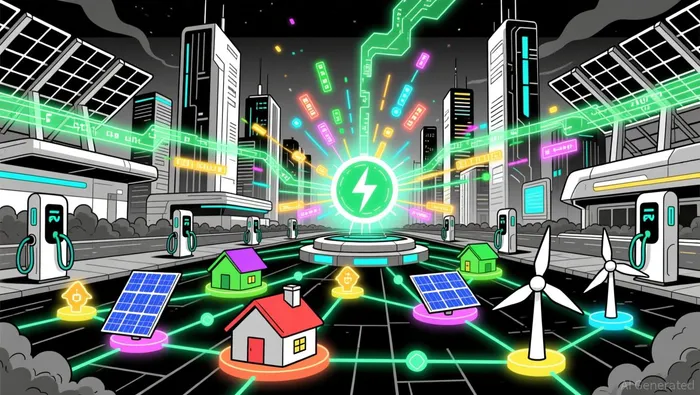
The energy sector is undergoing a seismic shift, driven by the convergence of blockchain technology and decentralized infrastructure. Decentralized Physical Infrastructure Networks (DePIN) are redefining how energy is produced, distributed, and consumed, offering scalable solutions to long-standing grid inefficiencies. At the forefront of this movement is Fuse Energy, a project leveraging blockchain to build a $5 billion renewable energy network with 1 terawatt (TW) of global capacity by 2025. This article examines the scalability, grid stability, and institutional validation of DePIN-driven energy systems, with a focus on Fuse Energy's Project Zero and its implications for investors.
Scalability: Blockchain as the Backbone of Decentralized Energy
Scalability remains a critical challenge for traditional energy grids, which struggle to integrate renewable sources like solar and wind due to intermittency and infrastructure limitations. DePIN projects address this by decentralizing control and enabling peer-to-peer (P2P) energy trading. For instance, Solana-based DePIN projects such as Grass Network and Render have demonstrated transaction throughputs exceeding 162 million daily transactions, with median fees under a penny. This efficiency is critical for micro-payments in real-time energy trading, where milliseconds matter.
Fuse Energy's Project Zero, built on SolanaSOL--, exemplifies this scalability. By incentivizing households to shift energy consumption to renewable-abundant periods, the project aims to create a virtual power plant (VPP) with 1 TW of global capacity. The Solana blockchain's hybrid Proof-of-History (PoH) and Proof-of-Stake (PoS) consensus mechanism enables energy-efficient transactions (0.00051 kWh per transaction), making it ideal for managing the complex coordination of distributed energy resources (DERs).
Moreover, layer 2 solutions like Solana's data rollups and the Lightning Network reduce congestion, ensuring seamless scaling for millions of devices. As of 2025, DePIN projects collectively manage 41.8 million devices globally, with a combined market cap of $19.2 billion. This growth is fueled by advancements in IoT and 5G/6G networks, which enhance real-time data processing and grid responsiveness.
Grid Stability: From Microgrids to Macro-Level Coordination
Grid stability is another cornerstone of DePIN's value proposition. Traditional grids face volatility from renewable intermittency and aging infrastructure, but blockchain-based systems introduce self-regulating mechanisms. A 2025 study demonstrated a blockchain architecture achieving a 29.6% peak-shaving rate and a 5% average supply-demand deviation in a microgrid prototype. This was enabled by AI agents for endpoint control and smart contracts for automated trading, addressing supply imbalances in real time.
Fuse Energy's Project Zero builds on this model by integrating DERs like solar panels into a decentralized network. Token-based incentives encourage participants to adjust consumption during peak renewable hours, reducing grid strain and enhancing flexibility. For example, the Brooklyn Microgrid case study showed how local communities could trade surplus solar energy directly via blockchain, reducing reliance on centralized utilities.
Institutional validation of these systems is growing. Siemens' blockchain-integrated grid management solutions, for instance, achieved a 15% improvement in grid efficiency in pilot projects. Meanwhile, the global utility electric fuse market-critical for grid safety-is projected to grow at a 7% CAGR through 2034, driven by renewable integration and modernization efforts. These trends underscore the importance of resilient infrastructure in DePIN ecosystems.
Institutional Validation: From $300M ARR to $5B Valuation
Institutional confidence in DePIN energy projects is surging, reflected in both financial metrics and strategic partnerships. Fuse Energy, founded in 2022 by Revolut executives, has grown from $1 billion to $5 billion in valuation within months. The company now serves 150,000 households and generates $300 million in annual recurring revenue (ARR), with a $70 million Series B round led by Lowercarbon Capital and Balderton Capital.
This institutional backing is not isolated. The broader DePIN market, valued at $30–50 billion in 2025, is projected to reach $3.5 trillion by 2028. Investors are drawn to DePIN's ability to tokenize carbon credits, automate settlements via smart contracts, and reduce operational costs by up to 30%. For example, Solana's Real Economic Value (REV) exceeded $550 million in January 2025, outpacing all other blockchains combined.
Regulatory tailwinds further bolster institutional validation. The World Economic Forum (WEF) highlights DePIN's role in achieving ESG goals, particularly in regions with limited grid infrastructure. Meanwhile, the U.S. Department of Energy forecasts a 15–20% increase in electricity demand over the next decade, creating urgency for scalable, decentralized solutions.
Challenges and the Path Forward
Despite its promise, DePIN faces hurdles. Regulatory uncertainty and high initial setup costs remain barriers to adoption. Additionally, while Solana's throughput is unmatched, interoperability between blockchain platforms and legacy grid systems requires further development. However, the integration of AI and IoT is accelerating grid automation and forecasting, mitigating these risks.
For investors, the key lies in projects with robust technical foundations and institutional partnerships. Fuse Energy's focus on vertical integration-bridging generation, distribution, and retail layers-positions it to dominate the decentralized energy market. Its Q1 2025 roadmap, including a points program and EV charging network, further strengthens its scalability and user base.
Conclusion: A $3.5 Trillion Opportunity
DePIN is not just a technological innovation-it's a paradigm shift in energy infrastructure. By combining blockchain's transparency, scalability, and smart contracts with renewable energy, projects like Fuse Energy are creating resilient, community-driven grids. With institutional validation growing and market projections pointing to a $3.5 trillion DePIN sector by 2028, the investment case is compelling. For those seeking exposure to the energy transition, DePIN offers a unique blend of ESG alignment, technological disruption, and financial returns.






Comentarios
Aún no hay comentarios