
Denny's Go-Private Deal: A Strategic Turnaround Opportunity for Value Investors?
Activist Influence: A Catalyst for Change
JCP Investment Management, led by James Pappas, has a history of reshaping underperforming casual dining chains. Its previous interventions at Red Robin and The Cheesecake Factory focused on cost-cutting, store rationalization, and menu innovation to boost profitability, according to Restaurant Dive. At Denny's, JCP's stated objective is to "enhance shareholder value" through strategic engagement with the board and management, as reported by Nation's Restaurant News. This aligns with the firm's playbook, which emphasizes surgical closures of underperforming units and operational streamlining.
Denny's CEO, Kelli Valade, has acknowledged the need for change, framing the company's 2023-2026 "surgical and methodical approach" as a response to investor pressure, per Restaurant Dive. The alignment between JCP's goals and Denny's leadership suggests a collaborative, if not fully harmonious, restructuring effort. However, the activist's influence raises questions about short-term pain versus long-term gains-particularly for a brand synonymous with late-night dining and family-friendly service.
Operational Restructuring: Balancing Efficiency and Innovation
Denny's restructuring strategy combines cost-cutting with innovation. By 2025, the company plans to close 70-90 underperforming locations, a move expected to reduce overhead and focus resources on high-performing units, reports FSR Magazine. This mirrors JCP's approach at Red Robin, where store closures were paired with menu simplification to improve margins.
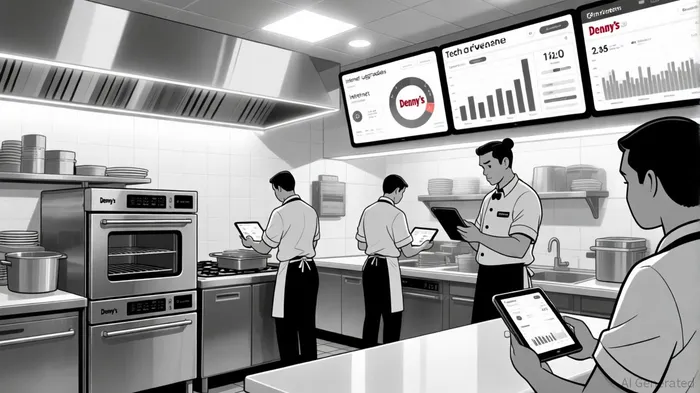
Simultaneously, Denny's is investing in digital infrastructure. A cloud-based POS system and smart kitchen technologies-such as internet-connected ovens-aim to enhance operational efficiency and consistency, according to MatrixBCG. Virtual brands like The Burger Den and Banda Burrito have also been introduced to diversify offerings and capture off-premises sales, generating $77 million in revenue to date, MatrixBCG says. These innovations suggest a dual focus on cost control and customer experience, critical for a brand struggling to adapt to shifting consumer preferences.
Financial Outlook: Cautious Optimism Amid Challenges
Despite these efforts, Denny's financials remain mixed. Domestic same-store sales for the core brand declined 1.3% in Q2 2025, according to Restaurant Dive, reflecting broader challenges in the family dining segment. However, the company's 2027 projections and adjusted EBITDA targets ($80-85 million in 2025) signal confidence in its turnaround strategy, per Public.com. Analysts are split: six rate the stock a "Buy," while seven give a "Hold," with a consensus price target of $5.96-implying a 53% upside from current levels, according to MarketBeat.
The stock's recent performance further complicates the picture. Investing.com reported that after a Q2 earnings miss, shares rose 4.17% in after-hours trading, suggesting market optimism about Denny's restructuring. Yet, with same-store sales guidance for 2025 ranging from -2.0% to +1%, the path to profitability remains uncertain, Public.com projects.
Conclusion: A High-Risk, High-Reward Proposition
Denny's Go-Private Deal represents a high-stakes gamble. JCP's activist playbook offers a proven framework for operational efficiency, but the company's cultural identity and brand loyalty may be harder to revitalize. For value investors, the key variables will be the success of store closures, the scalability of virtual brands, and the effectiveness of digital investments. If Denny's can execute its restructuring without alienating its core customer base, the 53% price target projected by analysts could materialize. However, given the sector's competitive landscape and consumer trends, patience-and a tolerance for volatility-will be essential.





Comentarios
Aún no hay comentarios