
Denmark's Cow Burp Tax: A Catalyst for Global Green Finance and Carbon Credit Markets
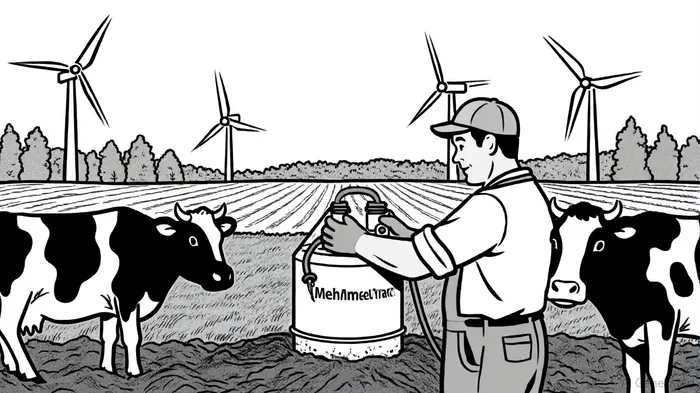
Denmark's bold move to implement the world's first carbon tax on agricultural emissions—targeting livestock burps and manure—has ignited a global conversation about the future of climate policy in agriculture. Starting in 2030, Danish farmers will pay 300 Danish kroner ($43) per tonne of CO2-equivalent emissions, rising to 750 kroner ($107) by 2035, after a 60% tax deduction to ease the financial burden[1]. This tax, part of the "Green Tripartite" agreement between the government, farmers, and environmental groups, aims to cut agricultural emissions by 55–65% by 2030 and align with Denmark's broader goal of reducing total emissions by 70% from 1990 levels[2].
A New Pricing Mechanism for Agricultural Emissions
Denmark's tax introduces a novel pricing mechanism for a sector long excluded from carbon markets. By assigning a monetary value to methane emissions from livestock—approximately $96 per cow annually in 2030[3]—the policy creates a financial incentive for farmers to adopt low-emission practices, such as feed additives or methane-capturing technologies. This approach mirrors the EU Emissions Trading System (ETS) but tailors it to agriculture, potentially inspiring the creation of an "agriETS" across Europe[4].
The tax's structure also signals to global carbon credit markets that agricultural emissions can be quantified, traded, and monetized. Currently, agricultural carbon credits represent 100 million tonnes of CO2e annually in voluntary markets, with prices for removal credits (e.g., soil carbon sequestration) ranging from $40 to $130 per tonne[5]. Denmark's tax could accelerate demand for these credits by normalizing the idea that farmers must offset emissions, much like industrial sectors.
Investment Flows and Green Finance Opportunities
The Danish government's 40-billion-kroner Green Area Fund, which supports reforestation, peatland restoration, and climate-smart agriculture, underscores how carbon pricing can drive investment. By 2030, the fund aims to reforest 250,000 hectares and restore 140,000 hectares of carbon-rich peatlands[6]. Such projects align with global trends: the agricultural carbon credit market is projected to grow at a 31.49% CAGR through 2033, reaching $97 billion[5].
Investors are already taking note. Denmark's commitment to carbon capture and storage (CCS) in the North Sea, targeting 13 million tonnes of annual storage capacity by 2030[7], highlights how agricultural and industrial decarbonization can converge. This integration could attract green finance capital to hybrid projects, such as biogas plants that convert manure into renewable energy while capturing methane.
Challenges and Global Implications
Critics argue the tax could strain Danish farmers' competitiveness, particularly if other countries lag in implementing similar policies. However, the tax's phased rollout and deductions aim to balance environmental goals with economic realities. The Danish model also addresses a key challenge in carbon markets: additionality. By tying subsidies to verified emission reductions, Denmark reduces the risk of "greenwashing," a concern that has plagued voluntary carbon credit schemes[5].
Globally, the tax could pressure the EU to harmonize agricultural emissions policies. If adopted widely, agriETS systems could expand carbon credit markets by 20–30%, according to analysts[4]. Meanwhile, emerging economies might follow Denmark's lead in linking carbon pricing to land-use reforms, particularly in regions with high agricultural emissions like South Asia and Latin America[5].
Conclusion: A Precedent for Climate Innovation
Denmark's cow burp tax is more than a quirky headline—it's a strategic experiment in pricing nature's externalities. By embedding carbon costs into agriculture, the policy bridges the gap between climate action and market mechanisms. For investors, the implications are clear: agricultural carbon credits, green tech for farms, and nature-based solutions are poised for growth. As the world watches Denmark's experiment unfold, one thing is certain: the next frontier of green finance lies in the fields.







Comentarios
Aún no hay comentarios