
The Demise of the SAVE Plan and Its Impact on Financial Markets and Student Loan-Linked Asset Classes
The Biden administration's Saving on a Valuable Education (SAVE) student loan repayment plan, once a cornerstone of federal debt relief, is now a relic of a bygone era. Legal challenges from Republican-led states, culminating in a settlement finalized in July 2025, have effectively terminated the program. The One Big Beautiful Bill Act (OBBBA), signed into law that month, phases out SAVE by 2028 and replaces it with the Repayment Assistance Plan (RAP), set to launch in 2026. For the 7.6 million borrowers enrolled in SAVE, the transition has been abrupt: they've been placed in administrative forbearance since February 2025, with no clear timeline for repayment resumption. This uncertainty, coupled with the resumption of federal collections and wage garnishments, has triggered a surge in borrower defaults and a seismic shift in credit markets.
The Delinquency Surge and Credit Market Fallout
The termination of the SAVE Plan has exacerbated an already fragile financial landscape. Delinquency rates for student loans have skyrocketed, with nearly 8% of total student loan balances 90+ days delinquent as of Q1 2025. This surge has been driven by a combination of factors: the end of a 12-month "on-ramp" period that shielded missed payments from credit bureaus, the resumption of aggressive collections, and the compounding effects of inflation and higher interest rates. According to a report by PGIM Fixed Income, over 2.2 million borrowers experienced credit score drops exceeding 100 points, with 3.2 million falling into subprime territory. These deteriorating credit profiles have rippled through consumer ABS markets, where traditional underwriting metrics like FICO scores are proving increasingly unreliable.
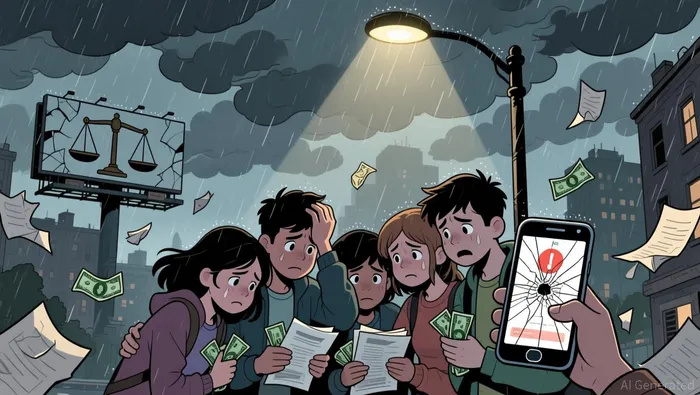 The Federal Reserve has noted a 39-basis-point increase in the weighted average 2-year default rates for student loans as of June 2025. This trend is not isolated to student loans: auto and credit card delinquencies have also risen, as borrowers prioritize essential expenses over debt service. For securitized credit investors, the implications are stark. Lenders that failed to account for student loan obligations in their underwriting models during the forbearance period now face elevated default risks, while those that integrated dynamic behavioral analytics into their risk assessments are better positioned to navigate the transition according to a receivables analysis.
Investor Strategies: Hedging and Sector Rotation
In response to the delinquency crisis, investors are recalibrating their strategies. One key approach is hedging against borrower default risk through diversified asset allocation. According to a KPMG analysis, the severe delinquency rate for student loans-16.32% as of Q3 2025-has prompted a shift toward defensive sectors like utilities and healthcare, where cash flows are more predictable. Meanwhile, asset-backed securities (ABS) tied to student loans have seen risk premiums widen, reflecting heightened uncertainty. For example, the spread on student loan ABS tranches increased by 120 basis points in Q3 2025 compared to pre-SAVE levels according to Diamond Hill insights.
Sector rotation is another critical tactic. As delinquency rates in student loans climb, investors are divesting from high-risk consumer ABS and reallocating capital to more stable asset classes. A Deloitte report highlights that auto loan delinquencies, while rising, remain lower than student loan defaults due to collateral-backed structures. Similarly, mortgage markets have proven resilient, as underwriting models for government-sponsored enterprises (GSEs) already incorporate student loan obligations.
The Road Ahead: Policy Uncertainty and Market Volatility
The OBBBA's phased rollout introduces further complexity. While the Repayment Assistance Plan (RAP) is designed to offer more affordable payment structures for low- and middle-income borrowers, its July 2026 launch leaves a gap for those currently in forbearance. Borrowers who transition to Income-Based Repayment (IBR) face additional challenges: months spent in SAVE forbearance do not count toward Public Service Loan Forgiveness (PSLF) milestones according to Forbes analysis. This creates a Catch-22 for borrowers seeking to qualify for forgiveness programs, while investors grapple with the uncertainty of how many will default before RAP's implementation.
The Department of Education's extended forbearance notices-some stretching to 2028-add another layer of unpredictability according to college investor reporting. While this provides temporary relief, it also delays the normalization of credit markets. As Deloitte notes in its 2026 banking outlook, the prolonged transition period could suppress loan growth and net interest margins for financial institutions.
Conclusion: Preparing for a New Normal
The demise of the SAVE Plan marks a turning point in the student loan crisis. For investors, the key takeaway is clear: traditional risk assessment models are no longer sufficient in a landscape defined by rapid credit dispersion and regulatory flux. The surge in delinquencies has forced a reevaluation of underwriting standards, asset allocation strategies, and hedging mechanisms. As the OBBBA's reforms take shape, agility and adaptability will be paramount.
In the short term, investors should prioritize defensive sectors and leverage behavioral analytics to mitigate default risk. In the long term, the transition to RAP offers a potential stabilization, but its success hinges on borrower adoption and policy execution. Until then, the student loan market remains a volatile asset class-one that demands both caution and creativity from those navigating its turbulence.







Comentarios
Aún no hay comentarios