
Delta Air Lines Tackles Overcrowded Premium Lounges Amid Post-Pandemic Travel Surge
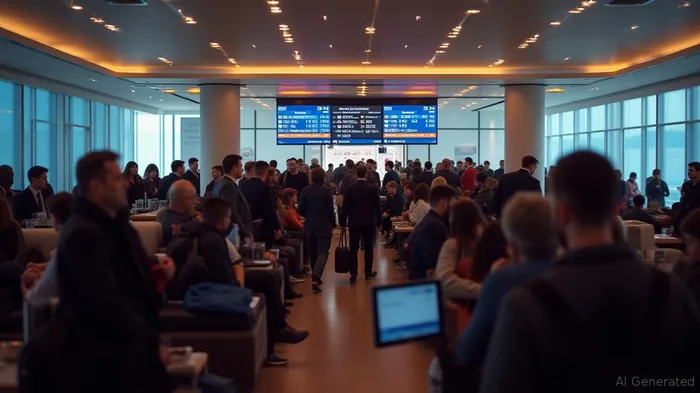
Delta Air Lines, despite reporting robust second-quarter earnings and reaffirming its 2025 profit guidance, faces mounting challenges in its premium lounge offerings. The carrier, which has maintained its position as America’s most profitable airline, is grappling with overcrowded Sky Club lounges, a problem exacerbated by surging demand post-pandemic. CEO Ed Bastian, who introduced DeltaDAL-- One lounges with enhanced amenities in early 2025, acknowledged the airline’s “struggle with our own success” as customers who once valued exclusivity now find themselves waiting in long lines. Bastian attributed the crisis to a $300 billion surge in travel demand, driven by “revenge travel” and a broader shift toward premium services [1].
The lounge congestion reflects a deeper societal trend known as “elite overproduction,” a theory posited by UConn professor Peter Turchin. This phenomenon describes how societies with abundant resources produce more individuals with elite credentials and wealth than can be accommodated by the available high-status roles or privileges. Delta’s Sky Club, once a symbol of distinction, now epitomizes this issue: as premium credit card programs and status tiers expand access, the exclusivity that made lounges desirable erodes. Travelers who pay hundreds of dollars annually for elite benefits—such as American ExpressAXP-- cardholders—now often encounter crowded terminals, particularly at major hubs like JFK. Airport Dimensions’ 2024 report underscores this paradox: airport lounges are simultaneously democratized and diluted [2].
Delta’s attempts to manage the crisis have drawn mixed reactions. In 2023, the airline restricted Basic Economy passengers and capped lounge visits for credit cardholders, moves that sparked public frustration. By early 2025, Delta further tightened access, limiting AmEx cardholders to 15 visits annually unless they spent $75,000 or more. Travelers are now restricted to entering lounges within three hours of departure, reducing extended stays. While these measures aim to preserve the premium experience, critics argue peak-hour congestion persists, particularly in flagship locations [3].
To address capacity issues, Delta is investing in larger, redesigned lounges, including 30,000-square-foot Delta One locations in cities like Seattle and Los Angeles. Expansions in Atlanta and other hubs aim to enhance flow and guest capacity. Executives project that by 2026, most crowding will subside, though design flaws and operational hiccups may delay full resolution. The airline’s strategy mirrors that of American Express, whose CenturionALF-- Lounges have similarly expanded to accommodate a growing base of high-net-worth individuals [4].
The broader implications of this struggle extend beyond airXAIR-- travel. Turchin’s theory, supported by data showing the U.S. top 10% holding increasing wealth over four decades, highlights how elite privileges—whether lounge access, college degrees, or lucrative careers—are becoming less distinct. The “overproduction” of elites has led to status anxiety among the upper middle class, a demographic that once saw premium services as a reward for meritocratic achievement. Analyst Nick Maggiulli of Ritholtz Wealth Management notes that the “death of the AmEx lounge” reflects a broader societal shift: “There are too many people with lots of money,” he wrote, though he did not explicitly tie this to Turchin’s theory [5].
Delta’s response—balancing exclusivity with accessibility—mirrors the tension between modern capitalism’s promise of reward and its reality of oversaturation. As Bastian noted, the $100,000 household income threshold, which defines 40% of U.S. households, is no longer a marker of elite status. Yet, this same cohort now competes for dwindling premium experiences, creating a paradox where success is both attainable and unattainable. The airline’s struggle, therefore, is not just operational but symbolic: it reflects a world where the very idea of exclusivity is under siege by the democratization of wealth and privilege.
Source:
[1] [Delta’s struggles with the airport lounge and the angst of the upper middle class in the age of ‘elite overproduction,’ explained] [https://fortune.com/2025/07/26/why-airport-lounges-so-crowded-delta-american-express-elite-overproduction-turchin/?itm_source=parsely-api]
[2] [Delta’s struggles with the airport lounge and the angst of the upper middle class in the age of ‘elite overproduction,’ explained] [https://fortune.com/2025/07/26/why-airport-lounges-so-crowded-delta-american-express-elite-overproduction-turchin/?itm_source=parsely-api]
[3] [Delta’s struggles with the airport lounge and the angst of the upper middle class in the age of ‘elite overproduction,’ explained] [https://fortune.com/2025/07/26/why-airport-lounges-so-crowded-delta-american-express-elite-overproduction-turchin/?itm_source=parsely-api]
[4] [Delta’s struggles with the airport lounge and the angst of the upper middle class in the age of ‘elite overproduction,’ explained] [https://fortune.com/2025/07/26/why-airport-lounges-so-crowded-delta-american-express-elite-overproduction-turchin/?itm_source=parsely-api]
[5] [Delta’s struggles with the airport lounge and the angst of the upper middle class in the age of ‘elite overproduction,’ explained] [https://fortune.com/2025/07/26/why-airport-lounges-so-crowded-delta-american-express-elite-overproduction-turchin/?itm_source=parsely-api]







Comentarios
Aún no hay comentarios