
Delta Air Lines' Sustained Revenue Growth in 2026: A Strategic Deep Dive into Premium Fare Expansion and Network Resilience
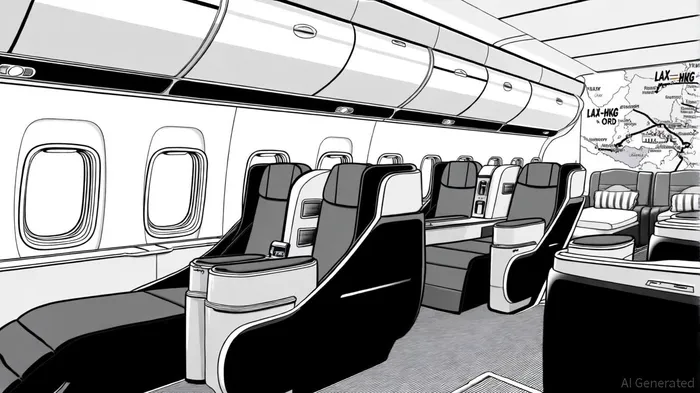
In 2026, Delta Air LinesDAL-- stands at the forefront of the aviation industry's transformation, leveraging a dual strategy of premium fare innovation and network resilience to drive sustained revenue growth. With premium cabin revenue surging and operational efficiency gains accelerating, the airline is poised to outperform broader market expectations. This analysis examines how Delta's strategic focus on high-margin premium offerings and agile network planning positions it as a compelling investment opportunity.
Premium Fare Strategy: A Catalyst for Margin Expansion
Delta's premium fare segment has emerged as a cornerstone of its financial strategy. According to CNBC, Delta's Q3 2025 premium cabin revenue reached $5.8 billion, a 9% year-over-year increase, while main cabin revenue declined by 4% to $6 billion, as shown in the company's Q3 2025 earnings. This divergence underscores a broader industry trend: travelers are increasingly prioritizing comfort and flexibility, even at a premium price point.
Historical analysis of Delta's stock performance around earnings releases from 2022 to 2025 reveals that while there were positive returns in the immediate aftermath, these gains were not statistically significant. For instance, the average cumulative return in the first two trading days post-earnings was positive but lacked robustness due to a small sample size of four events. Over a 30-day window, the mean excess return remained mildly positive but again failed to achieve statistical significance. This suggests that earnings dates alone may not provide a reliable trading edge for DAL during this period, as noted in an InvestorsHangout report.
The airline's leadership, under CEO Ed Bastian, has emphasized a shift toward "higher-margin premium offerings" rather than simply increasing seat counts; the company predicts premium passenger revenue will overtake main cabin earnings by 2027. For instance, DeltaDAL-- is retrofitting its Airbus A350-1000 fleet with 50% premium seating and introducing A321neos equipped with flatbeds, with 85% of new 2025 capacity allocated to premium cabins, a strategy Simple Flying reports. These investments align with consumer demand for differentiated experiences, such as refundable tickets and flexible travel products, which have become critical differentiators in a competitive market, a point the InvestorsHangout report also noted.
Moreover, Delta's loyalty programs are projected to generate $10 billion in annual revenue by 2026. Analysts note that the airline's long-term financial framework-targeting mid-teens operating margins and 10% earnings per share growth-hinges on maintaining this premium-driven momentum, as outlined in Mapping the skies.
Network Resilience: Strategic Route Optimization and Hub Efficiency
Delta's ability to adapt its network to shifting demand is another pillar of its 2026 growth strategy. The airline has launched high-impact routes such as daily nonstop service from Los Angeles (LAX) to Hong Kong (HKG) and three daily flights from LAX to Chicago O'Hare (ORD), reinforcing its position in transpacific and Midwest corridors. These moves are part of a broader effort to reclaim international market share and strengthen domestic connectivity.
Delta's route planning is underpinned by a data-driven approach that balances short-term demand, competitive positioning, and resource allocation. For example, the airline has expanded winter service to leisure destinations like Italy and increased ski season connectivity from LAX, reflecting its responsiveness to seasonal travel patterns. Additionally, Delta is testing non-hub expansion strategies, such as launching seven new Saturday-only routes from Orlando (MCO) to underserved markets like Columbus (CMH) and Milwaukee (MKE); these experiments align with reporting that Delta likely plans a new hub in the Orlando area. This approach allows the airline to gauge demand without committing to full hub operations.
Hub efficiency remains a priority, with Delta reinforcing its core hubs in Atlanta (ATL), Minneapolis-St. Paul (MSP), Salt Lake City (SLC), and Detroit (DTW). Investments like the $229 million Terminal 5 expansion at LAX underscore the airline's commitment to enhancing infrastructure and passenger experience. By maintaining operational flexibility and prioritizing high-yield markets, Delta is mitigating risks associated with volatile demand and competitive pressures.
Conclusion: A Compelling Investment Thesis
Delta Air Lines' 2026 trajectory is defined by two interlinked strengths: a premium fare strategy that captures rising consumer willingness to pay for quality, and a resilient network that adapts to dynamic market conditions. With premium revenue on track to surpass main cabin earnings by 2027 and operational efficiency gains accelerating, the airline is well-positioned to deliver top-line growth and margin expansion. For investors, Delta's strategic agility and financial discipline present a compelling case for long-term value creation.







Comentarios
Aún no hay comentarios