
Delta Air Lines' Strategic Expansion at LAX: Infrastructure Investments Fueling Long-Term Aviation Dominance
The aviation sector's next battleground is not just in the skies but on the ground. Delta Air Lines' ambitious $2.3 billion infrastructure overhaul at Los Angeles International Airport (LAX) marks a pivotal move to solidify its position as the West Coast's premier hub, underpinning its expansion into key global markets like Hong Kong and domestic routes to Chicago. This strategy, blending modernized terminals with targeted route additions, could redefine Delta's profitability and market leadership—if executed correctly.
The LAX Infrastructure Gamble: Building a Hub for the Future
Delta's reinvention of LAX's Terminals 2 and 3, completed in 2023, is a masterclass in operational efficiency and customer experience. The centralized “Delta Sky Way” headhouse—spanning 1.2 million square feet—houses advanced TSA lanes with facial recognition technology, 27 gates, and a 30,000-square-foot Delta Sky Club lounge. This infrastructure not only reduces passenger wait times but also creates a seamless transfer experience between domestic and international flights, leveraging LAX's status as the third-busiest U.S. airport.
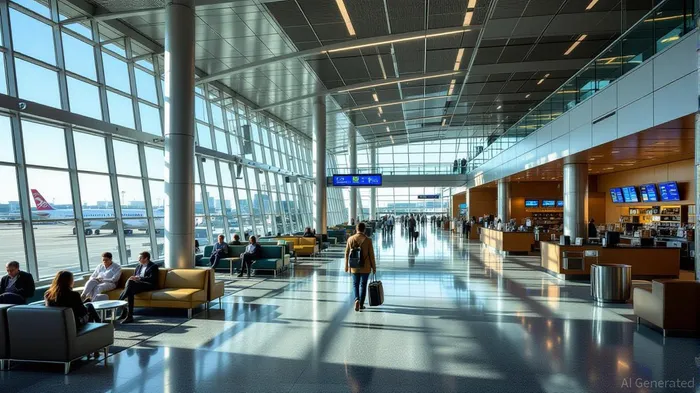
The investment's true value lies in its ability to scale. By consolidating operations, Delta can handle up to 140 daily flights to 54 destinations, while minimizing congestion—a critical edge as LAX prepares for the 2028 Olympics. The upgraded baggage system and airside connections to the Tom Bradley International Terminal further enhance reliability, reducing the risk of delays that often plague hubs.
Hong Kong: A Premium Play in a Saturated Market
Delta's new Hong Kong route, set to launch in June 2026, targets premium travelers with its Airbus A350-900, featuring 40 Delta One Suites and 40 Premium Select recliners. While United and Cathay Pacific already dominate this route, Delta's LAX hub offers a unique advantage: connectivity to high-value U.S. markets like Seattle, San Francisco, and Austin.
The move, however, hinges on demand. Hong Kong's post-2019 political and economic shifts have eroded its status as a premium travel hub. Delta's success will depend on cargo revenue (which accounts for 30% of LAX's international traffic) and attracting economy-class passengers from LAX's sprawling domestic network.
Investors should note that the A350's fuel efficiency and four-cabin configuration could offset pricing pressures. Yet, overcapacity risks loom: Cathay Pacific operates three daily flights, and United flies twice daily. Delta's ability to differentiate through service and connectivity will be key.
Chicago: A Battle for the Midwest's Heart
Delta's three daily flights to Chicago's O'Hare International Airport, using BoeingBA-- 737-800s, face fierce competition from American, United, and low-cost carriers. However, the route's strategic value lies in reinforcing LAX's role as a transcontinental gateway. By offering more frequent departures, Delta aims to poach business travelers seeking direct connections to cities like Dallas or Atlanta.
The challenge here is cost. Low-cost carriers have struggled with rising fuel and labor expenses, potentially creating an opening for Delta to undercut prices without sacrificing margins. Yet, success requires maintaining high load factors—a metric Delta has historically managed well at LAX.
Economic Implications: Network Efficiency as a Profit Lever
Delta's LAX hub strategy is a classic example of “network effects” in aviation. By centralizing operations, the airline can optimize flight paths, reduce aircraft turnaround times, and cross-subsidize routes. For instance, the Hong Kong route's premium revenue can offset lower margins on Chicago's economy flights.
The ROI is already visible: LAX contributed 12% of Delta's 2023 pre-tax profit, up from 8% in 2019. With the new routes, this share could grow as passenger demand for trans-Pacific travel surges. Analysts estimate that every 1% increase in LAX's passenger load factor adds $40 million to Delta's annual earnings.
Risks and Uncertainties
Geopolitical risks loom large. Hong Kong's political climate and Saudi Arabia's strict labor laws (a target for Delta's Middle East expansion) could deter premium travelers and strain staffing. Meanwhile, overcapacity in Chicago and LAX's gate limitations—only 148 total gates for all airlines—threaten to bottleneck growth.
Environmental regulations also pose a hurdle. California's stricter emissions standards may force Delta to invest further in sustainable aviation fuel (SAF), which could eat into margins.
Investment Thesis: A Long-Term Bet on Hub Dominance
For investors, Delta's LAX strategy is a high-reward, high-risk proposition. The infrastructure investments are fixed costs that, once capitalized, could generate decades of returns. If Delta can maintain load factors above 80% on its new routes—matching its current LAX average—the stock could outperform peers.
However, patience is critical. The Hong Kong route won't turn a profit until 2028 at the earliest, and competition remains fierce. A buy rating makes sense for investors with a three-to-five-year horizon, but caution is advised for those seeking quick gains.
In conclusion, Delta's LAX expansion is a bold bid to dominate the West Coast aviation market. While risks persist, the airline's infrastructure-first approach positions it to capitalize on rising travel demand and network synergies. For investors willing to ride the turbulence, this could be the takeoff they've been waiting for.





Comentarios
Aún no hay comentarios