
Delta Air Lines' Q3 2025 Earnings Performance: Assessing Operational Resilience and Margin Recovery in a Volatile Economic Climate
In Q3 2025, Delta Air LinesDAL-- delivered a compelling earnings report that underscored its operational resilience and margin recovery amid a turbulent economic landscape. The airline reported adjusted earnings of $1.71 per share and $15.2 billion in revenue, surpassing analyst expectations and reflecting a 4.1% year-over-year revenue increase, according to a Quartz report. This performance positions DeltaDAL-- as a standout in an industry grappling with capacity imbalances, fluctuating fuel prices, and domestic demand volatility. Historically, Delta's earnings beats have demonstrated strong market reactions: since 2022, a simple buy-and-hold strategy following earnings beats has generated an average 4.36% return over three days and a cumulative 12–14% alpha over 30 days, according to an AviationOutlook analysis.
Financial Highlights: Profitability and Margin Expansion
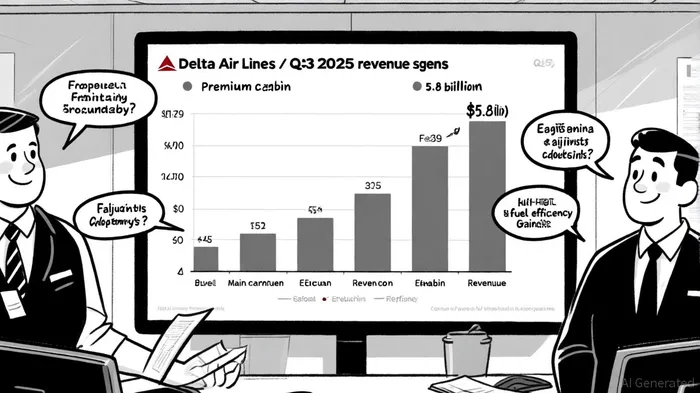
Delta's adjusted operating income of $1.7 billion in Q3 2025, with an operating margin of 11.2%, highlights its ability to maintain profitability despite macroeconomic headwinds, according to a CNBC report. While the margin declined slightly from 12.9% in Q3 2024, this was offset by a 15% increase in adjusted net income to $1.12 billion, CNBC noted. The airline's premium revenue streams, including Delta One and Comfort Plus cabins, surged 9% year-over-year to nearly $5.8 billion, accounting for nearly 40% of total revenue, according to CNBC. This shift toward high-margin services has become a cornerstone of Delta's strategy, insulating it from weaker main cabin demand and broader economic uncertainties such as Trump-era tariffs and a federal government shutdown, as reported by Quartz.
Operational Resilience: Cost Management and Fleet Modernization
Delta's operational efficiency is a key driver of its margin recovery. The airline reduced adjusted net debt by $2.4 billion year-to-date, bringing it down to $15.6 billion, while investing in fuel-efficient aircraft like the A321neo and A330-900, CNBC reported. These modernization efforts, coupled with the retirement of older, less efficient models such as Boeing 757s and 767s, have improved fuel efficiency and reduced operating costs, according to the AviationOutlook analysis. Additionally, Delta's capacity adjustments-trimming unprofitable midweek flights and focusing on high-demand routes-supported a 2% year-over-year increase in domestic unit revenue, CNBC noted. Such strategic pruning contrasts with competitors like American Airlines and Frontier, which face steeper challenges in stabilizing yields, according to an AviationTitans analysis.
Industry Context: Navigating a Challenging Sector
The U.S. airline sector in Q3 2025 was marked by divergent performances. While Delta and United demonstrated resilience with operating margins of 9–11%, carriers with high domestic exposure, such as American and Frontier, struggled with declining unit revenue and capacity overhangs, AviationTitans observed. Delta's focus on premium and loyalty-driven revenue-now 60% of its total revenue-has insulated it from these pressures, Quartz reported. For instance, its loyalty program revenue, bolstered by a billion-dollar credit card partnership with American Express, provided a stable cash flow stream, AviationTitans noted. Meanwhile, lower fuel prices (averaging near $2.00 per gallon in August 2025) further supported margin stability, AviationTitans added.
Future Outlook: Sustaining Momentum
Delta's Q3 performance aligns with its long-term financial framework, with CEO Ed Bastian projecting adjusted earnings of $1.60–$1.90 per share for Q4 2025, exceeding the $1.65 consensus estimate reported by CNBC. The airline's fleet modernization-on track to receive 42 new aircraft in 2025-will further enhance efficiency and reliability, according to the AviationOutlook analysis. However, challenges remain, including a $15.6 billion debt load and reliance on the North American market, CNBC noted. That said, Delta's disciplined approach to capacity management, premium revenue growth, and cost control positions it to outperform peers in 2026, particularly as corporate travel demand and international routes continue to recover, Quartz observed.
Conclusion
Delta Air Lines' Q3 2025 results exemplify operational resilience in a volatile environment. By leveraging premium pricing, fleet modernization, and strategic capacity adjustments, the airline has not only stabilized its margins but also positioned itself for sustained growth. As the industry navigates ongoing uncertainties, Delta's balanced approach to profitability and innovation offers a compelling case for investors seeking stability in the aviation sector.





Comentarios
Aún no hay comentarios