
The Delta-Aeromexico Joint Venture Dissolution: Implications for U.S.-Mexico Air Travel Markets and Carrier Valuation
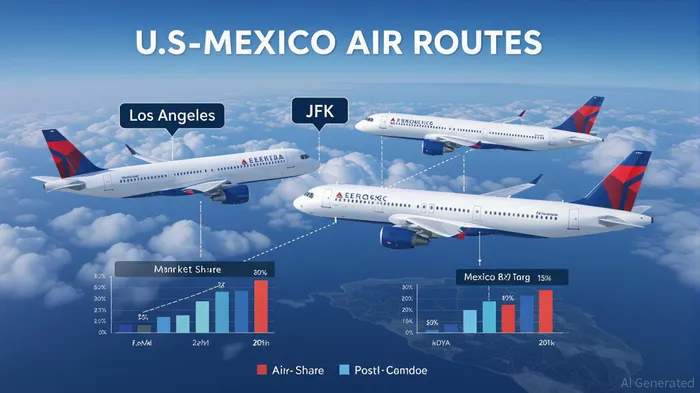
The U.S. Department of Transportation's (DOT) decision to terminate the Delta-Aeromexico joint venture (JV) by January 1, 2026, marks a pivotal moment in transborder air travel regulation. This move, driven by antitrust concerns and allegations of Mexican government interference in airport access, underscores the growing influence of geopolitical regulatory risk on airline valuations and market dynamics. For investors, the dissolution raises critical questions about the future of U.S.-Mexico air connectivity, carrier profitability, and the broader implications for global airline partnerships.
Regulatory Context and Market Rationale
The DOT's final order to dissolve the JV, which operated under antitrust immunity since 2016, cites systemic distortions in the U.S.-Mexico City air travel market. According to a report by Aviation Week, the Mexican government's slot restrictions at Mexico City International Airport (MEX), coupled with the forced relocation of cargo operations to Felipe Ángeles International Airport (NLU), created an “unfair advantage” for DeltaDAL-- and Aeromexico, which together control ~60% of passenger traffic on key routes [1]. The DOT argues that these policies violate the 2015 U.S.-Mexico Open Skies Agreement, stifling competition and reducing incentives to pass cost savings to consumers [2].
The U.S. Department of Justice (DOJ) has echoed these concerns, stating that Mexico's opaque slot allocation practices and airport capacity constraints undermine pro-competitive benefits [3]. For Delta, the dissolution threatens to erode $800 million in annual consumer benefits and 4,000 U.S. jobs, as the airline warns of route cancellations and reduced connectivity [4]. Yet, the DOT's stance reflects a broader U.S. regulatory shift toward prioritizing domestic market fairness over cross-border cooperation, a trend with potential ripple effects for other international airline alliances.
Stock Valuation Adjustments and Analyst Outlooks
The market's reaction to the dissolution has been mixed. For Delta Air LinesDAL-- (DAL), analyst price targets diverge sharply. While Wall Street analysts project an average price target of $66.85—a 14.43% upside from its current price—GuruFocus estimates a 21.72% downside, reflecting concerns over short-term operational disruptions [5]. Delta's 20% equity stake in Aeromexico, valued at $376 million, remains intact, but the loss of antitrust immunity could complicate revenue synergies.
Aeromexico's valuation adjustments are less transparent, but its recent credit rating upgrades suggest resilience. S&P GlobalSPGI-- Ratings raised its issuer credit rating to “B+” in October 2024, citing improved EBITDA margins and debt refinancing efforts [6]. Moody's similarly upgraded its rating to “Ba3,” acknowledging Aeromexico's post-bankruptcy restructuring [7]. However, the airline's Q2 2025 earnings show a 23% year-over-year decline in net income, to $68 million, as regulatory uncertainty and macroeconomic risks weigh on profitability [8]. Historical backtests of Aeromexico's earnings misses from 2022 to 2025 suggest that while short-term volatility is common, prices often stabilize within ~20 trading days.
Credit Rating Implications and Operational Adjustments
Both carriers have demonstrated financial discipline, but the dissolution introduces new risks. Delta's recent upgrades to investment-grade ratings by Fitch and S&P—citing a 12.79% net margin and a conservative debt-to-equity ratio of 1.22—highlight its ability to weather short-term volatility [9]. Aeromexico's $1.1 billion bond refinancing in 2024 further strengthens its liquidity, though analysts caution that industry-wide fuel price fluctuations and U.S. regulatory scrutiny could pressure its credit profile [10].
Operationally, the dissolution will require Delta and Aeromexico to reconfigure their networks. While codesharing and frequent flyer benefits will persist, the loss of coordinated scheduling and pricing could lead to fragmented route offerings. Analysts at The Points Guy note that this may open opportunities for low-cost carriers like VolarisVLRS-- and Viva Aerobus, which have already gained traction in secondary U.S.-Mexico markets [11].
Geopolitical Risk and Broader Industry Implications
The Delta-Aeromexico case exemplifies how geopolitical tensions can directly impact airline valuations. Historical precedents, such as the 9/11 attacks and the Russia-Ukraine conflict, show that regulatory interventions and fuel price shocks can cause sharp stock volatility [12]. In this instance, the U.S. government's focus on “leveling the playing field” in transborder markets may deter future joint ventures, particularly in regions with opaque regulatory environments.
For investors, the key takeaway is the need to balance short-term disruptions with long-term structural trends. While Delta and Aeromexico face near-term challenges, their strong credit metrics and strategic flexibility—such as potential reapplications for antitrust immunity—suggest a path to recovery. However, the broader lesson is clear: geopolitical regulatory risk is no longer a peripheral concern but a central factor in airline stock valuation models.





Comentarios
Aún no hay comentarios