
Dell Technologies: Pioneering Secure Private Cloud Infrastructure for Enterprise Data Center Modernization
In the rapidly evolving landscape of enterprise data center modernization, secure private cloud infrastructure has emerged as a cornerstone for organizations seeking to balance agility, compliance, and cost efficiency. Dell TechnologiesDELL--, a leader in IT infrastructure, has positioned itself at the forefront of this transformation through strategic innovations in automation, storage, and cyberCYBER-- resilience. With the global private cloud market projected to grow at a compound annual growth rate (CAGR) of 12.30% from 2025 to 2030, reaching $244.06 billion by 2030[3], Dell's advancements in secure private cloud solutions are not just timely but critical for long-term investment potential.
Dell's Technological Edge in Secure Private Cloud
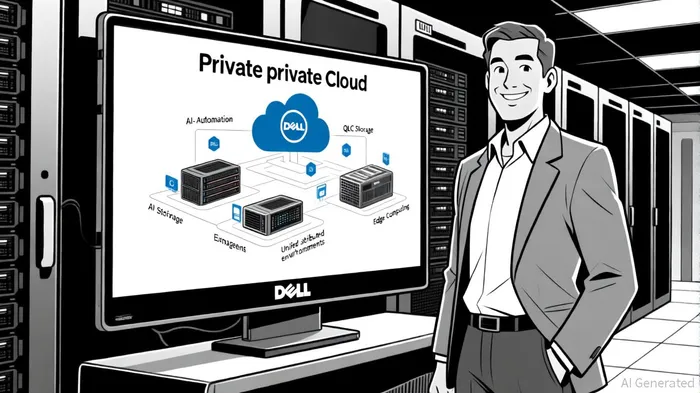
Dell's Dell Private Cloud, powered by the Dell Automation Platform, offers enterprises a flexible, scalable, and secure foundation for modern workloads. This platform streamlines deployment through AI-driven automation, reducing provisioning steps by 90% compared to traditional methods[2]. By integrating virtualization-optimized compute, storage solutions like PowerStore, PowerFlex, and PowerMax, and edge capabilities via Dell NativeEdge, DellDELL-- addresses the dual challenges of managing legacy and AI-driven workloads[1].
Key innovations include:
- QLC Storage Models: The PowerStore 5200Q and PowerFlex Ultra deliver cost-efficient, high-capacity performance, ideal for AI and data-intensive applications[2].
- AI-Powered Self-Healing: Advanced automation reduces issue resolution times, enhancing operational efficiency[1].
- Cyber Resilience: Dell PowerProtect provides end-to-end protection for virtual, cloud-native, and containerized workloads, a critical feature as cyber threats escalate[1].
- Edge Integration: Dell NativeEdge simplifies distributed operations, enabling secure, scalable edge AI deployments[2].
These advancements align with the growing demand for hybrid cloud strategies, where enterprises prioritize data sovereignty and compliance—particularly in regulated sectors like healthcare and finance[3].
Financial Performance and Market Position
Dell's Infrastructure Solutions Group (ISG) has been a growth engine, driven by AI and cloud infrastructure demand. In Q3 and Q4 of fiscal 2025, ISG revenue reached $11.4 billion each quarter, reflecting a 34% and 22% year-over-year increase, respectively[1]. For fiscal 2025, ISG revenue totaled $43.6 billion, a 29% year-over-year surge[2]. This growth is underpinned by AI server orders hitting $3.6 billion in Q3[1], highlighting Dell's ability to capitalize on the AI acceleration trend.
While specific private cloud market share data for Dell is not disclosed, broader metrics indicate a strong competitive position. As of Q1 2025, Dell holds a 13.18% market share in the Computer Hardware Industry and 7.91% in the Technology Sector[3]. Competitors like Oracle (3% cloud services share[2]) and IBM (5.66% Technology Sector share[3]) face stiff competition from Dell's integrated, secure private cloud offerings. Analysts note that Dell's focus on hypervisor flexibility and partner integrations (e.g., Nutanix, VMware) mitigates vendor lock-in risks, a key concern for enterprises[1].
Market Dynamics and Long-Term Growth Drivers
The private cloud market is being reshaped by three key trends:
1. AI Workload Repatriation: Over half of global IT leaders now default new AI projects to private infrastructure due to data privacy and performance needs[3]. Dell's AI Factory, as demonstrated in customer cases like NAVER Cloud and Continental, enables secure, context-aware AI deployment[3].
2. Regulatory Compliance: Stricter data governance (e.g., GDPR, HIPAA) is driving demand for private clouds. Dell's secure storage and automation solutions help enterprises meet compliance requirements without sacrificing agility[1].
3. Hybrid Cloud Flexibility: Dell's support for on-premises and SaaS deployment options, coupled with its ability to repurpose hardware across workloads, offers cost predictability and reduces egress fees compared to public clouds[3].
Customer Validation and Strategic Partnerships
Real-world adoption of Dell's solutions underscores their value. For instance:
- F1Soft, a Nepalese fintech firm, optimized performance and scalability using Dell PowerFlex[3].
- Continental leveraged the Dell AI Factory with NVIDIA to develop advanced automotive safety features[3].
These case studies highlight Dell's ability to deliver tailored, secure infrastructure that aligns with industry-specific needs.
Investment Implications
Dell's strategic alignment with market trends—AI acceleration, edge computing, and secure hybrid cloud—positions it as a long-term growth story. With ISG operating income surging 44% year-over-year in Q4 FY2025[2] and a robust R&D pipeline, the company is well-equipped to sustain its momentum. However, investors must monitor competitive pressures from hyperscalers like Microsoft (Azure's 20% global cloud share[3]) and IBM's enterprise-focused innovations.
Conclusion
As enterprises prioritize secure, flexible, and AI-ready infrastructure, Dell Technologies' advancements in private cloud solutions are not just a response to current demands but a forward-looking strategy. With a 12.30% CAGR in the private cloud market[3] and a proven track record of innovation, Dell offers a compelling investment opportunity for those seeking exposure to the next phase of data center modernization.







Comentarios
Aún no hay comentarios